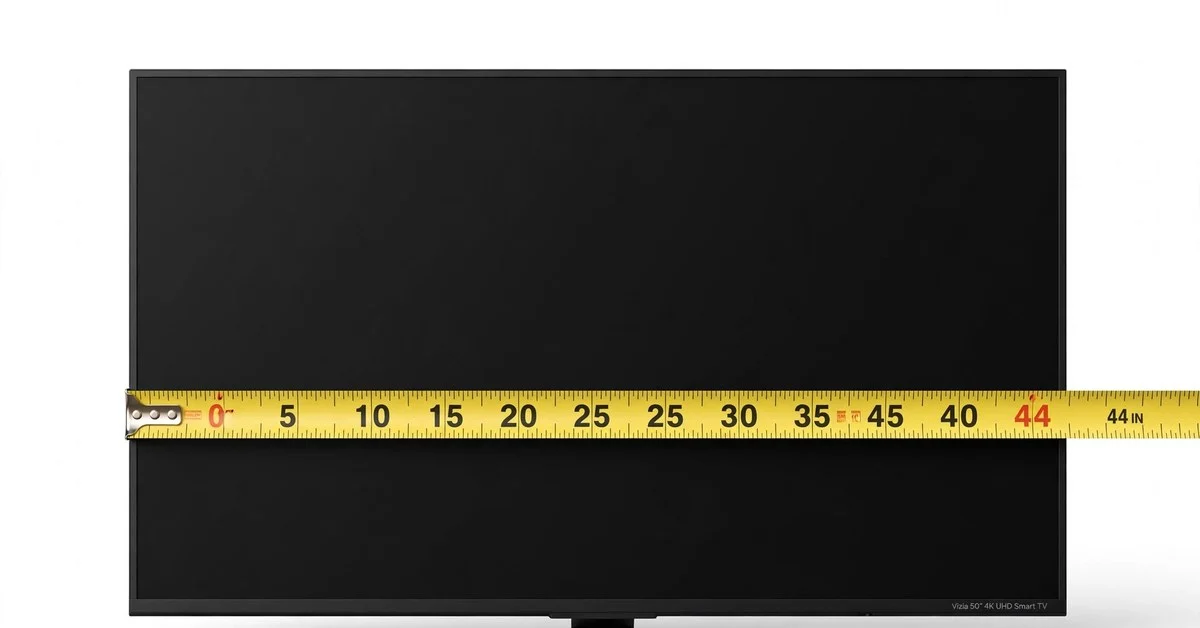
Ask a roomful of TV owners what size they have and the 50-inch owners give the same answer, almost word for word: “It’s the one that fit.” Not the one they dreamed about, not the one the salesman pushed — the one that fit the stand they already owned, the wall they already had, and the budget they had already set. The 50-inch TV is the compromise size, and compromise is not an insult here; it is the entire point. A 50-inch TV’s screen measures about 43.6 inches wide and 24.5 inches tall, with the 50 inches referring to the diagonal. That puts it in a genuinely useful middle: clearly bigger than a 43, noticeably less demanding than a 55. But the middle is also where furniture math gets tricky, because the 50 is wide enough to overhang the wrong stand and heavy enough to need a real mount. This guide is the furniture-first buying manual: measure your stand or your wall, understand the footprint, and decide between stand and mount before the box arrives.
Stand vs. mount: measuring your furniture footprint
The decision between stand and wall mount starts with two measurements you take before buying anything: the width of your console and the width between the TV’s feet. A 50-inch TV’s screen is 43.6 inches wide, and with the bezel most models total 45 to 46 inches. The feet, though, are the number that matters — on 50-inch models they typically span 36 to 44 inches apart, and the exact figure varies by brand and model year. Your stand must be wider than the foot span, with at least an inch or two of surface under each foot. A 48-inch console is the safe universal choice; a 44-inch stand works only if you verify the foot span first.
Here is the stand-buyer’s checklist. Measure the console’s top surface, not its base — some consoles taper. Confirm the depth: the feet need 10 to 12 inches front to back, and the console should be at least 14 inches deep so the TV cannot be nudged off the back edge. Check the weight rating if the console has glass shelves; a 50-inch TV weighs 25 to 35 pounds, trivial for wood but worth verifying on glass. And think about the soundbar: a 40-to-45-inch soundbar in front of the TV needs another 4 to 6 inches of depth, which pushes many setups to the console’s front edge. If your current stand is 40 inches wide or narrower, do not gamble — the 50’s feet will land at or past the edges, and an edge-standing 30-pound screen is one bumped elbow away from disaster.
The wall-mount route has its own math. A 50-inch TV typically uses a 200×200mm or 400×400mm VESA pattern and weighs 25 to 35 pounds without the stand, which puts it in easy territory: a basic tilt mount rated for 60-plus pounds, lag-bolted into two studs 16 inches apart, holds it with enormous margin. Set the screen center at seated eye level — 40 to 45 inches off the floor — which puts the bottom of the 24.5-inch-tall screen around 28 to 33 inches up. The mount decision also frees the console entirely: with the TV on the wall, a narrow 36-inch console works fine underneath for components, and the room instantly looks bigger. The rule of thumb: if your stand is 48 inches or wider, use it; if it is narrower, mounting is cheaper and safer than buying new furniture.
The full dimension sheet
| Measurement | Inches | Centimeters |
|---|---|---|
| Diagonal (the advertised size) | 50 | 127.0 |
| Screen width | ≈ 43.6 | ≈ 110.7 |
| Screen height | ≈ 24.5 | ≈ 62.3 |
| Total width with bezel (typical) | ≈ 45–46 | ≈ 114–117 |
| Typical weight (without stand) | ≈ 25–35 lb | ≈ 11–16 kg |
For furniture planning, memorize two numbers: 43.6 inches of screen and 45 to 46 inches with the frame. The 50-inch diagonal itself converts to 127 centimeters — a useful figure when comparing against metric-sized furniture from international brands. And the 24.5-inch screen height matters for wall-mounting: with the center at 42 inches off the floor, the top of the screen lands around 54 inches, comfortably below most people’s standing sightline, which keeps the room feeling open.
Fifteen furniture-scale references
Each item below sits within a few inches of the 50-inch diagonal or the 43.6-inch width — the scale of the furniture this TV lives on.
- A 55-gallon aquarium (48 inches long). The classic 55-gallon fish tank measures 48 by 13 inches — the 48-inch length landing two inches short of the diagonal. Aquarium stands are built to hold hundreds of pounds of water, which puts a 30-pound TV’s weight in perspective.
- A 48-inch fireplace mantel shelf. Floating mantel shelves are commonly sold in 48 and 60-inch lengths, with 48 the popular choice — two inches under the diagonal. If one hangs in your living room, its length is the TV’s corner-to-corner reach.
- A 48-inch double-sink vanity. The standard double vanity is 48 inches wide — two inches shy of the diagonal. A bathroom fixture and a TV sharing a dimension is unexpected, which is exactly why it sticks in memory.
- A 48-inch garage workbench. The compact workbenches sold for home garages commonly run 48 inches long — two inches under the diagonal. A sturdy, honest, right-angled reference for a sturdy, honest, right-angled screen.
- A 48-inch round mirror. Large round wall mirrors are sold in 48-inch diameters — two inches short of the diagonal. The circle’s width is the TV’s diagonal, and the mirror probably already hangs at viewing height.
- A 50-inch curtain rod. Adjustable curtain rods commonly extend to 50 inches — an exact match for the diagonal. If your window treatment spans 50 inches, your TV’s diagonal spans the same.
- A 44-inch gaming desk. Compact gaming desks run 40 to 55 inches wide, with 44 a popular size — within half an inch of the screen’s 43.6-inch width. The desk built for a battle station is exactly as wide as this TV’s picture.
- A 4-foot park bench (48 inches). The classic slatted park bench is 4 feet long — two inches under the diagonal. Sit on one and the bench’s length is the TV’s diagonal; stand it mentally upright and the comparison gets even clearer.
- A 48-inch sliding closet door. Bypass closet doors are commonly sold in 48-inch pairs — two inches shy of the diagonal. Your bedroom closet doors already know this measurement.
- A 4-foot step ladder (48 inches tall). The ubiquitous household step ladder stands 48 inches tall — two inches under the diagonal. It is probably in your garage right now, making it the most accessible gauge on this list.
- A 4-foot raised garden bed (48 inches). The standard raised bed kit is 4 by 4 feet — the 48-inch side landing two inches short of the diagonal. Backyard gardeners have been measuring in 48-inch increments for years.
- A 48-inch kitchen base cabinet. Wide base cabinets come in 48-inch widths for sinks and ranges — two inches under the diagonal. Another kitchen dimension that quietly matches the TV world.
- A 44-inch TV stand. Stands marketed for 50-inch TVs commonly run 44 to 58 inches wide, with 44 the compact end — within half an inch of the screen width. This is the one the TV was designed to sit on; measure yours against it.
- A 48-inch dresser. Wide dressers run 48 to 72 inches, with 48 the common small-wide size — two inches under the diagonal. The bedroom dresser is the 50-inch TV’s natural home, and the dimensions agree.
- A 48-inch gas grill. The big multi-burner grills with side tables stretch about 48 inches wide — two inches shy of the diagonal. The patio’s centerpiece and the living room’s centerpiece, dimensionally united.
Where the 50 sits between its neighbors
The 50’s identity is defined by the two sizes flanking it. Against the 43, the 50 is the meaningful upgrade: the screen grows from 37.5 to 43.6 inches wide, a six-inch gain you can see from across the room, while the price typically climbs only modestly. For a bedroom viewed from 8 to 10 feet, those six inches convert “fine” into “cinematic.” The 43 only wins when the furniture is truly small — a 36-inch dresser, a dorm desk — where the 50’s feet simply will not fit.
Against the 55, the 50 is the prudent choice: the screen narrows from 47.9 to 43.6 inches, just over four inches slimmer. From the couch at 8 feet, most viewers struggle to tell them apart — the difference is real on a spec sheet and subtle in a living room. The 55 wins when the room gives it 7 to 9 feet of viewing distance and a 48-inch console; the 50 wins when the console is 44 inches, the room is a den rather than a great room, or the budget has a hard ceiling. The viewing-distance math backs this up: the 50’s sweet spot runs about 6.5 to 8 feet, neatly between the 43’s 5.5-to-7 and the 55’s 7-to-8.5. Measure your couch distance and the answer usually picks itself.
Furniture-first questions, answered
What size stand do I need for a 50-inch TV?
A stand at least as wide as the TV’s foot span — typically 36 to 44 inches — with margin. In practice, buy a 48-inch or wider console and stop worrying. The stand should also be at least 14 inches deep to hold the feet (which need 10 to 12 inches) plus a soundbar if you use one. Check the weight rating on glass-shelf consoles; a 50-inch TV at 25 to 35 pounds is fine for wood but verify glass. If your existing stand is under 44 inches wide, measure the foot span in the TV’s specs before trusting it.
Is it better to wall-mount a 50-inch TV or use the stand?
It depends on your furniture. If you own a sturdy 48-inch-plus console, the stand is simpler, cheaper, and perfectly safe — set it and forget it. Wall-mounting wins when your console is narrow, when toddlers or pets make a freestanding screen risky, or when you want the clean look and the extra floor space. A 50-inch TV is light enough (25 to 35 pounds) that a basic $30 tilt mount on two studs is rock solid. There is no picture-quality difference either way; it is purely a furniture and safety decision.
Can one person hang a 50-inch TV alone?
Yes, with care — most 50-inch TVs weigh 25 to 35 pounds without the stand, which one fit adult can lift. The tricky part is not the weight but the wingspan: at nearly 44 inches wide, you need a second pair of hands to hold the panel level while you set it on the bracket, or a mount with a locking arm that catches the TV for you. Installers recommend a buddy for anything over 43 inches — not for strength, but because dropping a $400 screen costs far more than dinner for a friend.
Will a 50-inch TV fit in a 44-inch-wide entertainment center?
Usually yes, but verify the foot span. The screen is 43.6 inches wide, so a 44-inch opening clears it — barely. The real question is the feet: if they span 40 inches, you are fine; if your model spans 44, the feet land exactly at the edges, which is unstable. Also check the compartment height if the TV sits inside a hutch: you need the 24.5-inch screen height plus a few inches of ventilation above. When the fit is this tight, the model’s spec sheet is mandatory reading, not optional.
What VESA mount fits a 50-inch TV?
Most 50-inch TVs use 200×200mm or 400×400mm VESA patterns — check your model’s specs, as it varies by brand. Buy a mount that lists your exact pattern and is rated for at least 50 to 60 pounds (your TV weighs 25 to 35, so this gives comfortable margin). A tilt mount is the best default: it sits close to the wall, allows a slight downward angle, and costs far less than a full-motion arm while being far more stable.
See also: how big a 55 inch TV is.
See also: how big a 65 inch TV is.
The size that fits real rooms
The 50-inch TV will never win a spec-sheet contest, and it does not need to. Its victory is quieter: the screen that fits the 48-inch console you already own, the wall your room already has, the 7-foot couch distance your den already provides. At 43.6 inches wide and 25 to 35 pounds, it asks almost nothing of your furniture — just a wide-enough surface or two studs and a basic mount — and in return it delivers a genuinely cinematic picture from 6.5 to 8 feet. Measure the stand, check the foot span, choose stand or mount with intention, and the 50 rewards you with the rarest thing in TV buying: zero regrets. Not the biggest, not the cheapest — just the one that fit.

I’m Owen Reeves, a content writer at MeasureZit.com, specializing in measurements, unit conversions, and mathematical concepts. I turn technical topics into clear, accurate content that’s easy to understand. My focus is precision, clarity, and genuinely useful information.