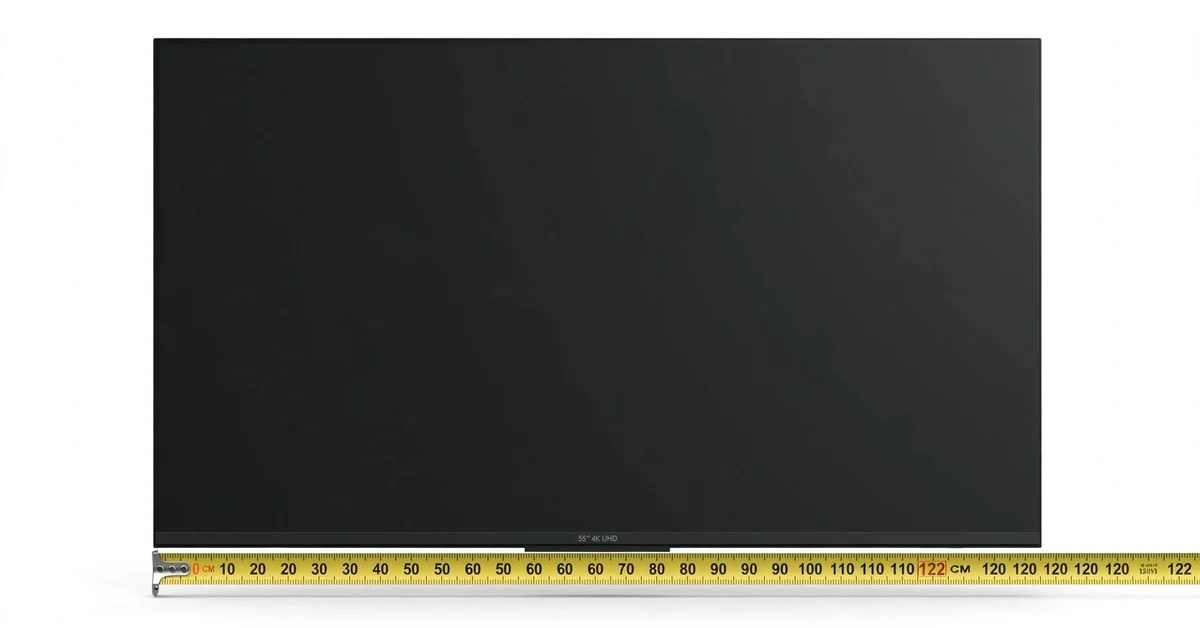
Television showrooms are designed to lie to you. The ceilings are high, the walls stretch forever, and every screen on display looks a little smaller than it really is — so the 55-inch TV that seemed perfectly reasonable under those fluorescent lights can feel like a drive-in movie screen once it is hanging in your living room. That is the number-one surprise buyers report: not the price, not the picture quality, but the sheer physical presence of the thing. A 55-inch TV measures about 47.9 inches wide and 27 inches tall, and the “55 inches” in its name is the diagonal of the picture, corner to corner. In plain terms, you are bringing home a screen just under four feet wide and a little over two feet tall — the most popular TV size in America for one simple reason. It is the largest screen that still fits comfortably in an ordinary room, on an ordinary stand, at an ordinary viewing distance. Before you buy, it pays to know what those inches mean in your space, how far back your couch should sit, and which everyday objects already match the size.
The numbers on the box, translated
TV makers sell the diagonal because one number describes the whole 16:9 rectangle. Here is what that 55-inch diagonal breaks down into:
| Measurement | Inches | Centimeters |
|---|---|---|
| Diagonal (the advertised size) | 55 | 139.7 |
| Screen width | ≈ 47.9 | ≈ 121.8 |
| Screen height | ≈ 27.0 | ≈ 68.5 |
| Total width with bezel (typical) | ≈ 49–50 | ≈ 124–127 |
| Diagonal in feet | ≈ 4.58 | — |
The detail that trips people up is the width. The screen is only 47.9 inches wide — a full seven inches narrower than the “55” suggests. That is actually good news for your furniture: a 48-inch-wide stand or console fits this TV almost edge to edge. The bezel, the frame around the picture, adds roughly an inch on each side on most models, so plan on about 49 to 50 inches of total width when you measure a wall or a stand. Height-wise, 27 inches of picture plus a couple of inches of stand puts the top of the screen around 30 to 32 inches above whatever it sits on — low enough that it never looms, high enough to watch comfortably from a couch.
Fifteen things in your house that already know this size
Forget abstract numbers. These are objects you have handled, and each one lands within a few inches of either the 55-inch diagonal or the 47.9-inch screen width.
- A standard pool cue. Regulation cues run 57 to 58 inches — just three inches longer than the diagonal. Hold one corner to corner and you have the TV.
- A foosball table. Full-size tables measure about 56 inches long, one inch past the diagonal. If you have played on one, you have felt this size.
- A full-size bed’s width. A double mattress is standardized at 54 inches wide — one inch short of 55. The TV’s diagonal would barely span the bed.
- An average 10-year-old. Most 10-year-olds stand roughly 54 inches tall — about four and a half feet. Lay one across your wall (gently) and that is the diagonal.
- A four-drawer filing cabinet. The classic vertical cabinet stands about 52 inches tall — three inches shy of the diagonal, and almost exactly the screen width plus a few inches.
- A cello. A full-size cello stands about 48 inches tall — nearly identical to the 47.9-inch screen width. It is the width comparison made physical.
- An electric bass guitar. Headstock to body end runs about 46 inches — within two inches of the screen width. Rock fans already know this dimension.
- A 4-foot office desk. Standard small desks are 48 inches wide — essentially the screen width to the inch. This TV would fit your desk edge to edge.
- A 4-foot artificial Christmas tree. The tabletop trees sold each December stand about 48 inches tall — the screen width, upright.
- An average 7-year-old. Most 7-year-olds measure roughly 48 inches tall — four feet even. Same as the screen width.
- An upright vacuum cleaner. Typical uprights stand about 45 inches tall — ten inches short of the diagonal, but the screen width plus the vacuum’s hose would get you there.
- A standard bathtub. The classic alcove tub is 60 inches long — five inches past the diagonal. The TV would lie in the tub with room to spare.
- An adult snowboard. All-mountain boards run 150 to 165 centimeters — about 59 to 65 inches — with 60 inches a common length. A little longer than the diagonal.
- A ping-pong table’s width. Regulation tables are 5 feet wide — exactly 60 inches. Five inches wider than the TV’s diagonal.
- An adult hockey stick. Adult sticks measure roughly 57 to 63 inches, with 60 inches common. Lean one diagonally across the screen and it just overhangs.
The couch sweet spot: how far back to sit
Here is the question that actually decides whether a 55-inch TV makes you happy: where is your couch? The old rule of thumb — sit back 1.5 to 2.5 times the diagonal — puts the ideal range at roughly 7 to 11.5 feet from the screen. The modern guidance for 4K is tighter, because higher resolution rewards sitting closer: about 1 to 1.5 times the diagonal, or 4.5 to 7 feet.
What does that mean in a real room? A standard living room with the couch 8 to 10 feet from the wall is squarely in the 55-inch sweet spot — close enough for a cinematic feel, far enough that you never crane your neck. In a bedroom where you watch from 10 to 12 feet away, it still works, though a 65-inch TV starts looking tempting. In a small apartment where the couch is 5 or 6 feet from the screen, a 55-inch 4K TV is actually ideal for detail — but if you are sensitive to motion or eye strain, consider dropping to a 50-inch TV instead.
Two practical wrinkles. First, measure your viewing distance from where your eyes will be, not from the wall — couch depth eats a foot or two. Second, if you wall-mount, the screen sits a few inches farther from you than it would on a stand, which effectively buys you a little distance for free.
One size up, one size down
The 55 does not exist in isolation, and knowing its neighbors helps you commit. Compared with its siblings:
Step up to a 65-inch TV and the screen grows to about 56.7 inches wide — nearly nine inches wider than the 55. That is a dramatic jump in presence: the 65 dominates a wall the way the 55 merely anchors it. You need about 9 to 13 feet of viewing distance to do it justice, and a 60-inch-wide stand at minimum. Choose the 65 if your room is large and the TV is the room’s centerpiece.
Step down to a 50-inch TV and the screen narrows to about 43.6 inches wide — roughly four inches slimmer than the 55. That four inches is the difference between fitting a 48-inch console and needing a smaller one, and between commanding a living room and suiting a bedroom. Choose the 50 if your viewing distance is under 7 feet or your stand tops out at 44 inches wide.
What 55-inch shoppers keep asking
Will a 55-inch TV fit on my 48-inch TV stand?
Almost certainly yes. The screen is 47.9 inches wide, so it sits nearly edge to edge on a 48-inch stand — and the TV’s feet or pedestal are usually inset a few inches from the screen edges anyway, giving you margin. With the bezel, the total width is about 49 to 50 inches, which may overhang a 48-inch stand by half an inch per side — cosmetically fine and structurally safe, since the weight rests on the feet, not the edges. For a cleaner look, a 55 to 60-inch stand gives the TV breathing room.
How high should I mount a 55-inch TV on the wall?
Put the center of the screen at seated eye level, typically 42 to 48 inches from the floor. For a 55-inch TV, that means the bottom of the screen lands around 28 to 34 inches off the floor and the top around 55 to 61 inches. Above a fireplace is the classic mistake — it forces your neck up for every movie. If the fireplace is the only option, use a tilting mount and sit farther back.
Is a 55-inch TV too big for a bedroom?
It depends on the bed-to-wall distance. Measure from your pillow to the wall: if it is 9 feet or more, a 55-inch TV is perfect for a bedroom. At 7 to 9 feet it is still comfortable, especially in 4K. Under 7 feet, the screen fills a lot of your field of vision when you are lying down — some people love that, others get eye fatigue. When in doubt, tape the 47.9-by-27-inch outline on the wall and watch it for a day before you buy.
What size wall mount do I need for a 55-inch TV?
Match the mount to the TV’s VESA pattern and weight, not to the screen size. Most 55-inch TVs use a 200×200mm or 400×400mm VESA pattern and weigh 30 to 45 pounds without the stand. Any mount rated for 55-inch TVs will list the VESA patterns it fits — check the TV’s spec sheet for the pattern, buy a mount that includes it, and make sure the mount’s weight rating exceeds the TV’s weight by a comfortable margin. Into drywall, always hit studs.
Does a 55-inch TV use a lot of electricity?
Less than you probably think. A modern 55-inch LED TV draws roughly 60 to 150 watts while running, depending on brightness and whether it is LED, QLED, or OLED. At five hours a day, that works out to roughly 110 to 275 kWh per year — on the order of fifteen to forty dollars annually at average US electricity rates. OLEDs tend to use more on bright scenes; LEDs with local dimming use less. Either way, the TV is not what is driving your electric bill.
See also: how big a 65 inch TV is.
See also: how big a 50 inch TV is.
Big enough to matter, small enough to fit
A 55-inch TV earns its bestseller status by threading a needle: a screen just under four feet wide that fits a standard 48-inch stand, a 27-inch height that never looms over a room, and a diagonal that delivers a cinematic picture from an ordinary couch eight to ten feet away. Measure your stand, measure your viewing distance, tape the outline on the wall — and then enjoy the one TV size that almost never gets returned for being the wrong size. It is the size that disappears into your room until the lights go down, and then reminds you why you bought it.

I’m Dane Whitfield, a content writer at MeasureZit.com, where I specialize in creating clear, accurate articles on measurements, unit conversions, and mathematical concepts. I enjoy breaking down complex numerical topics into simple, practical explanations that readers can actually use. My goal is always precision and clarity helping people make sense of the numbers around them.