Introduction
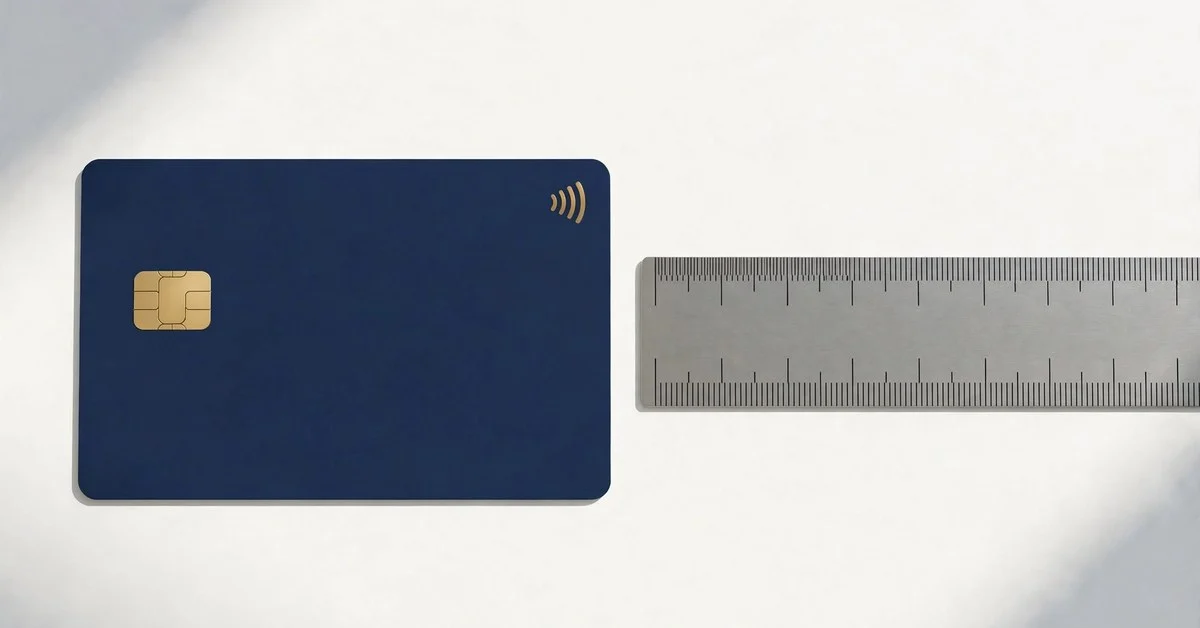
Pull out your wallet and you are holding one of the most standardized objects on earth. A credit card measures exactly 3.37 inches long and 2.125 inches wide, which is 85.6 × 53.98 mm. Every bank card on the planet follows this ID-1 specification, so the size never varies by brand or country.
This tiny rectangle matters more than its size suggests. It determines whether a card fits your wallet slots, a phone’s card holder, or an ATM. Designers use it as a reference for hotel keys, ID badges, and gift cards, which is why so many cards feel identical in your hand.
So how big is a credit card, really? Below are the exact dimensions, a conversion chart, 15 everyday objects that match its size, and simple ways to picture it anytime.
Credit Card Size Conversion Chart
Based on the card’s length of 3.37 inches:
| Unit | Converted Value |
|---|---|
| Inches | 3.37 in |
| Feet | ≈ 0.28 ft |
| Yards | ≈ 0.09 yd |
| Millimeters | 85.6 mm |
| Centimeters | 8.56 cm |
| Meters | ≈ 0.09 m |
For reference, the width is 2.125 in (53.98 mm), and the card is about 0.03 in (0.76 mm) thick.
Table A: Common Objects About the Size of a Credit Card
| Item | Approximate Size |
|---|---|
| 1. Driver’s License | 3.37 × 2.125 in (identical) |
| 2. Hotel Room Key Card | 3.37 × 2.125 in (identical) |
| 3. Gift Card | 3.37 × 2.125 in (identical) |
| 4. Transit/Metro Card | 3.37 × 2.125 in (identical) |
| 5. Business Card | 3.5 × 2 in (very close) |
| 6. Pack of Chewing Gum | ≈ 3.5 × 2 in |
| 7. Deck-of-Cards Box | ≈ 3.7 × 2.6 in (slightly bigger) |
| 8. Travel-Size Bar of Soap | ≈ 3 × 2 in |
Table B: More Everyday Items Near Credit Card Size
| Item | Approximate Size |
|---|---|
| 9. Standard Lighter | ≈ 3.2 in tall |
| 10. USB Flash Drive | ≈ 2.5 in (shorter) |
| 11. Playing Card | 2.5 × 3.5 in (slightly bigger) |
| 12. Lipstick Tube | ≈ 3 in tall |
| 13. Matchbox | ≈ 2 × 1.5 in (smaller) |
| 14. House Key | ≈ 2.5 in (shorter) |
| 15. Bottle Cap | ≈ 1.2 in diameter (smaller) |
How Big Is a Credit Card?
Hold any card from your wallet and you are holding the international standard. At 3.37 inches long, a credit card is a little longer than 3-inches, and at 2.125 inches wide it sits just above 2-inches. In metric terms the length is 8.56 cm, or just under 9 cm. The proportions follow the golden ratio closely, which is one reason the shape feels so naturally balanced.
For a smaller comparison, a standard house key at 2.5 inches is clearly shorter than the card’s length. On the larger side, a single playing card at 2.5 × 3.5 inches frames the credit card with a small border all around. The card’s real trick is its thinness: at 0.03 inches thick, you can stack more than 30 of them to reach a single inch.
Easy ways to estimate credit card size in everyday life
- Use your driver’s license: It follows the exact same ID-1 standard, so it is a perfect 1:1 match.
- Grab a gift card: Unused gift cards in your drawer are the same size. Keep one as a template.
- Check a business card: At 3.5 × 2 inches, a standard business card is almost identical, just a hair longer and narrower.
- Picture a pack of gum: A standard stick-gum pack covers nearly the same footprint.
- Stack two bottle caps: Two 1.2-inch caps side by side roughly span the card’s width.
- Use your thumb: The card’s width is close to the length of an average adult thumb tip.
1. A Driver’s License
The perfect match is already in your wallet. Driver’s licenses follow the exact same ID-1 specification as credit cards: 85.6 × 53.98 mm, down to the fraction of a millimeter. Lay your license on top of your credit card and the edges align perfectly. Governments chose this standard deliberately so licenses would fit the same wallets, sleeves, and card readers. Because the match is exact rather than approximate, this is the most reliable reference on the list. Pull out your license anytime you need a true-size template.
2. A Hotel Room Key Card
Travelers collect these little rectangles on every trip. Hotel key cards are manufactured to the identical ID-1 dimensions as credit cards, 3.37 × 2.125 inches. The magnetic stripe or chip sits in the same standardized positions. Stack a hotel key on your credit card and you will see zero overhang on any side. Most people toss these in a drawer after checkout, which means you probably own several free templates. Next time you need to check a wallet slot or a phone case, grab an old hotel key instead of risking your real card.
3. A Gift Card
That unused gift card in your junk drawer is a secret ruler. Retail gift cards are produced to the same ID-1 standard as credit cards, so the footprint matches exactly. The raised numbers or printed designs do not change the dimensions. Because gift cards carry no sensitive account data once spent, they make ideal throwaway measuring tools. Keep one in your desk for sizing wallet pockets, badge holders, or craft projects. It is a free, precise template hiding among the takeout menus.
4. A Transit/Metro Card
Commuters tap an exact match every day. Transit cards, metro passes, and bus smart cards are all built to ID-1 dimensions so they work in standardized readers and wallets. The 3.37 × 2.125 inch rectangle feels identical to a credit card in your fingers. Cities from New York to London to Tokyo issue cards on this spec. If you ride public transit, you handle this reference twice a day. Tap it, pocket it, and remember: that familiar rectangle is credit-card size by international design.
5. A Business Card
Networking’s classic rectangle comes very close. A standard US business card measures 3.5 × 2 inches, making it a hair longer and a touch narrower than a credit card. Lay one over your credit card and the difference is barely visible: about an eighth of an inch in each direction. The similarity is no accident, since both are designed to fit wallets and card cases. Desk drawers everywhere contain stacks of these. It is an excellent near-match when you need a quick visual without reaching for your wallet.
6. A Pack of Chewing Gum
The checkout aisle offers a tasty near-match. A standard pack of stick gum measures roughly 3.5 × 2 inches, covering almost the same footprint as a credit card. The slim cardboard sleeve is a bit thicker, but length and width line up closely. Gum packs are designed to slip into pockets and small purses, which explains the shared sizing logic. Buy a pack and compare it to your card before you unwrap it. The match is close enough for any casual estimate.
7. A Deck-of-Cards Box
Game night provides the “slightly bigger” frame. The tuck box holding a standard deck measures about 3.7 × 2.6 inches, clearly larger than a credit card in both directions. Place your credit card on top of the box and a small border of cardboard shows all around. This contrast is useful: it shows what “bigger than a credit card” looks like in concrete terms. Almost every household owns a deck of cards. The box is a ready-made frame for the card’s true size.
8. A Travel-Size Bar of Soap
Hotel bathrooms hide a chunky cousin. A travel-size bar of soap typically measures about 3 × 2 inches, just under a credit card’s footprint. The bar is far thicker and heavier, but the flat rectangle it presents is remarkably similar. Lay your card on top of the soap and the card overhangs slightly on every side. Mini toiletries are standardized for travel kits, so the size stays consistent across brands. It is a fun comparison the next time you unpack a hotel toiletry bag.
9. A Standard Lighter
Smokers and campers know this shape well. A standard disposable lighter stands about 3.2 inches tall, just under a credit card’s 3.37-inch length. Lay the lighter across your card and it spans nearly the full length. The lighter is much thicker, built to hold fuel safely. But as a length gauge it works beautifully. Kitchen drawers and glove compartments everywhere contain one. It is a quick, honest ruler for the card’s longest dimension.
10. A USB Flash Drive
Tech drawers hold the “shorter” anchor. A typical USB flash drive measures about 2 to 2.5 inches long, clearly shorter than a credit card. Lay the drive on your card and it covers roughly two-thirds of the length. The drive’s width is close to the card’s thickness many times over, which highlights how slim cards really are. Most people own several of these little sticks. They are perfect for showing what fits inside a credit-card footprint with room to spare.
11. A Playing Card
Card players get the “slightly bigger” sibling. A standard poker-size playing card measures 2.5 × 3.5 inches, framing a credit card with a slim margin on all sides. The playing card is thinner and more flexible, built for shuffling rather than swiping. Lay your credit card centered on a playing card and the border tells the size story instantly. Decks are cheap and universal. This comparison is a favorite of crafters who design card-sized projects.
12. A Lipstick Tube
Makeup bags contain a cylindrical cousin. A standard lipstick tube stands about 3 inches tall, a bit shorter than a credit card is long. Stand the tube next to your card and the card rises above it slightly. The tube’s round cross-section contrasts with the card’s flat rectangle, but the heights are close enough for a quick estimate. Cosmetics packaging is fairly standardized, so the reference holds across brands. It is an everyday gauge hiding in plain sight.
13. A Matchbox
The matchbox gives you the “smaller” anchor. A standard small matchbox measures about 2 × 1.5 inches, distinctly smaller than a credit card in both directions. Place the matchbox on your card and it covers barely half the area. The comparison is striking because both are thin rectangles, yet the size gap is obvious. Kitchen drawers and camping kits keep these handy. It answers the question “is it bigger than a matchbox?” with an emphatic yes.
14. A House Key
Your keychain holds another “shorter” reference. A standard house key measures about 2 to 2.5 inches long, well under the card’s 3.37-inch length. Lay the key diagonally across your card and it still does not reach corner to corner. The key’s bow (the round head) is about an inch wide, close to half the card’s width. Everyone carries keys, so this check is always available. It is a humble but honest ruler.
15. A Bottle Cap
The bottle cap is the “much smaller” anchor that puts the card in perspective. A standard crown bottle cap measures about 1.2 inches across, roughly a third of the card’s length. You could line up nearly three caps along the card’s long edge. The cap’s crimped circle contrasts sharply with the card’s smooth rectangle. Kitchen counters everywhere hold these. It is a vivid reminder that a credit card, small as it feels, is large compared to the truly tiny objects in your day.
FAQs About Credit Card Size
How big is a credit card in inches?
A standard credit card is 3.37 inches long, 2.125 inches wide, and about 0.03 inches thick.
How big is a credit card in mm?
It measures 85.6 × 53.98 mm, with a thickness of about 0.76 mm. This is the international ID-1 standard.
Are all credit cards the same size?
Yes. Every bank card, debit card, driver’s license, and hotel key follows the ID-1 specification, so the size is identical worldwide.
Why are credit cards this exact size?
The dimensions come from the ISO/IEC 7810 ID-1 standard, chosen so cards fit universal wallets, readers, and ATMs. The proportions also closely follow the golden ratio.
See also: how big an iPhone is. See also: how tall a refrigerator is.
Final Thoughts
So how big is a credit card? Exactly 3.37 × 2.125 inches, a rectangle so standardized that your driver’s license, hotel key, and gift cards all match it perfectly. It is a little longer than 3 inches, a touch wider than 2, and thin enough to disappear into a wallet slot.
The beauty of this measurement is that the reference never changes. Any ID-1 card in your wallet is a true-size template you carry everywhere. The next time you need to picture credit card size, just pull out any card at all. You are already holding the answer. At 85.6 × 53.98 mm, it is the rare object with zero size variation worldwide. Designers, crafters, and travelers all rely on that consistency, and now you can too.

I’m Owen Reeves, a content writer at MeasureZit.com, specializing in measurements, unit conversions, and mathematical concepts. I turn technical topics into clear, accurate content that’s easy to understand. My focus is precision, clarity, and genuinely useful information.