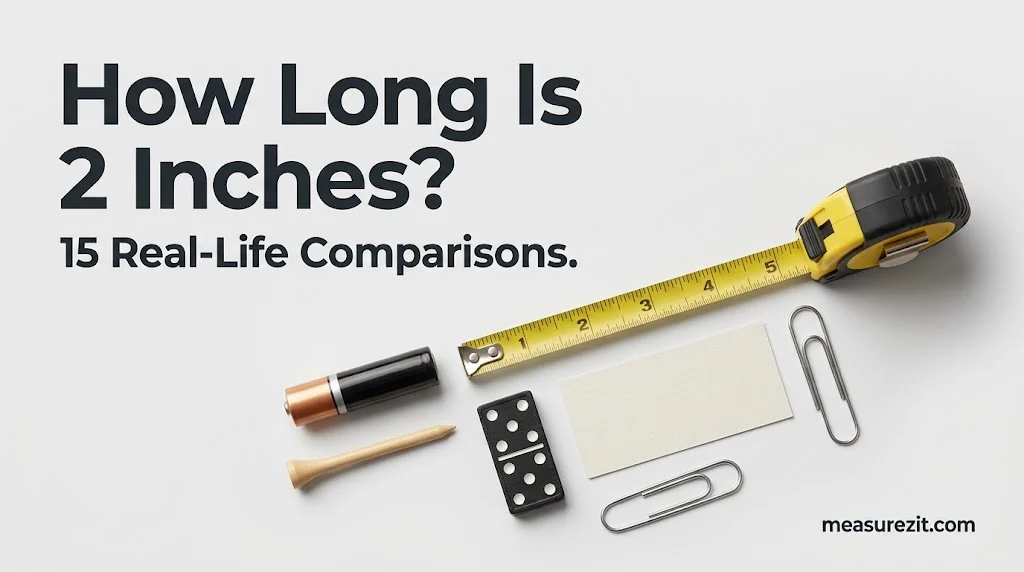
Hold up an AA battery from the junk drawer and you’re holding almost exactly 2 inches. Most people are surprised how small that is once they actually see it next to something familiar. Two inches equals 5.08 centimeters, or 50.8 millimeters.
It’s roughly the width of a golf tee standing on end, the short edge of a business card, or a stack of about twenty credit cards.
That number matters more often than it seems. It’s the difference between a phone case that fits a drawer and one that doesn’t, the spacing woodworkers leave between screws, or the size a suitcase-packing app flags before you get to the airport. Whenever someone asks how long 2 inches is, what they usually want isn’t the math, it’s something they can picture without pulling out a tape measure.
This guide gives you both: a straightforward conversion chart and fifteen everyday objects, some manufactured to that exact size, others close enough to trust so you can size things up on sight.
Conversion Chart
| Unit | Converted Value |
| Inches | 2 in |
| Feet | ≈0.17 ft |
| Yards | ≈0.06 yd |
| Millimeters | 50.8 mm |
| Centimeters | 5.08 cm |
| Meters | ≈0.05 m |
Common Objects That Are About 2 Inches
| Item | Approximate Length |
| AA Battery | ≈1.97 in |
| Golf Tee (classic wooden style) | ≈2.13 in |
| Standard Domino | ≈2 in |
| Business Card, short edge | 2 in |
| Large Chicken Egg | ≈2.25 in |
| Standard House Key | ≈2 in |
| USB Flash Drive body | ≈2 in |
| 6d Construction Nail | 2 in |
More Everyday Items Around 2 Inches
| Item | Approximate Length |
| Jumbo Paperclip | 2 in |
| AAA Battery | ≈1.75 in |
| Small Post-it Note | 2 in (per side) |
| Wine Cork | ≈1.75–2 in |
| Folded Tea Bag | ≈2 in (per side) |
| Casino Poker Chip | ≈1.5 in |
| Tournament Chess Pawn | ≈1.75–2.25 in |
A quick note before the list: a few of these, the nail, the business card, the Post-it are manufactured to a fixed size, so their measurements are exact. Others, like the egg, the cork, and the chess pawn, are natural or handmade objects that vary a bit, so those are given as honest ranges rather than false precision.
How Long Is 2 Inches, Really?
Two inches sits in an in-between zone. It’s bigger than a coin but smaller than your palm long enough to notice, short enough to lose in a junk drawer. You handle this length constantly without measuring it: the gap between two knuckles on a closed fist, the width of a wide marker cap, the thickness of a paperback’s spine.
For scale, 1 inch is close to the width of a quarter, and 3 inches is closer to the width of a small smartphone. Two inches lands right in between noticeably longer than a coin, but shorter than most people’s pinky fingers.
A few ways to estimate 2 inches without a ruler:
- Check your thumb. Most adults’ thumbs, measured from the tip to the first knuckle, land somewhere close to 2 inches, a useful rough guide even though hand size varies.
- Reach for a battery. An AA is close enough to 2 inches that it works as a quick mental ruler.
- Look at a business card. Its short edge is manufactured to exactly 2 inches, so it doubles as a precise reference.
- Picture a domino. The long edge of a standard tile runs close to 2 inches.
- Grab your house key. Most keys run close to 2 inches from the top of the bow to the tip of the blade.
- Line up two quarters. Since a quarter is just under an inch across, two placed edge to edge get you close.
1. AA Battery
An AA battery measures about 1.97 inches end to end, just shy of a full 2 inches, but close enough that it functions as a near-perfect stand-in. Because AA cells are built to the same dimensions across every brand, you don’t need to check the packaging to trust the size.
That consistency is what makes it useful. Grab one from a remote or a flashlight, hold it against whatever you’re sizing up, and you’ll get a fast, fairly accurate read: no app, no ruler, no guessing.
2. Golf Tee
The classic wooden golf tee, the short, tapered kind most courses still stock, runs about 2.125 inches, making it one of the closest matches to 2 inches on this list. Golfers who’ve pushed a few hundred of these into the ground develop a feel for the length without ever thinking about it in inches.
Even for non-golfers, the shape is easy to picture: a slim wooden peg, tapered to a point, slightly longer than your longest finger. It’s a surprisingly handy reference for spacing seedlings in a garden bed or checking the depth of a small pilot hole.
3. Standard Domino
A domino tile in a standard double-six set runs close to 2 inches along its long edge, with the width and thickness both considerably smaller. The rectangular shape makes it easy to picture measuring a straight line, which is part of why the game feels so tactile when you’re lining tiles up on a table.
This one works well for spacing tasks figuring out how far apart to set small tiles, magnets, or shelf hardware since the object itself is essentially a small, flat ruler.
4. Business Card, Short Edge
Standard business cards in the U.S. print industry measure 3.5 by 2 inches, and that short edge is where the exact 2-inch reference comes from. It’s one of the few objects on this list with genuinely no wiggle room printers cut to that spec consistently.
Because business cards turn up in wallets, desk trays, and junk drawers everywhere, there’s rarely a need to go find one. If you’re framing a small photo, cutting a sticker, or laying out a label, the short edge of a card gets you an exact 2 inches with zero measuring required.
5. Large Chicken Egg
USDA grading for large eggs is based on minimum weight (2 ounces per dozen average, technically), not length, so egg length varies more than the other items here. Still, a large egg typically measures somewhere around 2.25 inches at its longest point, putting it just above the 2-inch mark.
It’s a comparison most people don’t need to go looking for; there’s likely one in the fridge right now. For bakers eyeballing portion sizes or checking If a container will hold a dozen eggs upright, this is a reference that’s already part of the kitchen routine.
6. Standard House Key
Most residential keys run close to 2 inches from the top of the bow (the part you grip) to the tip of the blade, though this shifts slightly depending on the lock manufacturer. Unlike a battery or a nail, there’s no single industry spec. It’s close enough, most of the time in comparison.
Since keys are already in a pocket or bag, this is one of the few 2-inch references that requires no extra step at all. It’s a handy gut-check for If a small accessory, like a bottle-opener charm, will crowd the rest of a keyring.
7. USB Flash Drive
The body of a typical USB flash drive measured without the cap tends to land around 2 inches, though this varies more by design than by any real standard. Compact or nano style drives run shorter; older, chunkier styles run a bit longer.
Flash drives show up often enough in desk drawers and laptop bags that most people can picture the size without much effort. It’s a fair reference point for judging if small electronics will fit into a tight laptop-bag pocket or a car’s center console tray.
8. A 6d Construction Nail
In the U.S. penny sizing system that’s been used in construction for generations, a 6d (six-penny) common nail has a standardized length of exactly 2 inches. Unlike most of the natural comparisons on this list, this one comes with real manufacturing precision behind it; it’s cut to spec, not estimated by eye.
Anyone who’s framed a wall or built a simple shelf has likely handled one of these without registering the exact length. For DIY projects that call for a specific nail size, this is one of the few objects here you can trust down to the fraction of an inch.
9. Jumbo Paperclip
The larger jumbo paperclip, used for thick stacks of paper rather than a handful of sheets, measures exactly 2 inches. Standard paperclips run noticeably shorter, so it’s worth picturing the bigger version specifically rather than the everyday one clipped to a notepad.
Office drawers tend to have a few of these mixed in with the regular size, which makes them a free, no-effort reference. For anyone organizing paperwork or picking hardware like small hooks or binder rings, a jumbo paperclip offers a quick visual gauge.
10. AAA Battery
An AAA battery runs about 1.75 inches noticeably shorter than its AA counterpart, and a useful marker for the lower edge of the 2-inch range. It’s the battery that powers most remotes, small flashlights, and kids’ toys.
Comparing an object to a AA and an AAA side by side gives a rough sense of If something is closer to a full 2 inches or falls a bit short of it a trick that works particularly well for judging small parts or hardware.
11. Small Post-it Note
Among the smaller standard Post-it note sizes is a 2-by-2-inch square, which makes it one of the more exact comparisons on this list assuming you’ve got that particular size and not the larger 3-by-3-inch version most offices stock. It’s worth checking the size printed on the pad, since Post-its come in several dimensions.
If you have one on hand, it doubles as a small, disposable ruler useful for a quick check on If a sticker or label will fit a given spot.
12. Wine Cork
Standard wine corks typically run somewhere between 1.75 and 2.4 inches, depending on the wine style sparkling wine corks tend to run shorter and wider than still-wine corks. That range puts a typical cork right around the 2-inch mark, though it’s genuinely a range rather than a fixed number.
For anyone who saves corks for craft projects or corkboards, this is a comparison that’s often sitting in a drawer already. It’s a reasonable stand-in when eyeballing small cylindrical spaces, like a pen cap or a narrow vase opening.
13. Folded Tea Bag
A standard square tea bag, folded flat, typically measures close to 2 inches per side though bag size varies by brand and style more than most manufactured goods do. Pyramid-style bags and single-serve pods run to different dimensions entirely, so this comparison works best for the classic folded square bag.
It’s a low-effort reference for anyone in the kitchen already, useful for judging if small sachets or spice packets will fit inside a container or drawer organizer.
14. Casino Poker Chip
A standard casino-style poker chip measures close to 1.5 inches across (about 39 millimeters), which is the size most Las Vegas casinos and chip manufacturers use as their baseline. That’s noticeably smaller than 2 inches, making it a useful lower-end anchor rather than a close match.
Poker nights and board game collections make chips a familiar household object even for people who rarely play. Comparing round items buttons, magnets, coasters against a poker chip helps judge If they’re approaching the full 2-inch range or falling well short of it.
15. Tournament Chess Pawn
In a tournament-regulation Staunton chess set, the king typically stands 3.75 to 4.5 inches tall, and a pawn proportioned at roughly half that height usually comes out somewhere between 1.75 and 2.25 inches. Travel sets and decorative sets run smaller or larger, so this comparison applies best to standard tournament pieces.
Chess is common enough in households and classrooms that the general shape is easy to picture even without a board nearby. It’s a fair way to estimate the height of small figurines or short decorative objects standing upright on a shelf.
FAQ
Is 2 inches bigger than a quarter?
Yes. A quarter measures just under an inch across, so 2 inches is roughly double the width of a quarter laid flat.
What household item is closest to exactly 2 inches?
The short edge of a standard business card is one of the most reliable matches, since U.S. print shops cut it to exactly 2 by 3.5 inches. A 6d construction nail is another exact match, if there’s one in a toolbox nearby.
How many centimeters is 2 inches?
Two inches equals 5.08 centimeters, or 50.8 millimeters.
Is an AA battery exactly 2 inches?
Almost a AA battery measures about 1.97 inches, just a hair under a full 2 inches, which is close enough for most everyday comparisons.
Final Thoughts
How long is 2 inches? It comes out to 5.08 centimeters about the length of a golf tee, a domino, or the short edge of a business card sitting in your wallet right now. It’s a size most people already handle daily without ever putting a number to it.
The objects that make this easiest to remember are the ones you already own: a battery from the remote, a card from your wallet, a key from your pocket. Keep one or two of those in mind, and you’ll rarely need to go looking for a ruler.
If it’s checking if a gift will fit in a box, sizing up produce at the store, or making sure a part clears a tight space, these everyday comparisons turn an abstract number into something you can actually picture and that’s really what how long 2 inches is asking in the first place.
Discover More!
How Long Is 20 Inches? Real-World Size Comparisons
How Long Is 13 Inches? Easy Everyday Comparisons
How Long Is 11 Inches? A Real-World Size Guide

I’m Priya Sharma, a content writer at MeasureZit.com, specializing in measurements, unit conversions, and mathematical concepts. I turn technical topics into clear, accurate content that’s easy to understand. My focus is precision, clarity, and genuinely useful information.


2 thoughts on “How Long Is 2 Inches? Real-Life Comparisons”