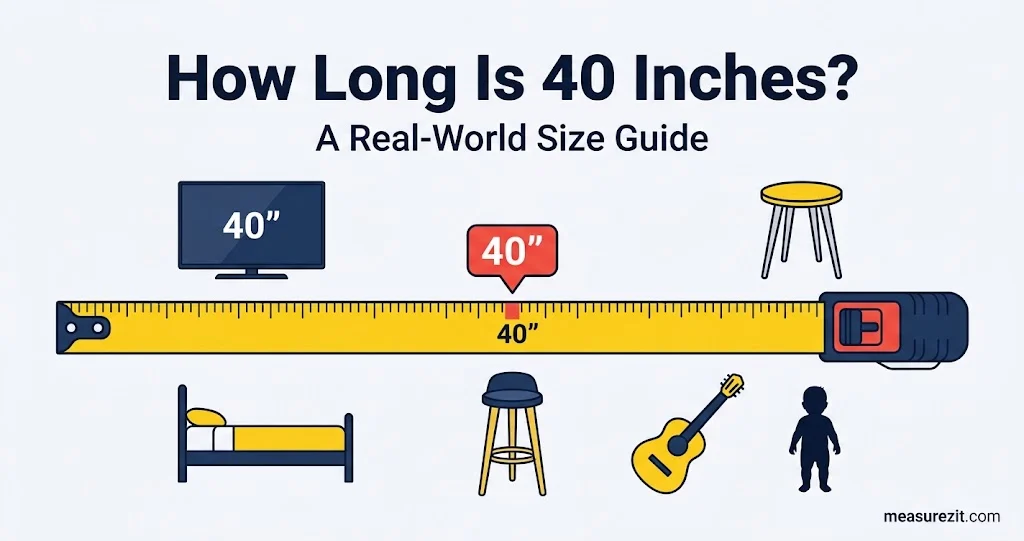
40 inches works out to 3 feet 4 inches, or about 101.6 centimeters (just over a meter). That’s the math. But numbers on their own don’t tell you much until you can picture them.
Here’s a quick way to feel it out: grab a yardstick if you have one lying around. Now add roughly the width of your palm to the end of it. That’s 40 inches. It’s also, not coincidentally, the exact screen measurement on one of the most popular TV sizes sold today which is a handy mental anchor if you don’t have a yardstick within reach.
This length comes up more than you’d expect once you start noticing it: sizing up a TV stand, checking if a stroller will clear a doorway, figuring out if a dresser will make it around a stairwell corner. Below is a full breakdown of a conversion chart, side-by-side comparisons to everyday objects, and answers to the questions people usually have next.
A note on the numbers: most household and furniture dimensions vary a bit by brand and model, so where a comparison isn’t an exact match to 40 inches, that’s called out honestly rather than rounded to sound more precise than it is.
Conversion Chart
| Unit | Converted Value |
| Inches | 40 in |
| Feet | ≈ 3.33 ft (3 ft 4 in) |
| Yards | ≈ 1.11 yd |
| Millimeters | 1,016 mm |
| Centimeters | 101.6 cm |
| Meters | ≈ 1.02 m |
40 Inches, at a Glance
Before getting into individual comparisons, here’s the fastest way to place 40 inches in context: it’s longer than a yardstick (36 in) but shorter than most interior doors. They are tall nowhere close to that, actually, since doors run about 80 inches. It sits in that awkward in-between zone that’s too long to guess casually and too short to pace off in footsteps with any accuracy.
A simpler anchor: the diagonal screen size of a 40-inch television. Nothing to convert, nothing to estimate it’s the number itself. If you’ve ever stood in an electronics aisle sizing up TVs, you already have a working sense of this length If you realized it or not.
Around the House
A few appliance and fixture measurements cluster right around this mark, which makes them useful even though none hit exactly 40 inches on the nose.
Kitchen countertops sit at a near-universal 36 inches, which is close enough that counter height plus a hand’s width is a reliable shortcut. Standard refrigerators run 33 to 36 inches wide, a bit under 40, but in the same visual neighborhood, which matters if you’re checking If a fridge will clear a kitchen entryway. Front-load washing machines land closer, typically 33 to 39 inches tall depending on If there’s a pedestal base underneath.
Then there’s the tall kitchen trash can, usually 34 to 38 inches a size most people have bumped into (literally) while doing dishes, which makes it an oddly reliable gut-check for anything in this range.
Furniture and Seating
Furniture tends to bracket 40 inches from both directions rather than landing on it exactly, which is actually useful it gives you a just under and just over reference at the same time.
On the shorter side: a twin bed is about 38 to 39 inches wide, and a dining chair, measured to the top of the backrest, usually comes in around 38 to 40 inches. Standard interior doors run 32 to 36 inches wide, so a doorway is one of the most-touched objects that’s still a few inches shy of the mark.
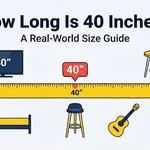
On the taller side: a typical bar stool, measured to the top of the backrest, often runs 40 to 45 inches meaning the shortest bar stools in a showroom are about as close to exactly 40 inches as furniture gets.
If you’re mid-move and trying to guess if something will fit through a doorway or around a landing, stacking one just under and one just over comparison in your head tends to work better than trying to picture 40 inches as one fixed thing.
Sports, Hobbies, and Daily Carry
A few recreational items round out the picture, and this is where the comparisons get a little looser. Sporting goods vary more by model than furniture does.
A full-size acoustic guitar measures roughly 40 to 41 inches from headstock to base, making it one of the closer matches on this list and a familiar shape for anyone who’s seen one leaned in a corner. A longboard skateboard typically runs 38 to 42 inches, so mid-range models land almost exactly on the mark. Golf drivers, by contrast, run longer, usually 44 to 46 inches so think of a driver as 40 inches, plus a bit more rather than a direct match. The longest baseball bats allowed in adult play approach the 40-inch range, though most players actually swing bats closer to 33 or 34 inches.
And for anyone who’s pushed one through a store aisle: an unfolded baby stroller typically measures 38 to 40 inches front to back which is also, per CDC growth-chart data, close to the average height of a 3-year-old child. Toddler and stroller, oddly enough, are about the same size.
How to Eyeball 40 Inches Without a Tape Measure
- Start with a yardstick. At 36 inches, it gets you most of the way there just by adding a palm’s width.
- Picture a 40-inch TV. The diagonal measurement is the number itself, no conversion needed.
- Use two steps, roughly. Most adult strides run 24 to 30 inches, so 40 inches is a step and a half, give or take.
- Think counter height, plus a bit. Kitchen counters sit at 36 inches; 40 is that height plus about four inches.
- Compare it to a toddler. If you’ve spent time around a 3-year-old, you’ve already got a rough sense of this height at eye level.
Common Questions
How many feet is 40 inches?
About 3 feet 4 inches, or 3.33 feet as a decimal.
Is 40 inches longer than a yardstick?
Yes a yardstick is 36 inches, so 40 inches is about 4 inches longer.
What’s the closest everyday match to exactly 40 inches?
A 40-inch TV screen, since that’s the literal advertised measurement rather than an approximation.
Is a 3-year-old about 40 inches tall?
Close. CDC growth data puts the average around 37 to 39 inches, just under the mark.
The Short Version
40 inches breaks down to 3 feet 4 inches, or about 101.6 centimeters and once you’ve got a few reference points, it’s easy to place without a tape measure. A yardstick plus a palm’s width gets you there. So does picturing a 40-inch TV, a twin bed, or a kitchen counter with a little extra height stacked on.
The real usefulness isn’t the number itself, it’s having it on hand for the moments that actually call for it: figuring out if a dresser will clear a stairwell, If a stroller fits through a doorway, or if that new TV is really the size you’re picturing.
A little context turns an abstract measurement into something you can judge at a glance.
Discover More Posts!
How Long Is 12 Inches? Easy Everyday Comparisons
How Long Is 18 Inches? 15 Easy Comparisons
How Long Is 17 Inches? 15 Easy Size Comparisons

I’m Priya Sharma, a content writer at MeasureZit.com, specializing in measurements, unit conversions, and mathematical concepts. I turn technical topics into clear, accurate content that’s easy to understand. My focus is precision, clarity, and genuinely useful information.