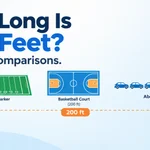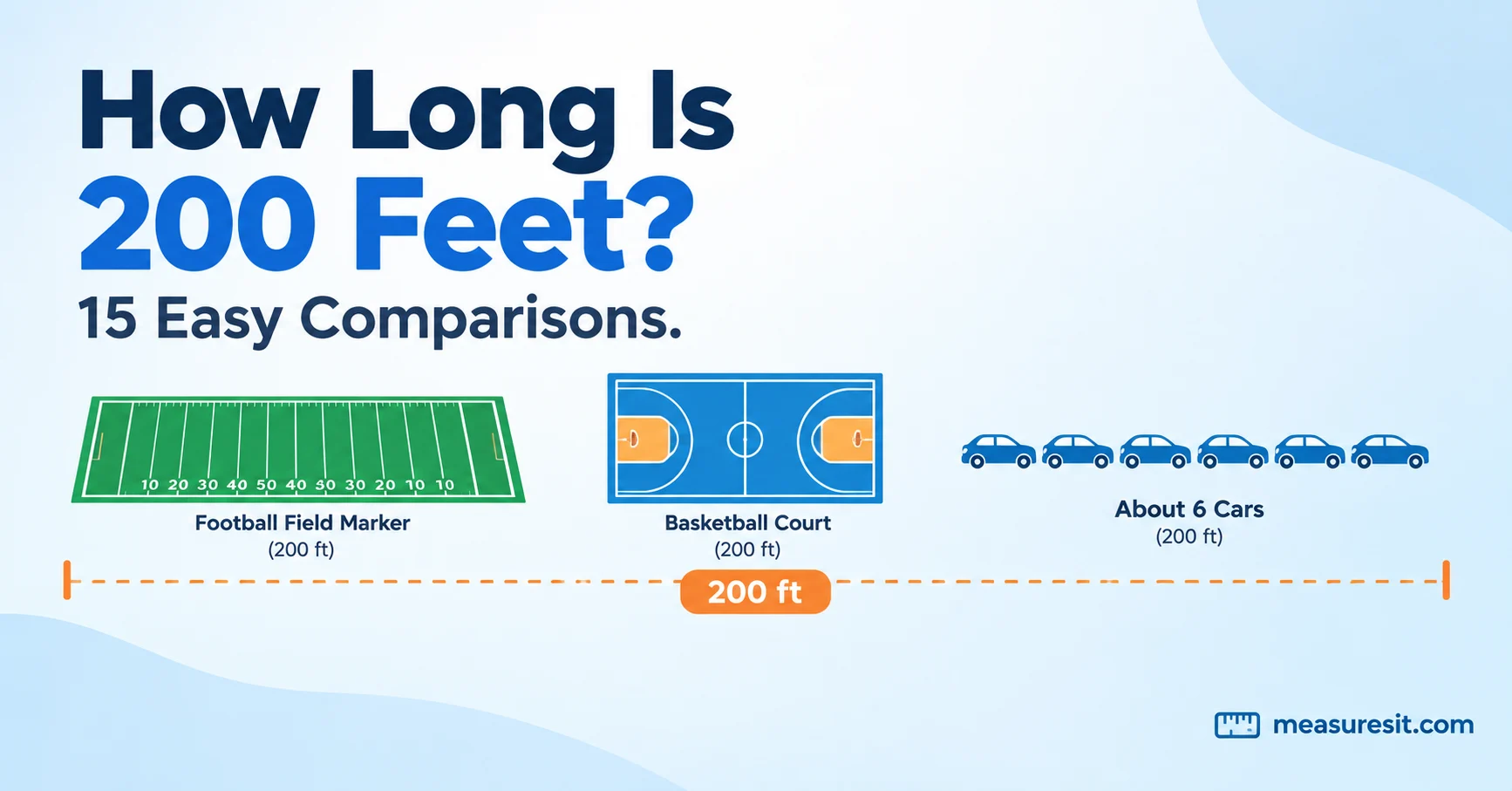
Try guessing the distance across a parking lot sometime, then pace it off. Most people are off by 30 feet or more, because distance on flat, open ground is genuinely hard to judge by eye. 200 feet works out to about 66.7 yards, or roughly 61 meters close to two-thirds of a football field, or the length of five school buses parked bumper to bumper.
That number comes up more often than it seems like it should. Homeowners run into it when checking if a fence line or a garden hose will reach far enough.
Movers use it to judge if a truck can clear a driveway. Runners and hikers lean on it to picture how far off a trailhead or a mile marker really is. Once you’ve got two or three solid mental images of what 200 feet actually looks like, you stop needing a tape measure just to get a reasonable guess
Conversion Chart
| Unit | Converted Value |
| Inches | 2,400 in |
| Feet | 200 ft |
| Yards | 66.67 yd |
| Miles | ≈0.038 mi |
| Millimeters | 60,960 mm |
| Centimeters | 6,096 cm |
| Meters | ≈60.96 m |
Common Objects That Are About 200 Feet
| Object | Approximate Length |
| Two-thirds of a football field | 200 ft (exact, by field markings) |
| A city block | ≈200–260 ft |
| Two blue whales | ≈180–200 ft |
| Two NBA basketball courts | 188 ft |
| A mid-size superyacht | ≈195–210 ft |
| Five school buses | ≈200 ft |
| Five 40-foot shipping containers | 200 ft (exact) |
| A 20-story building | ≈200–240 ft |
More Everyday Items Around 200 Feet
| Object | Approximate Length |
| Three bowling lanes | ≈180 ft |
| Eighteen parked cars | ≈198–216 ft |
| Two and a half tennis courts | ≈195 ft |
| An Olympic pool, plus its deck | ≈195–205 ft |
| The Leaning Tower of Pisa | ≈186 ft |
| Thirty-three adults lying end to end | ≈198 ft |
| A young redwood tree | ≈150–200 ft |
How Long Is 200 Feet, Really?
Two hundred feet lands in an awkward gap. It’s too long to size up accurately with a glance, but too short to think about in miles, so most people default to a vague guess and move on. A cleaner way to picture it: stand at one baseline of a basketball court and look past the far basket to roughly two more court-lengths beyond that. That’s close to where 200 feet ends.
It helps to sandwich it between something smaller and something bigger. Five school buses lined up nose to tail gets you almost exactly there from the small end. On the larger end, it’s a little more than half the open deck space on a modern cruise ship. Once you’ve got both of those in mind, 200 feet stops being an abstraction and starts being something you can actually stand inside.
Easy ways to estimate 200 feet without a tape measure:
- Use a football field. The stretch from the goal line to about the 33-yard line covers close to 200 feet.
- Count your steps. Most adult strides cover 2.5 to 3 feet, so somewhere between 65 and 80 steps in a straight line will get you close.
- Think about car lengths. Around 18 average sedans, parked bumper to bumper, add up to about 200 feet.
- Double a garden hose. Two standard 100-foot hoses, connected end to end, hit the mark exactly.
- Look up instead of across. A 20-story building is a reasonable stand-in when you’re estimating height rather than ground distance.
- Borrow a bowling alley. Three lanes laid end to end land just under 200 feet, which is close enough for a quick gut check.
1. Two-Thirds of a Football Field
An American football field runs 300 feet between the goal lines, not counting the end zones. Two hundred feet covers exactly two-thirds of that, landing around the 33-yard line if you’re standing at one end. Because the yard lines are painted every ten yards, this comparison is unusually precise as far as visual references go. You’re not eyeballing an estimate, you’re reading a ruler that’s already on the ground. Anyone laying out a driveway, a long garden bed, or a stretch of new fencing can use this as an exact reference rather than a rough one.
2. A City Block
Block length isn’t standardized nationally, but in a lot of U.S. downtown grids, a typical block runs somewhere between 200 and 260 feet on its shorter side. Manhattan’s east-west blocks tend to sit toward the lower end of that range, which is part of why walking just one more block in New York often takes longer than visitors expect. This comparison works because most people have already walked a city block without ever measuring it, so the scale is stored somewhere in memory even if the number wasn’t attached to it.
3. Two Blue Whales
According to research published by NOAA Fisheries, blue whales can grow close to 100 feet long, making them the largest animals known to have ever existed. Put two of them nose to tail and you land right around 200 feet. What makes this comparison stick is how often blue whales show up in documentaries and museum exhibits; most people already carry a mental image of one, even without ever seeing one in person. Doubling that image is an easy way to grasp a length that otherwise feels too large to picture at all.
4. Two NBA Basketball Courts
A regulation NBA court measures 94 feet from baseline to baseline. Two of them end to end come out to 188 feet, just short of 200. Courts make a dependable yardstick because their dimensions are fixed by league rules everywhere, unlike a park or a lawn that might vary from place to place. If you’ve ever stood at one baseline and looked toward the far hoop, picturing that same distance twice over gets you within about twelve feet of the full 200.
5. A Mid-Size Superyacht
Private yachts built for long-range cruising commonly fall somewhere between 195 and 210 feet, a size class often labeled mid-size within the superyacht industry. Vessels at this length usually have room for multiple decks, guest cabins, and sometimes a small pool, which is part of why they get photographed so often in coastal marinas. Unlike a building or a field, a yacht this size is a single moving object, which makes it a useful comparison for picturing 200 feet as one continuous shape rather than a stretch of ground.
6. Five School Buses
A standard American school bus measures close to 40 feet from bumper to bumper. Five of them lined up end to end land almost exactly at 200 feet, which makes this one of the tidier comparisons on the list. School buses are recognizable to nearly everyone, if from riding one, waiting behind one, or watching one stop traffic on a residential street. That familiarity is what makes the comparison useful for estimating distances around schools, bus lanes, or neighborhood streets.
7. Five 40-Foot Shipping Containers
Standard intermodal shipping containers used in global freight measure exactly 40 feet long. Five of them end to end totaling precisely 200 feet, no rounding required. Shipping containers have become a familiar sight well beyond ports and rail yards, thanks to their growing use in modular housing and pop-up retail spaces. For anyone working in logistics, construction, or warehousing, this comparison offers a clean, exact reference rather than an approximate one.
8. A 20-Story Building
Commercial buildings generally allow 10 to 12 feet of height per floor, which puts a 20-story building somewhere close to 200 to 240 feet tall. This flips the measurement on its side, which is useful when you’re picturing a crane, a radio tower, or a tall tree rather than a distance across flat ground. Most people have looked up at a building around this height in a downtown skyline, even without knowing exactly how many stories it had, which makes the image easy to recall later.
9. Three Bowling Lanes
A regulation bowling lane runs 60 feet from the foul line to the head pin. Three lanes placed end to end total about 180 feet, a bit short of the full 200 but close enough to be useful as a quick mental check. Bowling alleys are common enough that most people have walked the length of a lane at some point, even if they weren’t thinking about measurement at the time. Indoors, where football fields and city blocks don’t apply, this is one of the few comparisons that still works.
10. Eighteen Parked Cars
Average sedans run somewhere between 11 and 12 feet long, so 18 of them parked bumper to bumper land in the 198 to 216 foot range, depending on the mix of vehicles. Parking lots make this an easy comparison to test in real life, since most people have walked the length of one while hunting for their car. It’s a practical way to judge distance across retail lots, stadium parking, or a long stretch of street parking.
11. Two and a Half Tennis Courts
A tennis court measures 78 feet long, including the space behind each baseline. Two and a half courts placed end to end add up to about 195 feet, close enough to 200 that the difference barely registers on the ground. Tennis courts are built to the same dimensions everywhere, from public parks to private clubs, so the comparison holds up no matter where you’ve encountered one. Anyone who’s played or watched a match already has an instinctive sense of that length.
12. An Olympic Pool, Plus Its Deck
A competition pool built to World Aquatics standards measures 50 meters, or about 164 feet, from wall to wall. Add a typical pool deck of 30 to 40 feet on one side and the total lands close to 200 feet. This comparison works well for picturing 200 feet as a single enclosed space rather than an open stretch, especially for anyone who’s swam laps and has a physical memory of how long that pool actually feels underwater.
13. The Leaning Tower of Pisa
Italy’s famous bell tower stands close to 186 feet tall on its shorter side, just under the 200-foot mark. It’s better known for its tilt than its height, but the tower’s actual measurement lands closer to 200 feet than most people would guess. Because the tower appears constantly in photos and travel guides, it’s one of the easier landmark comparisons to call to mind without any extra explanation.
14. Thirty-Three Adults Lying End to End
The Centers for Disease Control and Prevention puts the average adult height in the U.S. at roughly 5 feet 9 inches for men and 5 feet 4 inches for women. Using a rounded average of about 6 feet per person, laying 33 adults head to toe would stretch close to 198 feet. This one leans on something more personal than a building or a vehicle, your own body, or the people around you which makes it easier to picture a long line of people rather than an object.
15. A Young Redwood Tree
Coast redwoods are capable of growing past 300 feet at full maturity, according to the National Park Service, but a tree that’s still decades from full growth often stands closer to 150 to 200 feet. A redwood near the upper end of that growth stage lines up closely with 200 feet in height. This comparison flips the measurement vertically again, which is useful for anyone picturing a forest canopy, a flagpole, or anything else measured by how high it reaches rather than how far it stretches.
FAQ
Is 200 feet longer than a football field?
No A football field measures 300 feet between the goal lines, so 200 feet only covers about two-thirds of that distance.
What’s a good indoor comparison for 200 feet?
Three bowling lanes end to end come close, landing around 180 feet, or two and a half tennis courts at about 195 feet.
How many steps is 200 feet?
For most adults, that’s roughly 65 to 80 walking steps, depending on stride length.
Is a city block about 200 feet?
Often, yes. Many U.S. city blocks fall between 200 and 260 feet on their shorter side, though this varies significantly by city.
Final Thoughts
200 feet is easier to picture than it sounds once you attach it to something real. It’s about two-thirds of a football field, close to five school buses in a row, or 61 meters if you’re working metric. if it’s two blue whales, a pair of basketball courts, or a line of 18 parked cars, each comparison gives you a way to check a distance without pulling out a measuring tape.
That’s really the point of collecting reference points like these. The next time you’re eyeing a fence line, sizing up a driveway for a moving truck, or trying to settle an argument about how far away something actually is, you’ll have a mental image ready instead of a guess. A number stops being abstract the moment you can picture standing inside it.

I’m Dane Whitfield, a content writer at MeasureZit.com, where I specialize in creating clear, accurate articles on measurements, unit conversions, and mathematical concepts. I enjoy breaking down complex numerical topics into simple, practical explanations that readers can actually use. My goal is always precision and clarity helping people make sense of the numbers around them.