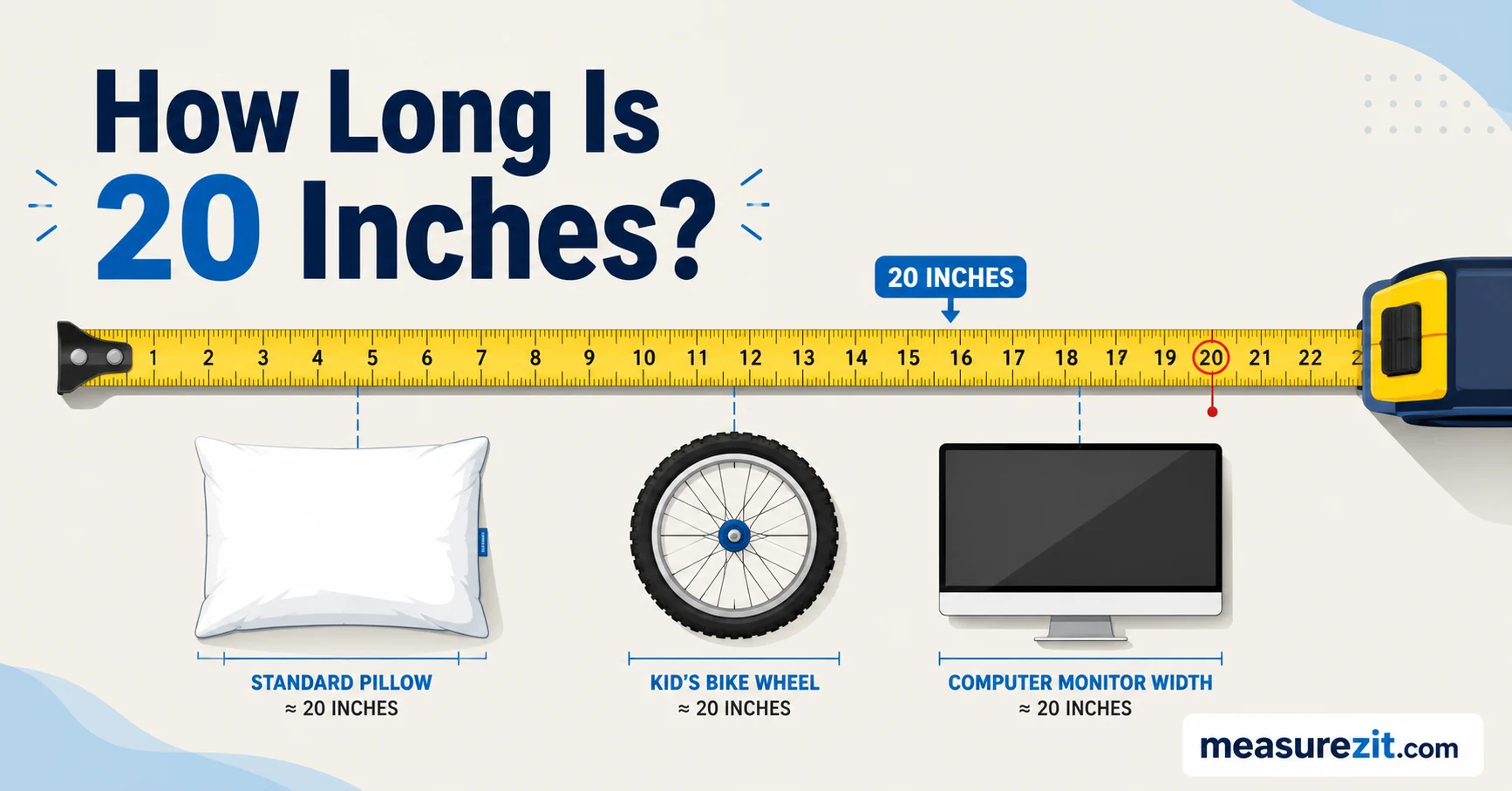
You measure the box the courier just dropped off, and the label says 20 inches. Is that going to fit on the shelf, or are you rearranging the whole closet? Twenty inches works out to about 1.67 feet, or 50.8 centimeters close to the width of a standard bed pillow lying flat. That single comparison is usually enough to settle the question without pulling out a tape measure at all.
This size shows up more often than people expect once they start paying attention to it. It’s the wheel size on a kid’s bike, a common width for a checked appliance, and roughly how long airline carry-ons run. Once you’ve got a feel for 20 inches, sizing up a suitcase, a shipping box, or a gap in your furniture layout gets a lot faster.
Conversion Chart
| Unit | Converted Value |
| Inches | 20 in |
| Feet | ≈1.67 ft |
| Yards | ≈0.56 yd |
| Millimeters | 508 mm |
| Centimeters | 50.8 cm |
| Meters | ≈0.51 m |
Common Objects That Are About 20 Inches
| Object | Approximate Length |
| 20-inch bicycle wheel | 20 in |
| Newborn baby (average) | ≈19.5–20 in |
| Standard bed pillow | 20 in wide |
| 20-inch computer monitor | 20 in diagonal |
| Jumbo teddy bear | ≈20 in tall |
| Forearm, elbow to fingertip | ≈18–20 in |
| Extra-large pizza | ≈18–20 in diameter |
| Carry-on suitcase | ≈21–22 in |
More Everyday Items Around 20 Inches
| Object | Approximate Length |
| Microwave oven width | ≈20–24 in |
| Domestic cat’s body (nose to tail base) | ≈18–20 in |
| Soprano ukulele | ≈21 in |
| Large rolling pin | ≈18–20 in |
| Portable fire extinguisher | ≈18–20 in |
| Closed rain umbrella | ≈20–24 in |
| Large cutting board, long side | ≈20 in |
How Long Is 20 Inches, Really?
Set a bed pillow on the floor and look at it end to end. That’s almost exactly 20 inches, and it’s a size most people can picture without any effort. It’s also roughly the wheel size on a kid’s bike or a BMX bike bigger than a basketball, smaller than a yardstick.
For scale, 18 inches about the length of a rolling pin or a cat’s body sits just short of it. Push out to 24 inches, or 2 feet, and you’re at the length of two rulers laid end to end, noticeably longer than 20. This size lands in the gap between small enough to carry one-handed and big enough to need both arms.
Easy ways to estimate 20 inches without a tape measure:
- Use your forearm. Elbow to fingertips runs close to 18–20 inches on most adults, so your own arm doubles as a rough ruler.
- Grab a pillow. Standard bed pillows measure 20 inches wide, making them one of the most exact stand-ins on this list.
- Picture a kid’s bike wheel. The 20-inch size is printed right on the tire, so it’s a fixed reference rather than a guess.
- Compared to two rulers minus a third. Two 12-inch rulers end to end make 24 inches; 20 inches falls about four inches short of that.
- Think rolling pin plus a bit. A large rolling pin runs close to 18–20 inches, giving you a quick visual anchor from the kitchen.
- Line up a laptop’s long edge. Most 15-inch laptops measure roughly 13–14 inches wide; add a hand’s width and you’re close to 20.
1. A 20-Inch Bicycle Wheel
Check the tire on almost any bike built for a child around six to ten years old, or on a BMX bike, and the wheel diameter is printed right there: 20 inches. Unlike most comparisons on this list, there’s no rounding involved; it’s a standardized size that manufacturers stamp directly onto the rubber.
That makes it one of the more dependable references here. Anyone who’s helped a kid pick out a bike, or wheeled one out of a garage after years in storage, has a rough sense of how big that wheel actually is. It’s a handy mental yardstick the next time you’re eyeing a package at the door and trying to guess its dimensions before you even pick it up.
2. A Newborn Baby
According to CDC and WHO growth reference data, most full-term newborns measure somewhere between 19 and 20 inches long at birth, with the overall typical range running from about 18.5 to 21 inches. Boys tend to run slightly longer than girls on average, though the difference is small.
Anyone who’s held a newborn, even briefly, has some memory of how that length felt from head to heel. It’s a size tied to a real experience rather than an abstract figure, which is part of why the number sticks. Parents shopping for a bassinet, swaddle blanket, or an infant car seat often use this figure as a starting point before checking a product’s exact size chart.
3. A Standard Bed Pillow
A standard bed pillow measures 20 inches wide by 26 inches long dimensions that are consistent enough across brands that this is one of the most reliable exact matches on the whole list.
Because pillows are in nearly every bedroom, there’s no need to recall an unusual object to make this comparison work. Hold one up next to a storage bin, a box, or a gap on a shelf, and you’ll get an instant read on If 20 inches will fit. It’s one of the few comparisons here that doubles as an actual measuring tool if you’re in a pinch.
4. A 20-Inch Computer Monitor
When a screen is labeled 20-inch, that number refers to the diagonal measurement, corner to corner, not the width or height on its own. This size used to be a common baseline for desktop monitors before wider, larger displays took over.
The phrase 20-inch monitor shows up often enough in old office setups and secondhand listings that most people recognize it, even without owning one. It’s a useful reference specifically for diagonal measurements TV screens, tablets, and laptop displays are all sized the same way, so this comparison transfers well beyond monitors themselves.
5. A Jumbo Teddy Bear
Large stuffed bears sold at carnivals, fairs, and gift shops commonly run around 20 inches tall. Smaller medium bears are shorter, and true jumbo versions can exceed this, but 20 inches is a common size for what most stores label large.
Most people have seen one tucked in a hospital gift shop window or won at a carnival game at some point, which makes the size easy to recall on demand. If you’re boxing up a large stuffed animal to ship or gift-wrap, this comparison gives a fast reality check on If your box is actually big enough.
6. A Forearm, Elbow to Fingertip
Measured from the elbow to the tip of the middle finger, an adult forearm typically runs somewhere between 18 and 20 inches, though this varies with height and build. This rough distance is close to what people once called a cubit, an old unit of measurement based on the arm.
Because it’s attached to your body, this reference is always on hand literally. Stretch your arm out next to a shelf, a length of fabric, or a piece of trim, and you’ll get a workable estimate without digging through a drawer for a tape measure. It’s especially useful mid-errand, when checking a phone calculator feels like more trouble than it’s worth.
7. An Extra-Large Pizza
Pizza sizing isn’t standardized industry-wide, but many pizzerias’ extra-large option runs close to 18 to 20 inches across, particularly party size pies meant to feed a crowd. Standard large pizzas tend to run smaller, closer to 14 to 16 inches.
Pizza size categories tend to stick in memory better than most measurements, simply because most people have ordered one and compared options before. Next time you’re deciding between a large and an extra-large for a group, picturing this size difference can help you judge If the bigger option is worth the extra cost.
8. A Carry-On Suitcase
Most major airlines cap carry-on bags somewhere close to 22 x 14 x 9 inches, which puts the long side just slightly over our 20-inch benchmark. Exact limits vary by airline, so it’s worth checking before a flight rather than assuming.
Anyone who travels regularly has wheeled a bag close to this size through security more than once. Because airlines publish these limits at check-in and on booking confirmations, many travelers already have a rough sense of the size memorized. It’s a useful gut check when packing a box or bag you’re hoping will pass as a carry-on.
9. A Microwave Oven
Compact and mid-size microwaves commonly measure somewhere between 20 and 24 inches wide, with the width scaling up alongside interior capacity and wattage. Larger over-the-range models tend to run wider still.
Since a microwave sits on nearly every kitchen counter, this comparison doesn’t ask you to picture anything unfamiliar. When you’re planning counter space or swapping in a replacement appliance, this width range gives a fast rationality check on what will actually fit in the gap you have.
10. A Domestic Cat’s Body
A typical house cat’s body, measured from the nose to the base of the tail and not counting the tail itself, runs roughly 18 to 20 inches. Breed and individual size shift this in either direction, but it’s a fairly consistent range across common household cats.
Cat owners often develop a good instinct for their pet’s size without ever pulling out a measuring tape, just from years of handling them. That instinct translates surprisingly well into judging other object sizes. If you’re shopping for a carrier or a cat bed, this range is a solid starting point before checking a product’s listed dimensions.
11. A Soprano Ukulele
A soprano ukulele, the smallest and most common size, typically measures about 21 inches from top to bottom just over our 20-inch mark and small enough to be mistaken for a toy at a glance.
Ukuleles have become common enough in schools, beach photos, and beginner music kits that most people have seen one up close, even without playing an instrument themselves. Its slim, elongated shape also makes it a handy reference for judging the length of narrow items, like a wrapping-paper tube or a long picture frame.
12. A Large Rolling Pin
Rolling pins used for pie crusts and bread dough typically range from about 15 to 20 inches long, with bakery-style pins built for bigger batches landing at the longer end of that range.
Anyone who bakes regularly develops a feel for their rolling pin’s length just from repeated use, without ever measuring it directly. That familiarity carries over well to judging drawer space or storage container sizes for other long, thin kitchen tools. It’s a comparison that clicks fastest for people who’ve had to figure out If a rolling pin actually fits in a crowded drawer.
13. A Portable Fire Extinguisher
Standard home and office fire extinguishers, the kind mounted on a wall bracket, typically stand about 18 to 20 inches tall for common consumer sizes. Larger commercial units run taller.
Fire extinguishers are common enough fixtures that most people walk past one regularly without giving its size a second thought. Once you clock its actual height, though, it becomes a fairly reliable size marker. This comparison is especially handy for checking cabinet or closet clearance, since a lot of households already own one of roughly this size.
14. A Closed Rain Umbrella
A standard umbrella, closed and clipped shut, typically measures somewhere around 20 to 24 inches long, depending on the style. Compact travel umbrellas run shorter, while larger stick umbrellas can exceed this range.
Umbrellas tend to sit forgotten in a bag, a car door pocket, or an entryway stand, which means most people have handled one without really registering its length. That closed, narrow shape makes it a decent stand-in for judging other long, thin objects: a rolled poster, a tool case, or a length of pipe.
15. A Large Cutting Board
A large kitchen cutting board, the kind used for carving a roast or prepping vegetables for a big meal, often measures close to 20 inches along its longer edge. Smaller everyday boards tend to run shorter, closer to 12 to 15 inches.
Home cooks who prepare in bulk, for meal planning or a holiday dinner, often reach for a board somewhere in this size range without thinking twice about it. Its flat, rectangular shape also makes it an easy template to lay mentally over other flat items, like a serving tray or a storage bin, when you’re trying to judge if something will fit a given space.
FAQ
Is 20 inches bigger than a foot ruler?
Yes. A standard ruler measures 12 inches, so 20 inches is a full 8 inches longer, roughly two-thirds of a second ruler added on.
What household item is closest to 20 inches?
A standard bed pillow is one of the closest matches, since most measure exactly 20 inches wide.
How many centimeters is 20 inches?
Twenty inches equals about 50.8 centimeters, or 508 millimeters.
Is 20 inches close to a newborn baby’s length?
Very close. Most full-term newborns measure between 19 and 20 inches, according to CDC and WHO growth reference data, putting the average right at or just under 20.
Final Thoughts
So, how long is 20 inches? About 1.67 feet, or 50.8 centimeters roughly the width of a bed pillow, the wheel size on a kid’s bike, and close to how long a newborn baby measures at birth. That’s the short version, and it’s really all most people need.
What makes this size easy to work with is how many ordinary things already sit right around it. A pillow, a microwave’s width, a cutting board’s long edge none of these require special knowledge, just a little attention to things you already own.
The next time you’re packing for a flight, sizing up a shipping box, or figuring out if something will clear a doorway, one of these comparisons should get you a reliable answer faster than hunting down a tape measure.
Discover More Posts!
- How Long Is 6 Inches? Easy Comparisons
- How Long Is 2 Inches? Real-Life Comparisons
- How Long Is an Inch? 15 Everyday Objects to Compare

I’m Priya Sharma, a content writer at MeasureZit.com, specializing in measurements, unit conversions, and mathematical concepts. I turn technical topics into clear, accurate content that’s easy to understand. My focus is precision, clarity, and genuinely useful information.







4 thoughts on “How Long Is 20 Inches? Real-World Size Comparisons”