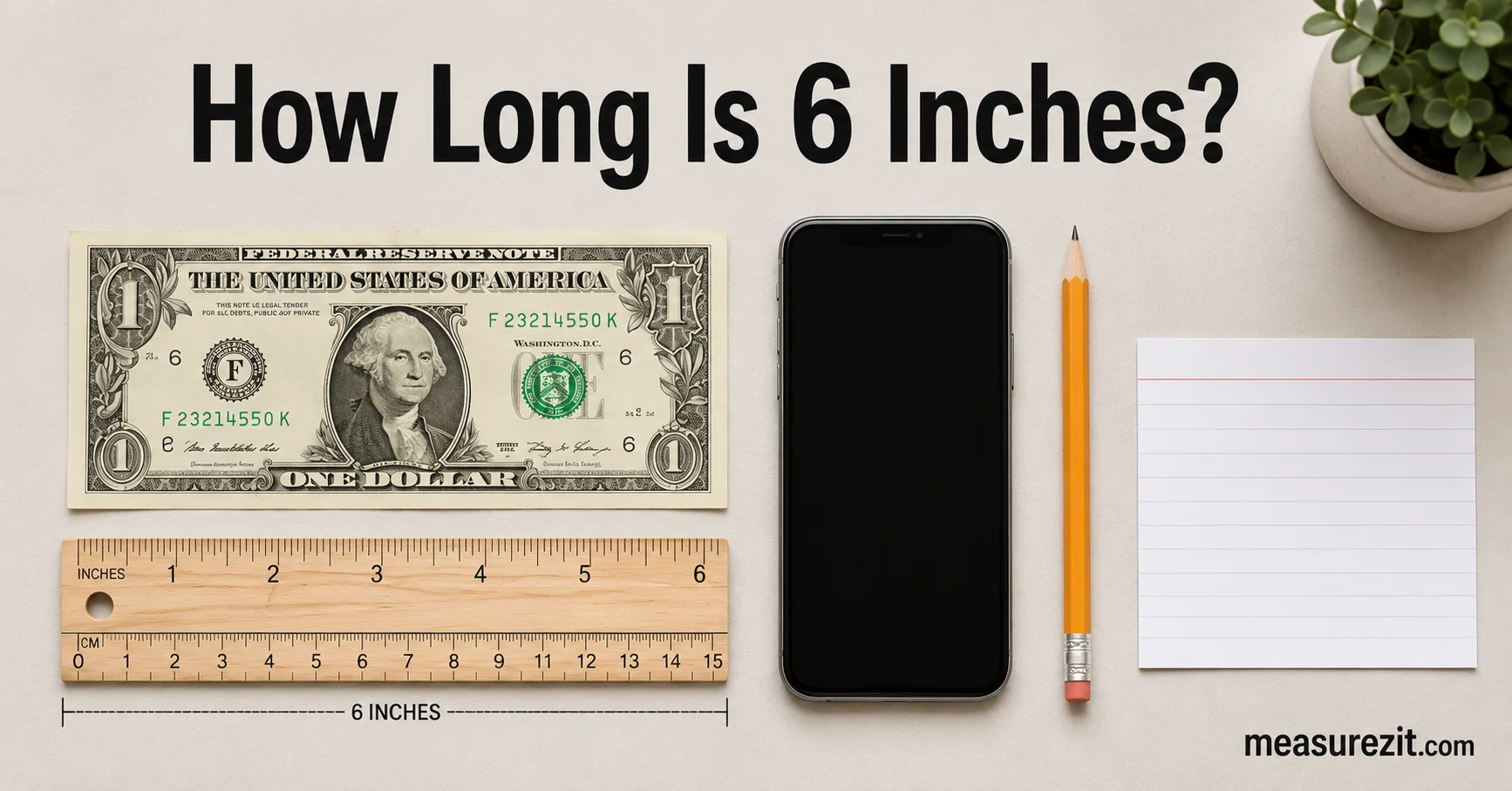
Grab a dollar bill out of your wallet and set it down flat. That’s almost exactly 6 inches half a foot, or 15.24 centimeters, give or take a hair. It’s one of those measurements that sounds simple until someone asks you to point at something that size, and your mind goes blank.
That’s really the problem with inches in general. You can know the number and still have no idea what it looks like in your hand. So instead of just handing you a conversion and moving on, this guide walks through fifteen ordinary objects, some in your kitchen, some in your wallet, one probably in your pocket right now that are all roughly 6 inches long.
If you’re measuring a gap on a bookshelf, checking if a gift will fit in a box, or just settling an argument about how long is 6 inches compared to your phone, one of these should do the trick.
Quick Conversion Chart
| Unit | Value |
| Inches | 6 in |
| Feet | 0.5 ft |
| Yards | ≈0.17 yd |
| Millimeters | 152.4 mm |
| Centimeters | 15.24 cm |
| Meters | ≈0.15 m |
8 Things That Are About 6 Inches
| Object | Approximate Length |
| Dollar bill | 6.14 in |
| Smartphone | 5.5–6.5 in |
| Pencil, sharpened down from new | ≈6 in |
| Adult hand span (thumb to pinky) | ≈6–7 in |
| Small pocket ruler | 6 in |
| Hot dog, bun included | ≈6 in |
| Salad or bread plate (diameter) | ≈6–7 in |
| Six-inch sub sandwich | 6 in |
7 More Things Around That Size
| Object | Approximate Length |
| Trade paperback (width) | ≈5.5–6 in |
| Standard ballpoint pen | ≈5.5–6 in |
| Dinner fork | ≈7 in |
| Index card, long edge | 6 in |
| Utility knife blade | ≈6 in |
| Box of crayons (length) | ≈5.5 in |
| Young child’s foot (toddler–early school age) | ≈6 in |
Getting a Feel for 6 Inches
Six inches lands in an in-between zone that’s easy to underestimate. It’s twice the length of a credit card, but only half the length of a standard 12-inch ruler so if you can picture either of those, you can split the difference and land pretty close.
What makes it a little trickier than, say, a foot or a yard is that nothing in everyday language rounds to it neatly. Nobody says about six inches the way they’d say about a foot. That’s exactly why object comparisons work better here than trying to eyeball it cold.
A few low-effort ways to check yourself without a tape measure:
- Pull out a dollar bill. It’s in almost every wallet, and at 6.14 inches, it’s about as close to exact as a household object gets.
- Check your phone against it. Most current smartphones fall within a quarter-inch of 6, so once you know your model, you’ve got a built-in reference.
- Spread your hand out flat. Thumb tip to pinky tip usually lands somewhere between 6 and 7 inches on an adult hand, not exact, but close enough for rough estimates.
- Use an index card. The long side is manufactured to exactly 6 inches, so it doubles as a flat, rigid ruler if you’ve got one in a drawer.
- Think in sub-sandwich units. It sounds silly, but the six-inch sub got its name for a reason, and most people have a decent mental picture of one.
1. A Dollar Bill
According to the U.S. Bureau of Engraving and Printing, every Federal Reserve note regardless of denomination measures 6.14 inches long. A single, a five, a hundred: all identical in size, which is part of what makes currency-counting machines work without recalibrating for each bill.
That consistency is what makes it such a dependable reference. Almost everyone has one within reach, and unlike a phone or a book, there’s no version-to-version variation to account for. If you need a fast, flat measuring stick and don’t have a ruler, this is usually the closest thing at hand.
2. Your Smartphone
Depending on the model, most modern smartphones run somewhere between 5.5 and 6.5 inches tall, screen included. It’s not a fixed number the way currency is, but it’s close enough that your own phone can double as a rough ruler in a pinch.
The advantage here is availability. Your phone is probably closer to you right now than an actual tape measure. Hold it up next to a gap in a shelf or a spot in a suitcase before you commit to packing something bulkier.
3. A Well-Used Pencil
A new, unsharpened pencil starts out closer to 7.5 inches. By the time it’s been through a sharpener a few dozen times, it typically settles around 6 inches which happens to describe most of the pencils actually sitting in junk drawers and pencil cups.
It’s a comparison that holds up because pencils are everywhere, even in households where nobody draws or writes by hand much anymore. Next time you’re eyeing If a small item will fit in a pencil case or drawer, this is a fair stand-in.
4. Your Own Hand Span
Stretch your hand out as far as it’ll go, thumb tip to pinky tip. On most adults, that lands somewhere between 6 and 7 inches, though hand size varies enough that it’s worth checking yours once against an actual ruler.
Once you know your own number, it becomes one of the more convenient tools on this list you’re never without it. Carpenters and crafters use this trick constantly for rough, in-the-moment measurements when reaching for a tape measure would slow things down.
5. A Six-Inch Ruler
Smaller rulers the kind that fit in a pencil case rather than a toolbox are frequently manufactured at exactly 6 inches. You’ll find them in school supply kits, sewing boxes, and desk drawers.
There’s no estimating involved here, since the length is printed directly on the tool. If precision actually matters for what you’re doing, this beats every comparison on this list. It’s worth keeping one somewhere accessible instead of relying on your phone or a dollar bill.
6. A Hot Dog
A standard hot dog, bun included, comes in close to 6 inches from end to end. It’s not a precise measurement bun size varies by brand but it’s close enough to work as a casual, memorable comparison.
Food comparisons tend to stick in people’s heads better than abstract numbers, mostly because they’re tied to something you’ve actually held and eaten. It won’t replace a ruler, but it’s a fine gut-check at a cookout or in the grocery aisle.
7. A Salad or Bread Plate
Smaller plates, the ones used for salads, bread, or dessert rather than a full dinner typically run 6 to 7 inches across. It’s a size category that shows up in nearly every kitchen, usually stacked separately from the larger dinner plates.
Because plate sizes are fairly standardized across dinnerware sets, this comparison holds up better than it might seem at first. It’s a genuinely useful one for anyone trying to visualize how big 6 inches looks laid flat on a table.
8. A Six-Inch Sub
The six-inch sub is one of the few items on this list that names its own measurement outright, which makes it about as reliable a mental anchor as you’ll find. Sandwich chains built their sizing around this length specifically because customers already understand portion sizes intuitively.
Beyond the literal size match, it’s useful because almost everyone has ordered one and has a rough sense of how much sandwich that actually is. When you need a fast, food-based comparison, this is the cleanest one available.
9. A Trade Paperback
Mass-market paperbacks the smaller, pocket-sized ones run closer to 4.25 inches wide. Trade paperbacks, the larger format more common for newer releases, typically measure 5.5 to 6 inches across, putting them right in range.
If you’ve got a bookshelf nearby, this is one of the easier comparisons to test on the spot. It’s particularly handy for figuring out If something will slide into a narrow shelf gap or a bag’s side pocket.
10. A Standard Ballpoint Pen
Most full-size ballpoint pens measure somewhere between 5.5 and 6 inches, cap included. It’s a size that’s stayed fairly consistent across brands for decades, since pens are designed to fit comfortably in an adult hand regardless of manufacturer.
Like the pencil comparison above, this one works because pens turn up in almost every bag, car, and junk drawer. Lay one next to whatever you’re measuring for a fast visual check.
11. A Dinner Fork
A standard dinner fork usually measures close to 7 inches, just a bit longer than 6. Laid next to a smaller object, it gives you a fairly tight upper bound to compare against.
Silverware drawers are one of the few places you can count on finding a consistent reference without digging. It’s a handy one to reach for mid-recipe, when you’re trying to gauge the size of a cut of meat or a piece of produce without stopping to find a ruler.
12. An Index Card
A standard index card measures exactly 6 inches along its long edge with no rounding required. You’ll find them in recipe boxes, classrooms, and office supply drawers.
Because the size is fixed by manufacturing convention rather than estimated, this is one of the more precise comparisons on the list. Keep one in a notebook or bag as a flat, disposable ruler substitute.
13. A Utility Knife Blade
Utility knives the mid-size blade between a small paring knife and a full chef’s knife typically run close to 6 inches. It’s a size built for tasks too big for delicate paring work but too small to justify pulling out the largest knife in the block.
Because it occupies such a specific, well-defined slot in most kitchen knife sets, it’s a dependable size reference for cooking-related estimates, like judging If a cut of squash or a loaf will fit a particular pan.
14. A Box of Crayons
A standard single-row box of crayons measures close to 5.5 inches just shy of 6, but close enough to be a useful visual anchor, especially for anyone estimating sizes with kids around.
It’s a comparison most people can picture instantly, since it comes from childhood rather than anything technical. Useful for craft projects, school supply shopping, or just explaining size to a kid in terms they already understand.
15. A Young Child’s Foot
Foot length in toddlers and early-elementary-age children often lands close to 6 inches, though this varies quite a bit with age and growth rate. The CDC’s pediatric growth charts track this kind of measurement over time as part of general child development monitoring, since foot growth tends to track fairly closely with a child’s overall size.
Parents who’ve been through shoe-shopping seasons tend to have an intuitive feel for this one already. It’s a relatable, human-scale comparison for anyone estimating sizes around a house with young kids in it.
Common Questions
Is 6 inches bigger than a credit card?
Yes noticeably. A standard credit card is 3.37 inches long, so 6 inches is nearly double that.
What’s the most accurate everyday object for 6 inches?
An index card’s long edge and a dollar bill are both about as close as you’ll get without an actual ruler within a couple hundredths of an inch.
Is 6 inches exactly half a foot?
Yes. A foot is defined as 12 inches, so 6 inches is precisely half, with no rounding involved.
How many centimeters is 6 inches?
6 inches converts to 15.24 centimeters exactly, since 1 inch equals 2.54 cm.
The Bottom Line
Six inches works out to half a foot, or 15.24 centimeters but the number alone rarely tells you what you need to know.
What actually helps is having a mental shortcut, and now you’ve got fifteen of them: a dollar bill in your wallet, the phone in your hand, the index card in your desk drawer.
Next time you’re sizing up a gap on a shelf, checking if a gift will fit in a box, or just trying to settle a casual argument about scale, skip the search for a tape measure.
Reach for whatever’s closest on this list instead odds are, something within arm’s reach is already close enough to trust.
Read More Posts!
How Long Is 11 Inches? A Real-World Size Guide
How Long Is 13 Inches? Easy Everyday Comparisons
How Long Is 20 Inches? Real-World Size Comparisons

I’m Owen Reeves, a content writer at MeasureZit.com, specializing in measurements, unit conversions, and mathematical concepts. I turn technical topics into clear, accurate content that’s easy to understand. My focus is precision, clarity, and genuinely useful information.

2 thoughts on “How Long Is 6 Inches? Easy Comparisons”