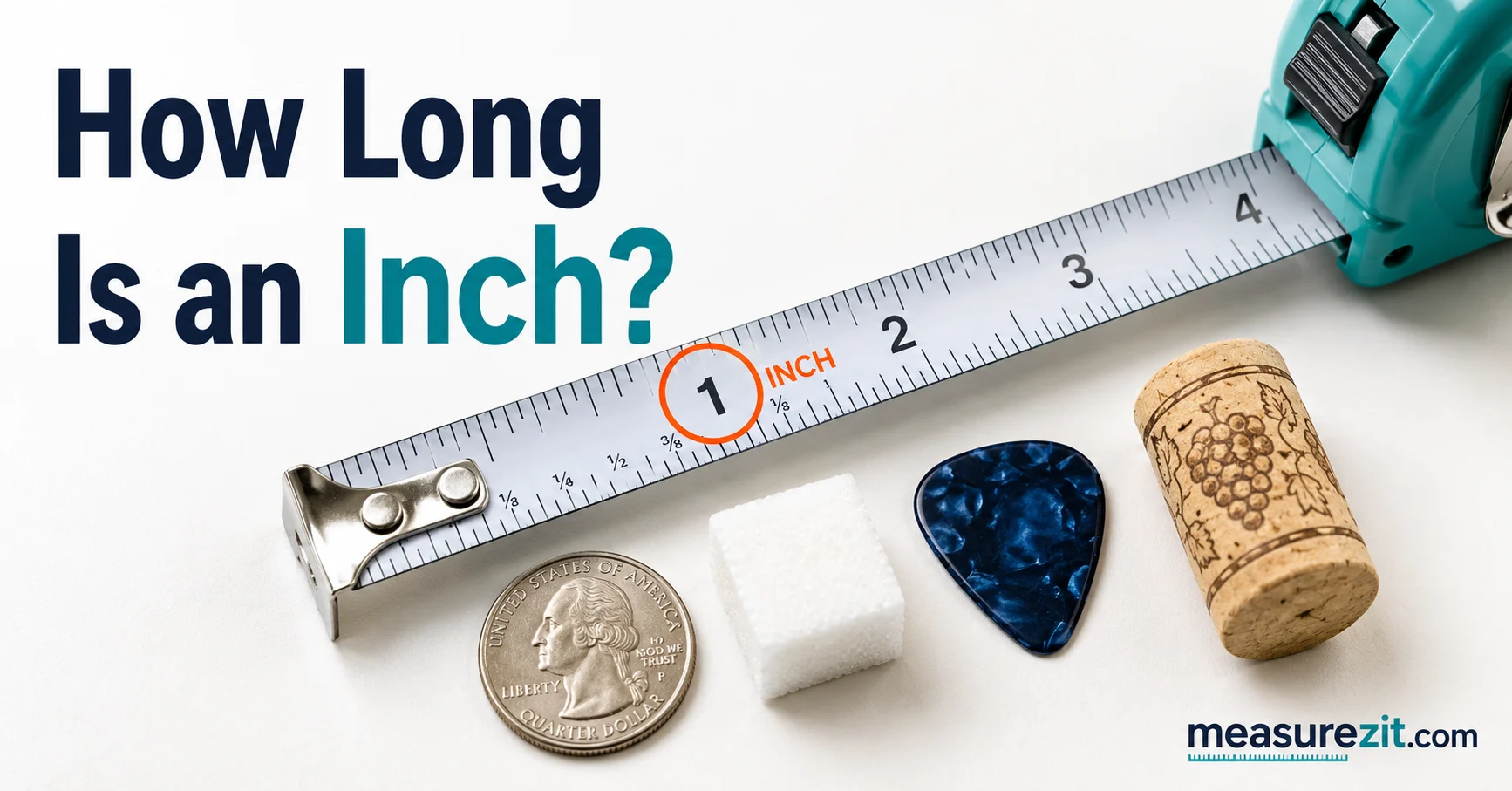
You’re holding one right now, probably. An inch equals 2.54 centimeters, and it’s just about the width of an adult thumb across the nail. That’s the whole answer but knowing what an inch actually looks like, without a ruler in your hand, is the part that actually saves you time.
This comes up more than people expect. You reach for it when a listing says a phone is 6.1 inches and you’re trying to picture the screen. You reach for it when you’re hanging a shelf and need to guess if a gap is wide enough. You reach for it in the kitchen, too.
A lot of baking and product sizing is described in inches without anyone handing you a tape measure. Once you can picture one inch clearly, all of that gets faster.
Conversion Chart
| Unit | Converted Value |
| Inches | 1.00 in |
| Feet | ≈ 0.08 ft |
| Yards | ≈ 0.03 yd |
| Millimeters | 25.40 mm |
| Centimeters | 2.54 cm |
| Meters | ≈ 0.03 m |
Miles are left off this chart an inch is such a tiny sliver of a mile that the comparison isn’t useful in practice.
Common Objects That Are About 1 Inch
Start with these. They’re things most people have within reach right now, which makes them fast, free rulers.
| Object | Approximate Length |
| U.S. quarter | ≈ 1 in (diameter) |
| Adult thumb | ≈ 1 in (width) |
| Large grape | ≈ 1 in (diameter) |
| Standard domino tile | ≈ 1 in (width) |
| Bottle cap | ≈ 1 in (diameter) |
| U.S. postage stamp | ≈ 1 in (width) |
| Sugar cube | ≈ 1 in (side) |
| Large strawberry | ≈ 1 in (diameter) |
More Everyday Items Around 1 Inch
If none of the above are nearby, one of these probably is.
| Object | Approximate Length |
| Standard paperclip | ≈ 1 in (short side) |
| Guitar pick | ≈ 1 in (length) |
| Large coat button | ≈ 1 in (diameter) |
| Chess pawn | ≈ 1 in (base diameter) |
| Tea bag | ≈ 1 in (width) |
| Shooter marble | ≈ 1 in (diameter) |
| Wine cork | ≈ 1 in (diameter) |
How Long Is 1 Inch, Really?
Picture a scale with a fingernail on one end and a golf ball on the other. An inch sits comfortably in the middle small enough to disappear in your palm, but large enough that you can actually make out detail in it, unlike a millimeter, which is closer to the thickness of a credit card and hard to judge by eye at all.
Scale it up instead, and a foot 12 inches is roughly the length of a standard classroom ruler. So an inch is that ruler’s length, chopped into twelfths. It’s a small unit, but not a fussy one; it’s the kind of size you can estimate reasonably well just by feel, especially once you’ve got a couple of go-to references memorized.
A few ways to check yourself without pulling out a tape measure:
- Use your thumb. The width across an adult thumbnail lands close to an inch for most people.
- Grab a quarter. Its diameter is one of the most reliable one-inch checks around, since coins never vary.
- Picture a domino. The short edge of a standard tile is right around an inch.
- Check a paperclip. The folded, short end not the full unclipped length is close to an inch across.
- Look at a stamp. Most U.S. stamps run close to an inch wide, and they’re flat enough to line up against almost anything.
1. A U.S. Quarter
Of everything on this list, the quarter is probably the most dependable. Its diameter measures just under an inch, and because it’s currency, that size never drifts from coin to coin the way a piece of fruit or a button might.
It’s also almost always within arm’s reach: a coin jar, a car cupholder, a couch cushion. Next time you’re trying to judge a small gap or a screw size, holding a quarter up against it beats guessing.
2. An Adult Thumb
There’s a reason rule of thumb became a phrase: for a lot of adults, the width across the base of the thumbnail comes out close to an inch. It won’t be exact, hands vary a fair amount from person to person but it’s close enough for a fast check.
The appeal here is availability. You don’t need to be near a coin or a ruler; your thumb travels with you, which makes it the go-to when you’re standing in a store aisle with nothing else to measure against.
3. A Large Grape
The bigger, rounder table grapes red or green tend to land close to an inch across at their widest point. Smaller seedless varieties usually run a bit under that, so this comparison works best with the fuller ones.
Because grapes show up in fruit bowls and lunch bags constantly, this is an easy mental image to call up even without one in front of you. It’s a handy stand-in whenever you’re picturing small, round objects at roughly this scale: beads, marbles, bolts.
4. A Standard Domino Tile
Dominoes are manufactured to a consistent size, and the short side of a typical tile comes out close to an inch. Unlike fruit, which varies with ripeness and variety, a domino’s dimensions barely shift between sets.
If you’ve spent any time playing, you likely already have a feel for that width in your fingers. That muscle memory makes dominoes a surprisingly practical reference when you’re eyeballing a slot or gap and don’t have anything else on hand.
5. A Bottle Cap
Most standard beverage bottle caps measure somewhere close to an inch across, If it’s a soda bottle or a beer bottle. Sizes shift slightly by brand and bottle type, so treat this as a solid approximation rather than an exact match.
Caps end up in kitchen drawers, junk drawers, and recycling bins more than almost anything else on this list, which makes them one of the easiest comparisons to test on the spot. They’re a good match for judging the width of small round openings, like the mouth of a narrow jar.
6. A U.S. Postage Stamp
Standard U.S. stamps run close to an inch across the shorter side. Stamp dimensions have shifted a little over the decades, but current standard issues stay in that general range.
Their flat, rectangular shape makes stamps a nice comparison for other small, flat items: SD cards, house keys, and a stack of a few coins. If you’ve got old mail sitting around, this one costs nothing to check.
7. A Sugar Cube
Most sugar cubes measure close to an inch on each side, which makes for a tidy, near-perfect one-inch cube. Sizes vary a little by brand, so don’t treat this as an exact standard, just a close one.
You’ll usually find a box of these near a coffee station or in a baking cabinet, so it’s an easy comparison to picture even without one in front of you. Its clean cube shape also makes it useful for estimating volume in three dimensions, not just a single length.
8. A Large Strawberry
A large strawberry, measured at its widest point, often comes close to an inch. Strawberry size swings quite a bit depending on the variety and how ripe it is, so this is one of the looser comparisons on this list useful as a rough visual, not a precise one.
Strawberries are available in produce sections year-round, so this comparison rarely requires much imagination. It works well for sizing up other rounded, slightly irregular objects, like small dinner rolls or thick buttons.
9. A Standard Paperclip
Look at a paperclip head-on, at the short folded end rather than stretched out, and that width comes in close to an inch. The full unfolded length is considerably longer, so it’s specifically that narrow end that matches.
Paperclips are about as common as office supplies get, sitting in nearly every desk drawer. That makes this comparison an easy one to check without leaving your desk handy for judging shelf spacing or the thickness of a stack of paper.
10. A Guitar Pick
Standard guitar picks run close to an inch from tip to base, though exact sizing varies a bit by brand and pick shape. Thinner, teardrop-style picks tend to sit most consistently around that mark.
For guitar players, or anyone with one lying around, this is an instant, no-effort comparison. It also holds up well for other small, flat objects roughly this size, like a tuning key or a small binder clip.
11. A Large Coat Button
The oversized buttons found on winter coats, as opposed to the smaller ones on dress shirts, often measure close to an inch across. Button sizing isn’t standardized the way coins are, so expect some give here.
Given how common statement buttons are on outerwear, most closets have an example within reach. They’re a reasonable comparison when shopping for hardware like drawer knobs or cabinet pulls in a similar range.
12. A Chess Pawn
On many standard tournament-style sets, the base of a pawn measures somewhere close to an inch across. Travel sets and oversized display boards scale differently, so this holds up best for typical wooden or plastic club sets.
If a chess set is tucked away in a closet, this is easy to pull out and check directly. It also works as a stand-in for small cylindrical objects, such as bottle caps or spools of thread, at roughly the same width.
13. A Tea Bag
Many standard tea bags measure close to an inch across the bag itself, not counting the string and paper tag. Pyramid-style bags tend to run a touch larger, so square, flat bags are the closer match.
Since most kitchens have a box of tea somewhere, this is one of the simplest comparisons to verify on the spot. It’s useful for eyeballing other small, flat, squarish shapes, like a folded receipt or a sticky note corner.
14. A Shooter Marble
The larger shooter marbles used in games like ringer typically measure close to an inch across. Regular playing marbles run noticeably smaller, so it’s specifically the oversized shooter variety that lines up here.
Marbles are a classic enough toy that plenty of adults still have a jar somewhere from childhood. They’re a good comparison for other small spheres, from oversized beads to certain hardware ball bearings.
15. A Wine Cork
A typical wine cork’s diameter sits close to an inch, though it can run slightly smaller depending on the bottle. Synthetic corks tend to hold a more consistent size than natural ones.
Corks are easy to find in kitchen drawers or recycling bags, making this a practical last resort if nothing else on this list is nearby. It’s especially useful for judging the width of small tubes or narrow cylindrical containers.
FAQ
Is an inch bigger than a centimeter?
Yes an inch equals 2.54 centimeters, so it’s a little more than double the length of a single centimeter.
What’s the single most reliable everyday item for checking an inch?
A U.S. quarter. Its diameter sits just under an inch, and since it’s currency, that size never changes from coin to coin the way organic or handmade items can.
How many inches are in a foot?
Twelve. That’s why a standard ruler is marked off in 12 evenly spaced inch increments.
Why does the U.S. still measure in inches instead of centimeters?
The U.S. built its tools, construction standards, and everyday habits around the imperial system long before most of the world standardized on metric units, and those systems have stayed in place even as international trade and science largely moved to metric units.
Final Thoughts
An inch comes down to 2.54 centimeters but the more useful takeaway is that it’s roughly a thumb’s width, a quarter’s diameter, or a sugar cube’s edge. Pick one or two of those that you’re likely to have nearby, and you’ve basically got a ruler in your pocket at all times.
That’s really the point of comparisons like these: they turn an abstract number into something you can check by feel. If you’re deciding if a screw will fit, sizing up a phone before you buy it, or figuring out if a picture frame will look right on a wall, having a couple of solid one-inch references means you can usually skip the search for a tape measure altogether.
Discover More About!
- How Long Is 4 Inches? A Real-World Size Guide
- How Long Is 6 Inches? Easy Comparisons
- How Long Is 2 Inches? Real-Life Comparisons

I’m Dane Whitfield, a content writer at MeasureZit.com, where I specialize in creating clear, accurate articles on measurements, unit conversions, and mathematical concepts. I enjoy breaking down complex numerical topics into simple, practical explanations that readers can actually use. My goal is always precision and clarity helping people make sense of the numbers around them.

1 thought on “How Long Is an Inch? 15 Everyday Objects to Compare”