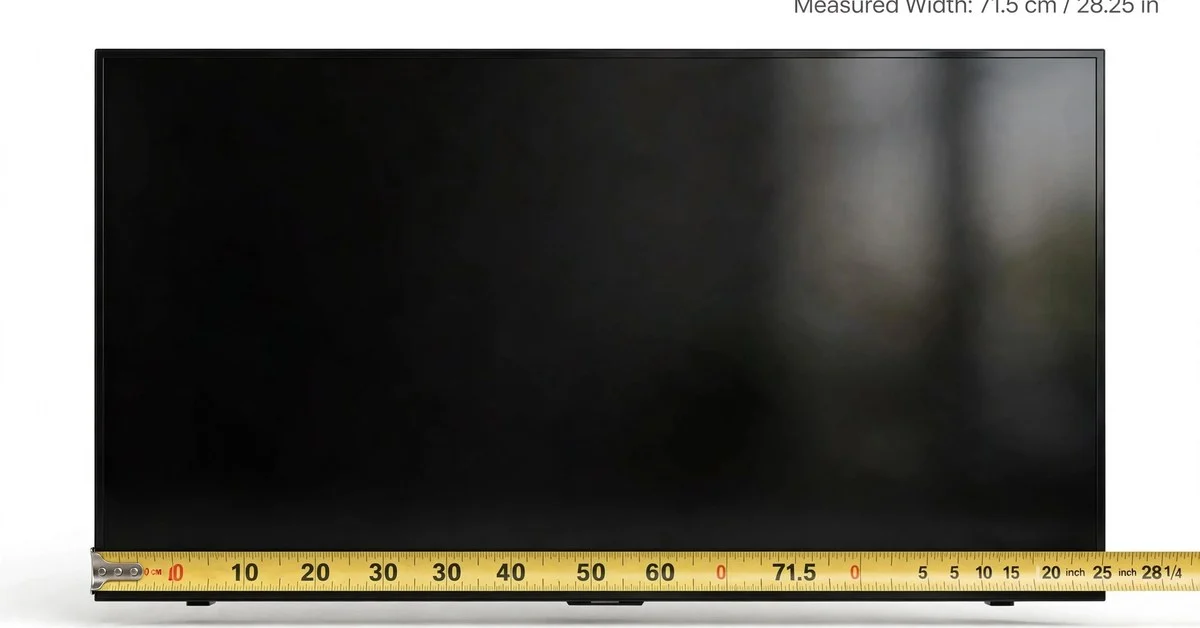
The 32-inch TV has lived three lives. First it was the giant — the flat screen that replaced the boxy 27-inch tube TV in the early 2000s and made the living room feel futuristic. Then it became the workhorse — the kitchen TV, the dorm TV, the guest-room TV, the screen you bought without thinking because it was cheap and it fit everywhere. Now it is living its third life as the specialist: the smallest screen that still feels like a real television, holding the line against monitors on one side and 43-inch upstarts on the other. A 32-inch TV measures about 27.9 inches wide and 15.7 inches tall, with the 32 inches referring to the diagonal. That is a screen just under two and a half feet wide — compact enough for a nightstand, legitimate enough for nightly viewing. Understanding the 32 means understanding the upgrade ladder it sits on: what it replaced, what it is better than, and what replaces it when you outgrow it.
The upgrade ladder, rung by rung
Every TV size is really an answer to the question “what did I have before?” — and the 32-inch TV’s answer has changed over the years. Two decades ago, the 32 replaced the 27-inch CRT television, and the upgrade felt enormous: the old tube was nearly two feet deep and weighed 80 pounds, while the flat 32 hung on a wall and showed a widescreen picture. The screen width jumped from about 22 inches of viewable tube to 27.9 inches of flat panel, and the depth collapsed from 20 inches to 3. Anyone who made that swap remembers it as the moment TV entered the modern age.
Today the 32’s most common predecessor is the 24-inch monitor. Millions of people “watch TV” on a 24-inch computer display — a screen about 20.9 inches wide — and stepping up to a 32-inch TV adds a full seven inches of width, a 33 percent wider picture. That jump crosses a psychological line: the 24 feels like a computer peripheral, while the 32 feels like a television. It is the smallest size where a room starts to arrange itself around the screen rather than the screen squeezing into the room’s leftovers. This is why the 32 remains the default recommendation for kitchens, dorms, and kids’ rooms — it is the entry point to proper TV-ness.
Above the 32 sits the 43, its natural predator. The 43’s screen is about 37.5 inches wide — nearly ten inches wider than the 32 — and it costs only modestly more. For a bedroom viewed from 6 to 8 feet, the 43 is the objectively better screen, and it is steadily eating the 32’s lunch in that role. What keeps the 32 alive is everything the 43 cannot do: fit on a 30-inch nightstand, tuck under kitchen cabinets, mount in an RV, or sell for the price of a dinner out. The ladder, then, runs 24-inch monitor to 32-inch TV to 43-inch TV, each rung roughly ten inches wider than the last. Know which rung you are on and the buying decision makes itself: if the 24 feels cramped, get the 32; if the 32 feels small from your viewing spot, skip straight to the 43.
What the numbers actually say
| Measurement | Inches | Centimeters |
|---|---|---|
| Diagonal (the advertised size) | 32 | 81.3 |
| Screen width | ≈ 27.9 | ≈ 70.8 |
| Screen height | ≈ 15.7 | ≈ 39.8 |
| Total width with bezel (typical) | ≈ 29–30 | ≈ 74–76 |
| Typical weight (without stand) | ≈ 8–12 lb | ≈ 4–5 kg |
The 32’s secret weapon is its weight: 8 to 12 pounds, light enough to hang on a single stud with a basic mount, light enough to carry under one arm, light enough that drywall anchors — while still not recommended — are at least in the realm of plausibility. The 27.9-inch width is the other key figure: it clears a standard 30-inch nightstand, fits between kitchen cabinets, and sits on a desk without crowding the keyboard. The VESA pattern is usually 100×100mm or 200×200mm, the two smallest standards, which means the cheapest mounts in the store fit it.
Fifteen objects that share the 32’s footprint
Each of these lands within a few inches of the 32-inch diagonal or the 27.9-inch width — small-room objects for a small-room screen.
- A 30-inch kitchen range. The standard American stove is 30 inches wide — two inches wider than the screen. Stand in your kitchen: the range’s width is the TV’s width, which is exactly why the 32 is the classic kitchen TV — it matches the scale of everything else in the room.
- An over-range microwave (30 inches wide). Built to span the same 30-inch opening as the range below it, the microwave’s width matches the screen within two inches. Kitchen dimensions and TV dimensions turn out to speak the same language.
- A 30-inch kitchen wall cabinet. The standard upper cabinet box is 30 inches wide — two inches past the screen width. The 32 tucks under these cabinets beautifully, which is no coincidence: both were designed around the same human scale.
- A large checked suitcase (about 32 inches tall). The biggest suitcases airlines accept stand roughly 30 to 32 inches tall — a direct match for the diagonal. It is also a practical preview of the TV’s box, which ships at roughly suitcase scale.
- A 28-inch tower fan. The slim oscillating fans that live in bedroom corners stand about 28 to 42 inches tall, with 28 a common compact size — four inches under the diagonal. A bedroom object for a bedroom TV.
- A 32-inch rolling duffel. The large wheeled duffels used for team travel and long trips run about 30 to 36 inches long, with 32 typical — an exact diagonal match. Athletes already own a 32-inch gauge in their gear bag.
- A 30-inch round side table. The small accent tables beside armchairs and beds commonly measure 30 inches across — two inches wider than the screen. Picture the tabletop: that is the picture’s width.
- A 32-inch freestanding pet gate. The folding gates that section off rooms for pets span about 32 inches per panel — an exact match for the diagonal. Unfold one where the TV would go and you have traced its reach.
- A 700c road bike wheel (about 28 inches). The standard adult road-bike wheel measures roughly 27 to 28 inches in diameter — four inches under the diagonal. A circle, not a rectangle, but the single-number size is instantly graspable.
- A 30-inch medicine cabinet. The wide mirrored cabinets in bathrooms run 24 to 30 inches, with 30 a common large size — two inches past the screen width. Your bathroom mirror is nearly as wide as this TV’s picture.
- A 30-inch lidded hamper. The tall laundry hampers with lids stand about 26 to 30 inches high — two inches under the diagonal. A humble bedroom object that happens to nail the number.
- A 30-inch range hood. Sized to match the 30-inch range below, the hood’s width is two inches past the screen width. Kitchens keep producing 30-inch objects because kitchens are built around the same human reach as small TVs.
- A 32-inch storage ottoman. The long ottomans that double as blanket storage run 30 to 40 inches wide, with 32 a common size — an exact width match. The footrest in your living room is as wide as this TV’s screen.
- A 30-inch wire dog crate. The medium crates sold for beagles and similar breeds measure 30 inches long — two inches under the diagonal. Another pet-world object that lands on the number.
- An oversized 32-inch wall clock. Statement wall clocks run 24 to 36 inches across, and 32-inch models are popular — an exact diagonal match. If one hangs in your kitchen, its diameter is the TV’s diagonal.
Where the 32 wins — and where it loses
The 32 wins on fit and price, and it is not close. No other TV size squeezes into as many places: the nightstand, the kitchen counter, the dorm desk, the RV dinette, the workshop wall, the treadmill console shelf. At 8 to 12 pounds it mounts anywhere, moves anywhere, and installs in minutes with the cheapest bracket on the shelf. And the price — often under half the cost of a 43 — makes it the obvious choice for rooms where the TV is secondary: guest rooms, kids’ rooms, garages. For those jobs, buying bigger is not an upgrade; it is a waste of money and space.
The 32 loses the moment viewing distance stretches past 7 feet. At 8 or 9 feet — a normal bedroom’s bed-to-wall distance — a 32-inch screen occupies a modest slice of your vision, and within a few months most viewers start wishing they had bought the 43. It also loses as a primary living-room TV, full stop: at 10-plus feet it looks like a large picture frame, not a television. The honest rule is distance-based. Under 6 feet of viewing distance — kitchen counter, desk, nightstand, dorm — the 32 is perfect and anything bigger is awkward. At 6 to 8 feet it is adequate but the 43 is better. Beyond 8 feet, the 32 is the wrong TV. Measure the distance, find your rung on the ladder, and buy accordingly — the 32 rewards the right room and punishes the wrong one.
Small-screen questions, answered
Is a 32-inch TV big enough for a kitchen?
It is the ideal kitchen size. Kitchens offer 4 to 6 feet of viewing distance — counter to wall — which lands squarely in the 32’s sweet spot of 4 to 5 feet. The 27.9-inch width fits under wall cabinets and on open counter sections, the light weight makes under-cabinet mounting simple, and the low price means cooking splatter and steam are annoyances rather than tragedies. Mount it at eye level from where you stand at the counter, usually with the screen center 55 to 60 inches off the floor.
What is the difference between a 32-inch TV and a 32-inch monitor?
Mostly the tuner, the speakers, and the price. A 32-inch TV includes a broadcast tuner, TV speakers, a remote, and smart-TV apps; a 32-inch monitor is a bare display meant for a computer, usually with better text sharpness but no tuner and weak or missing speakers. For watching shows from 5 feet away, the TV is the better buy and usually cheaper. For desk work at 3 feet, the monitor’s sharper text rendering wins. Some people buy the TV and use it as both — at 4K resolution it handles double duty well.
Can one person wall-mount a 32-inch TV alone?
Yes — it is the easiest TV to mount solo. At 8 to 12 pounds, you can hold it with one hand while securing the bracket with the other, though a second pair of hands is still safer. Use a fixed or tilt mount with a 100×100mm or 200×200mm VESA pattern, anchor into at least one stud with lag bolts, and set the screen center at seated eye level (40 to 45 inches) for bedrooms or standing eye level (55 to 60 inches) for kitchens.
How far should you sit from a 32-inch TV?
About 4 to 5 feet for the full experience. At 4 feet the screen fills a cinematic field of view; at 5 feet it is relaxed and comfortable. Closer than 3 feet, even 4K models start showing their pixel structure; beyond 7 feet, the picture feels small and a 43-inch set would serve you better. This short viewing distance is exactly why the 32 belongs in kitchens, dorms, and on desks — not in living rooms.
Is it worth buying a 4K 32-inch TV?
At typical 32-inch viewing distances of 4 to 6 feet, yes, you can actually see the difference — 4K packs four times the pixels of 1080p into that small screen, making text and fine detail visibly sharper. But the price premium only makes sense if you sit close; beyond 7 feet, the human eye cannot resolve the extra detail on a 32-inch screen, and a 1080p model looks identical. For a kitchen or dorm TV viewed from 5 feet, 4K is a genuine upgrade. For a guest room viewed from 9 feet, save the money.
See also: how big a 43 inch TV is.
See also: how big a 50 inch TV is.
Every ladder needs its first rung
The 32-inch TV endures because it is the honest entry point — the smallest screen that still earns the name television. At 27.9 inches wide and under 12 pounds, it fits the nightstand, the counter, the dorm desk, and the budget, and from 4 to 6 feet it delivers a genuinely satisfying picture. It replaced the tube TV, it beats the 24-inch monitor, and it holds its ground against the 43 everywhere space or money is tight. Just respect the ladder: buy the 32 for the small room it was made for, and when the viewing distance stretches past 7 feet, climb to the 43 without regret. Every home theater starts somewhere, and for millions of kitchens, dorms, and guest rooms, it starts right here — 32 inches, diagonal, done.

I’m Dane Whitfield, a content writer at MeasureZit.com, where I specialize in creating clear, accurate articles on measurements, unit conversions, and mathematical concepts. I enjoy breaking down complex numerical topics into simple, practical explanations that readers can actually use. My goal is always precision and clarity helping people make sense of the numbers around them.