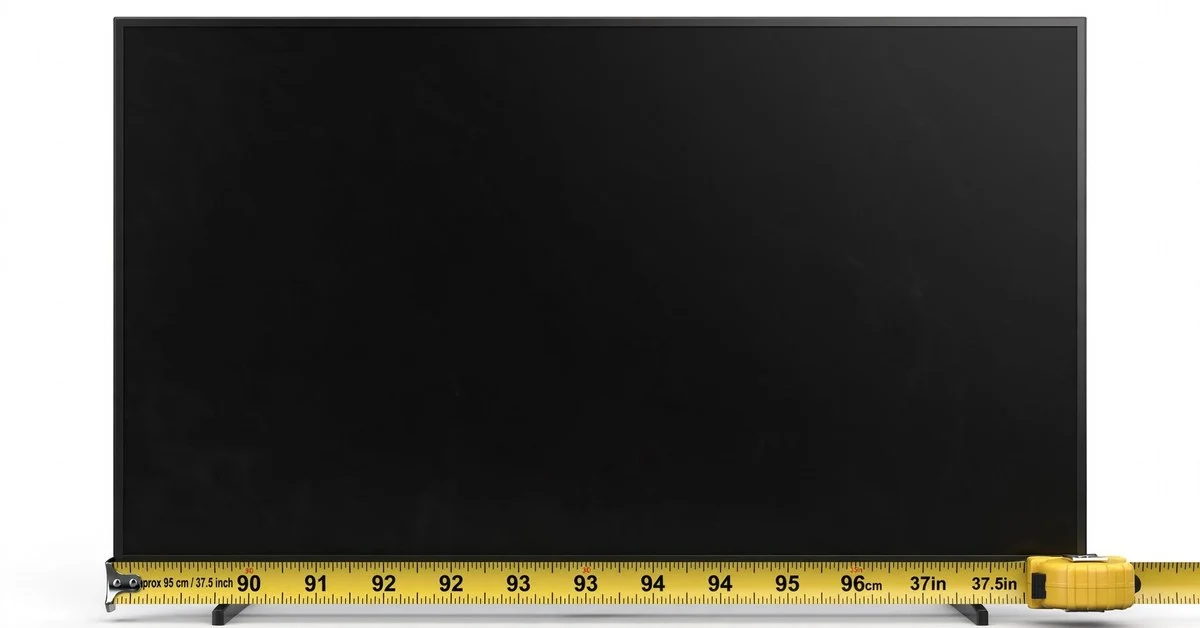
The 43-inch TV will never be the star of a home-theater magazine, and that is precisely its superpower. While everyone argues about 65 versus 75 inches for the living room, the 43 quietly sells millions as the second TV — the one for the bedroom, the kitchen, the dorm room, the garage gym, the home office. It is the size people buy after they have already bought the big one and realized that half of life happens in smaller rooms. A 43-inch TV measures about 37.5 inches wide and 21.1 inches tall, with the 43 inches referring to the diagonal. That footprint — just over three feet wide, under two feet tall — is the reason it fits on dressers, desks, and kitchen counters where bigger screens simply cannot go. But “small enough to fit” still requires checking. This guide runs the 43-inch TV through the bedroom test and its cousins, gives you the exact numbers, lines up fifteen small-room objects for scale, and helps you decide whether the 43 is your answer or whether you should size up or down.
The bedroom test: sizing the 43 for small rooms
The bedroom is where the 43-inch TV earns its keep, so let us run the test properly. Start with the surface: the screen is 37.5 inches wide, and the feet on most 43-inch models span 28 to 34 inches apart. That means it sits securely on any dresser, desk, or console at least 36 inches wide — which covers nearly every dresser ever made. Measure your surface’s width and depth (you need about 10 inches of depth for the feet). If the dresser is 40 inches or wider, the TV will look proportional, with a few inches of wood visible on each side.
Next, the viewing distance. In a bedroom you watch from bed, and the distance from pillow to wall is longer than people guess — usually 7 to 10 feet in a standard bedroom. The 43’s sweet spot is 5.5 to 7 feet, which means from a bed 9 feet away it will feel a touch small for cinematic viewing but perfectly fine for nightly news, sitcoms, and falling asleep to. If your bed-to-wall distance is under 8 feet, the 43 is genuinely ideal. Beyond 10 feet, step up to the 50.
Now run the same test for the other small rooms where the 43 shines. In the kitchen, it mounts under a cabinet or on a bare wall section at least 40 inches wide — check that the 21-inch screen height plus mount clears the backsplash and any shelving. In a dorm room, the 37.5-inch width fits on the standard 42-inch dorm desk with room for a laptop beside it, and the light weight (usually under 20 pounds) means one person can wall-mount it with a basic tilt bracket. In a home office, it doubles as a giant monitor at 3 to 4 feet of distance — glorious for spreadsheets, though text that small benefits from bumping up the display scaling. In a garage gym, mount it high enough that a kettlebell swing cannot reach it: the bottom of the screen should clear 5 feet off the floor. The 43 passes all of these tests because it was designed for exactly this life — big enough to watch properly, small enough to go anywhere.
Exact dimensions, no guessing
| Measurement | Inches | Centimeters |
|---|---|---|
| Diagonal (the advertised size) | 43 | 109.2 |
| Screen width | ≈ 37.5 | ≈ 95.2 |
| Screen height | ≈ 21.1 | ≈ 53.5 |
| Total width with bezel (typical) | ≈ 38.5–39.5 | ≈ 98–100 |
| Typical weight (without stand) | ≈ 15–20 lb | ≈ 7–9 kg |
The number that matters most for small rooms is the width: 37.5 inches of picture, just under 40 with the frame. That is just over three feet of picture — think of a 36-inch round bistro table with an inch to spare on each side — which tells you everything about how undemanding this TV is. The light weight is the other quiet advantage — at 15 to 20 pounds, a 43-inch TV is the largest size most people can safely wall-mount solo, and it works with inexpensive tilt mounts rather than the heavy-duty brackets bigger screens demand. The VESA pattern is usually 200×200mm, the standard small-TV pattern that every universal mount supports.
Fifteen small-room size references
Every object below lands within a few inches of the 43-inch diagonal or the 37.5-inch width — and every one of them lives in the kind of small room where this TV belongs.
- A 42-inch round dining table. The four-top round tables in kitchens and breakfast nooks commonly measure 42 inches across — one inch shy of the diagonal. If one fits your eat-in kitchen, a 43-inch TV’s diagonal fits the same wall.
- A 42-inch ceiling fan. The mid-size ceiling fan, a step down from the big 52-inch models, spans 42 inches blade tip to blade tip — one inch under the diagonal. Look up in a bedroom: that span is the TV’s corner-to-corner reach.
- A 40-inch soundbar. Soundbars run 36 to 55 inches, and 40-inch models are common for mid-size TVs. Two and a half inches wider than the screen, a 40-inch soundbar sitting under the TV gives you a live preview of the screen’s width every day.
- A dorm-room desk (about 42 inches wide). Standard dorm desks run 36 to 42 inches wide. The 37.5-inch screen fits on one with room to spare — the reason the 43 is the default dorm upgrade. If the desk fits the room, the TV fits the desk.
- A 3-drawer dresser (about 40 inches wide). The classic small dresser is roughly 40 inches wide and 18 inches deep. The TV’s feet land comfortably on top with inches to spare — measure yours, but the odds are strongly in your favor.
- A 38-inch ultrawide monitor. The big curved monitors on office desks measure about 38 inches diagonally — essentially identical to the TV’s 37.5-inch width. If you have ever thought “that monitor is huge,” you now know exactly how wide a 43-inch TV is.
- An extra-large 42-inch dog bed. The big rectangular dog beds sold for large breeds run about 42 by 30 inches — one inch under the diagonal. The dog already claimed the coziest spot in the bedroom; the TV just needs the wall.
- A 42-inch entryway bench. Hallway benches commonly run 36 to 48 inches, with 42 a popular size — one inch shy of the diagonal. Another piece of small-room furniture that speaks the same dimensional language as this TV.
- A 40-inch wall mirror. Round and rectangular wall mirrors are commonly sold in 40-inch sizes — 2.5 inches wider than the screen. Hang one mentally where the TV would go and you have the width within a couple of inches.
- A 3-shelf bookcase (about 42 inches tall). The short bookcases that fit under windows stand roughly 36 to 42 inches high. Tip 42 inches of bookcase on its side and you have the TV’s diagonal — a useful image for low bedroom walls.
- A 40-inch bar cart. The rolling carts that hold bottles and glassware run about 36 to 42 inches wide, with 40 common — 2.5 inches wider than the screen. A glamorous little gauge for a practical measurement.
- A 36-inch bathroom vanity. The standard single-sink vanity is 36 inches wide — an inch and a half narrower than the screen. A slightly conservative width reference hiding in every hallway bathroom.
- A 42-inch fireplace screen. The flat screens that guard fireplace openings run 38 to 44 inches wide, with 42 typical — one inch under the diagonal. If you are sizing a TV for a room with a fireplace, the screen guarding it is your measuring stick.
- A 40-inch rolling tool chest. The mid-size mechanic’s chests run about 40 inches wide — 2.5 inches past the screen width. For the garage-TV planner, the toolbox against the wall already marks the width.
- A 42-inch freestanding pet gate. The wide folding gates used to section off rooms span about 42 inches — one inch under the diagonal. Unfold one where the TV would sit and you have traced its reach.
The 43-inch decision: when it is right and when it is not
The 43 occupies a very specific niche, and knowing its borders saves you from buying wrong in either direction. Step down to a 32-inch TV and the screen shrinks to about 27.9 inches wide — nearly ten inches narrower. That is a visible, meaningful drop: the 32 feels like a large monitor where the 43 feels like a proper television. If the TV is the room’s main screen and you sit more than 7 feet away, the 32 will feel small within a month. The 32 only wins when the space is truly tight — a kitchen counter nook, a small dorm desk — or the budget is truly fixed.
Step up to a 50-inch TV and the width grows to about 43.6 inches — six inches wider than the 43. On the wall that reads as a real upgrade, and at bedroom distances of 8 to 10 feet the 50 delivers a noticeably more cinematic picture. The 50 costs only a little more and still fits most dressers, which is why it is the 43’s fiercest rival. Choose the 43 when the room is genuinely small — under 8 feet of viewing distance, a 36-inch dresser, a dorm, a kitchen — or when the TV is strictly secondary. Choose the 50 when the bedroom is standard-size and this will be your nightly screen. And if you are putting it in a living room as the main TV, skip both and start at 55: the 43 in a living room is the single most common size regret in TV buying.
Bedroom-TV questions, answered
What size TV is best for a 12×12 bedroom?
A 43 or 50-inch TV. In a 12-by-12 room the bed-to-wall distance usually runs 8 to 10 feet, which puts you at the far end of the 43’s comfort zone and the near end of the 50’s. If you watch mostly before sleep — news, sitcoms, YouTube — the 43 is plenty and its 37.5-inch width fits any dresser. If movie nights happen in bed, the 50’s extra six inches of width is worth it. Either way, mount or place it so the screen center hits 40 to 45 inches off the floor as seen from your pillow height.
Can a 43-inch TV work as a computer monitor?
Yes, with one adjustment. At a desk distance of 3 to 4 feet, a 43-inch 4K screen gives you the desktop area of four 21-inch monitors without bezels in between — spectacular for video editing, trading, and spreadsheets. The catch is pixel density: at that closeness, run your operating system’s display scaling at 125 to 150 percent so text stays readable. Also confirm the TV has a low-latency “game” or “PC” mode to keep mouse movement feeling instant.
How much does a 43-inch TV weigh for wall mounting?
Typically 15 to 20 pounds without the stand — light enough for one careful person to lift and hold while a second person secures the bracket, or for one person with a French cleat-style mount. Use a tilt mount rated for at least 40 pounds with a 200×200mm VESA pattern. Even at this weight, anchor into at least one stud; drywall-only mounting is never worth the risk above a dresser full of breakables.
Is 43 inches too small for a living room?
For a main living-room TV, yes, in most cases. Living-room seating typically sits 9 to 12 feet from the screen, where a 43-inch picture occupies a modest slice of your vision — fine for background viewing, underwhelming for movies and sports. The 43 belongs in bedrooms, kitchens, dorms, offices, and gyms. For a living room’s primary screen, 55 inches is the modern starting point, with 65 the sweet spot for rooms with 9-plus feet of viewing distance.
What is the best height to place a bedroom TV?
Lower than you think. Because you watch from bed with your head on a pillow, your eye level is lower than couch eye level — often 36 to 42 inches off the floor rather than the usual 40 to 45. Place the screen’s center at your reclined eye level: for most bed setups that means the bottom of a 43-inch screen sits about 24 to 30 inches off the floor. Too high is the classic bedroom mistake — craning upward from a pillow gets uncomfortable within an hour.
See also: how big a 32 inch TV is.
See also: how big a 55 inch TV is.
The right size for the second screen
The 43-inch TV is not trying to be the biggest screen in your life — it is trying to be the most useful one. At 37.5 inches wide and under 20 pounds, it goes where the home-theater giants cannot: the dresser, the dorm desk, the kitchen wall, the garage gym. Run the bedroom test before you buy — measure the surface, pace off the pillow-to-wall distance, tape the 37.5-by-21-inch rectangle on the wall — and the 43 will reward you by fitting on the first try and feeling exactly right from 6 to 8 feet. It is the rare TV size with almost no regrets attached, precisely because nobody buys it expecting a cinema. They buy it expecting a good screen in a small room, and that is exactly what it delivers, night after night.

I’m Priya Sharma, a content writer at MeasureZit.com, specializing in measurements, unit conversions, and mathematical concepts. I turn technical topics into clear, accurate content that’s easy to understand. My focus is precision, clarity, and genuinely useful information.










