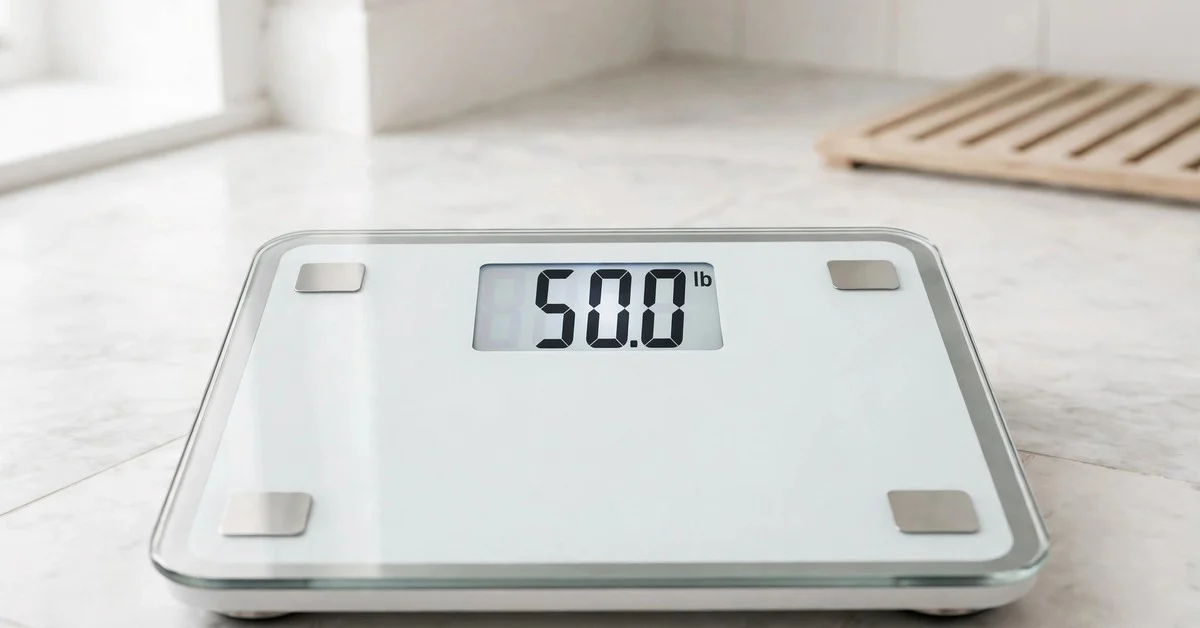
Fifty pounds is the weight that makes you grunt. Not the theatrical grunt of a heavy deadlift, but the small involuntary sound of a body confirming that yes, this is heavy, and yes, we are doing it anyway. It is the airline checked-bag limit, the standard bag at the hardware store, the load that turns a quick chore into a planned operation. A 50-pound object is liftable by one person and regrettable by one person, which is exactly why it deserves its own mental reference.
Knowing what 50 pounds feels like pays off in avoided surprises: the overweight baggage fee, the second trip you should have planned, the moment you realize the bag isn’t going in the trunk the way you pictured. This guide covers the exact numbers, fifteen everyday objects that weigh about 50 pounds, and the gym plate math: how to build exactly 50 pounds from standard plates, so lifters can feel the number under controlled conditions.
Fifty pounds in numbers
Fifty pounds is 800 ounces, about 22,680 grams, or 22.68 kilograms. It is five 10-pound bags stacked, ten 5-pound bags, or fifty single pounds, which makes it beautifully decomposable: almost any heavy object can be estimated by counting how many 10-pounders it contains. In water terms, 50 pounds is just about six gallons, since six times 8.34 equals 50.04, a coincidence so neat it feels designed.
The reason 50 pounds recurs as a commercial and regulatory standard is that it sits near the top of safe solo lifting. Airlines cap checked bags there because baggage handlers lift thousands of bags a day; hardware stores bag concrete and sand there because customers can still get it into a trunk. It is the heaviest weight that ordinary life expects ordinary people to handle alone, which makes it the most important heavy reference to own.
Gym plate math: building 50 pounds from plates
The gym is the one place where 50 pounds can be assembled to the ounce, and learning the plate combinations teaches the weight more precisely than any bag of concrete. Standard plate denominations in American gyms are 45, 35, 25, 10, 5, and 2.5 pounds. The rule for barbells: plates must match on both sides, so you build half the target per side and double it.
The clean fifty. One 25-pound plate per side: 25 plus 25 equals 50. This is the simplest build, two big plates, and the one to start with. Load them, lift the bar off the rack, and walk it a few steps. That is 50 pounds, honest and balanced, with no packaging and no awkward shape to blame.
The small-plate fifty. Two 10s and a 5 per side: 10 plus 10 plus 5 equals 25 per side, 50 total. This version teaches something the clean fifty doesn’t: how the same weight feels when it’s distributed across more pieces. It feels identical on the bar, which is the lesson. Weight is weight; only the package changes.
The change-plate fifty. Five 5-pound plates per side, or any combination summing to 25: 10 plus 5 plus 5 plus 2.5 plus 2.5, for example. Fiddly to load, instructive to lift. This is how you learn that 50 pounds is just twenty-five twice, and twenty-five is just small numbers added patiently.
The dumbbell fifty. Two 25-pound dumbbells, one in each hand: the balanced carry from the grocery-bag world, scaled up. Or a single 50-pound dumbbell, hugged or carried. The pair teaches symmetry; the single teaches respect. Most lifters find the single 50 harder than the barbell 50, because the dumbbell offers no rack, no symmetry, and nowhere to hide a weak grip.
The metric fifty. In kilogram gyms, plates run 25, 20, 15, 10, 5, 2.5, and 1.25 kilograms. Fifty pounds is 22.68 kilograms, so load 10 plus 1.25 per side: 11.25 kilograms per side, 22.5 total, which is 49.6 pounds, close enough that no human could tell. This is also a neat demonstration of why the kilogram lifters think in 2.5s: the small plates are the fine-tuning knobs of the system.
Form notes for the test lift. Whether barbell or dumbbell, the 50-pound lift is a form check, not a strength test. Feet flat, knees bent, back straight, weight close to the body, breathe out on the effort. If 50 pounds breaks your form, the number has done its job: it told you the truth before a heavier weight could. Practice the lift until 50 pounds feels boring. Boring is the goal; boring means owned.
The farmer’s carry final exam. The true test of owning 50 pounds isn’t the deadlift, it’s the farmer’s carry: a heavy dumbbell or kettlebell in each hand, 25 to 50 pounds per side, walked for distance. Two 25-pound dumbbells carried forty yards will tax your grip, your posture, and your breathing in a way the barbell never does, because nothing is racked and nothing is symmetric about a walk. Strongman competitors treat the farmer’s carry as a core event for exactly this reason: it converts the abstract number into a full-body negotiation. Start with the pair of 25s, walk slowly, set them down before your grip fails rather than after. When you can carry the fifty and chat at the same time, the number is yours, and every bag, box, and suitcase after that gets judged against a standard your body trusts.
Fifteen 50-pounders from garages to gyms
- An Olympic barbell plus a 5-pound plate. The bar alone is 45 pounds; add a single 5-pound plate and you have exactly 50. It is the most literal 50 pounds in existence.
- Two 25-pound dumbbells. One in each hand, 50 pounds total, perfectly balanced. The two-handed carry that calibrates the whole body at once.
- A 4-foot heavy boxing bag. About 50 pounds of packed fill hanging from a chain. Boxers move these regularly, and the swinging dead weight is the least cooperative 50 pounds on this list.
- A flat weight bench. About 50 pounds of steel and padding. Gym owners carry these more than anyone, usually through doorways, which adds a coordination tax.
- A small portable generator. About 50 to 60 pounds. The boxy shape and single handle make it the classic awkward carry, heavy enough to demand planning.
- A 10-foot recreational kayak. About 45 pounds of plastic. The length is the challenge: 45 pounds is manageable, 10 feet of it in the wind is a second sport.
- An electric bike. About 55 pounds with the battery. E-bike owners learn this weight carrying it up apartment stairs, the modern 50-pound commute.
- A compact mini-fridge. About 50 pounds. Dorm move-in day is a festival of these, carried up stairs by people meeting 50 pounds for the first time.
- A 1-cubic-foot bag of topsoil. About 45 pounds of dense, damp earth. Gardeners drag these from car to bed every spring, the seasonal 50-pound ritual.
- Two 2-cubic-foot bags of mulch. About 25 pounds each, 50 together. The two-bag carry teaches the balanced-pair lesson at full scale.
- A standard wooden pallet. About 40 to 50 pounds of lumber and nails. Warehouse workers handle hundreds a day; the rest of us meet one during a DIY project.
- A sheet of 1/2-inch plywood. A 4-by-8 sheet weighs about 50 pounds. The sail area makes it feel heavier in any breeze, which is why two people carry plywood.
- A 15-gallon potted tree. Pot, soil, and tree together run 50 to 60 pounds. Nursery workers move these by the dozen, hugging the pot and waddling.
- An adult border collie. About 45 pounds of muscle and opinion. The only 50-pounder on this list that can decide to become 60 pounds by leaning.
- A full 5-gallon water-cooler bottle. Five gallons at 8.34 pounds each is 41.7 pounds, plus the bottle, landing near 44. The smooth plastic and sloshing water make it feel like the full 50.
Fifty pounds at work: the jobs built around it
Step outside the home and 50 pounds stops being a reference and becomes a job description. Whole occupations are organized around this number.
Movers. Professional movers pack to the 50-pound box as a discipline: heavy enough to be efficient, light enough to carry all day. Boxes get labeled, weight gets distributed, and the crew rule is absolute, nobody heroes a box that should be a team lift. The moving industry’s injury statistics are a monument to what happens when 50 pounds meets bad form repeatedly.
Warehouses. The 50-pound bag, concrete, feed, salt, is the standard unit of the warehouse floor because forklifts and pallet jacks take it from there. Human hands move it from pallet to shelf to cart, and back again. Ergonomics research, notably the NIOSH lifting equation, puts the maximum recommended load under ideal conditions at about 51 pounds, which is why the 50-pound bag exists at all: it’s the heaviest thing the science says a person should lift solo, in perfect conditions, once.
Farms. Feed bags, seed bags, fertilizer bags: agriculture runs on 50-pound sacks, and farm kids learn the lift early, knees bent, bag hugged close, exactly the form the safety posters show. The difference between farm work and gym work is repetition: the fiftieth bag of the day is lifted by a different body than the first, which is why experienced hands pace, rotate, and never skip the cart when one’s available.
Delivery. The 50-pound dog food bag, the 50-pound box of copy paper, the overweight parcel: delivery drivers meet the limit daily, on doorsteps, in weather, against the clock. Their professional technique, dolly first, stairs planned, signature captured before the lift, is worth copying for anyone moving something heavy at home.
The pattern across all four: 50 pounds is the weight that professionals respect and amateurs underestimate. The pros have form, equipment, and rules. Borrow all three and the fifty stays boring, which, as ever, is the goal. And the next time a box, a bag, or a piece of furniture asks for a decision, run the numbers first: count the 10-pounders inside it, check your form, and choose the cart without shame.
Questions about lifting and moving 50 pounds
Can one person safely lift 50 pounds?
Most healthy adults can, with good form: bend the knees, keep the back straight, hold the load close, and avoid twisting while lifting. The risk isn’t the single lift but repetition: workplace guidelines treat 50 pounds as about the maximum for occasional solo lifting, and much less for repeated lifts. When in doubt, split the load or get a second person; backs are expensive.
Why do airlines limit checked bags to 50 pounds?
Worker safety. Baggage handlers lift thousands of bags per shift, and 50 pounds is the negotiated ceiling where a fit worker can lift all day without rapid injury. The overweight fee isn’t really about the airplane’s capacity; it’s the price of asking a human to repeatedly exceed the safe solo limit. Pack to 48 and everyone stays happy.
How many gallons of water weigh 50 pounds?
Almost exactly six. At 8.34 pounds per gallon, six gallons total 50.04 pounds, a coincidence close enough for any practical purpose. This is why the “six jugs” image is the standard mental model for 50 pounds of anything liquid.
Is 50 pounds heavy for a deadlift?
For a beginner, it’s a respectable working weight and an excellent form teacher. For an experienced lifter, it’s a warm-up. The value of the 50-pound deadlift isn’t the strength it builds but the honesty it enforces: at 50 pounds you can still feel every form flaw, which makes it the perfect weight for grooving the movement before adding plates.
What’s the best way to move a 50-pound bag without carrying it?
Don’t lift what you can slide, roll, or tip. Drag the bag on a tarp, tip it end over end, or use a hand truck; a $30 dolly turns 50 pounds into a steering problem instead of a lifting problem. For stairs, the two-person carry with one person above and one below beats any solo heroics, every time.
See also: what weighs 10 pounds.
See also: what weighs 1 pound.
Own the fifty
What weighs 50 pounds? The barbell with a small plate, the pair of dumbbells, the kayak, the e-bike, the mini-fridge, the pallet, the plywood sheet, the water-cooler bottle: the heavy inventory of garages, gyms, and garden centers. And now you can build it to the ounce from plates, feel it balanced across two hands, and recognize it as five 10-pounders stacked in your mind. Fifty pounds is the border between a casual lift and a planned one. Plan it, lift it well, and it stays exactly what it should be: heavy, but handled.

I’m Dane Whitfield, a content writer at MeasureZit.com, where I specialize in creating clear, accurate articles on measurements, unit conversions, and mathematical concepts. I enjoy breaking down complex numerical topics into simple, practical explanations that readers can actually use. My goal is always precision and clarity helping people make sense of the numbers around them.










