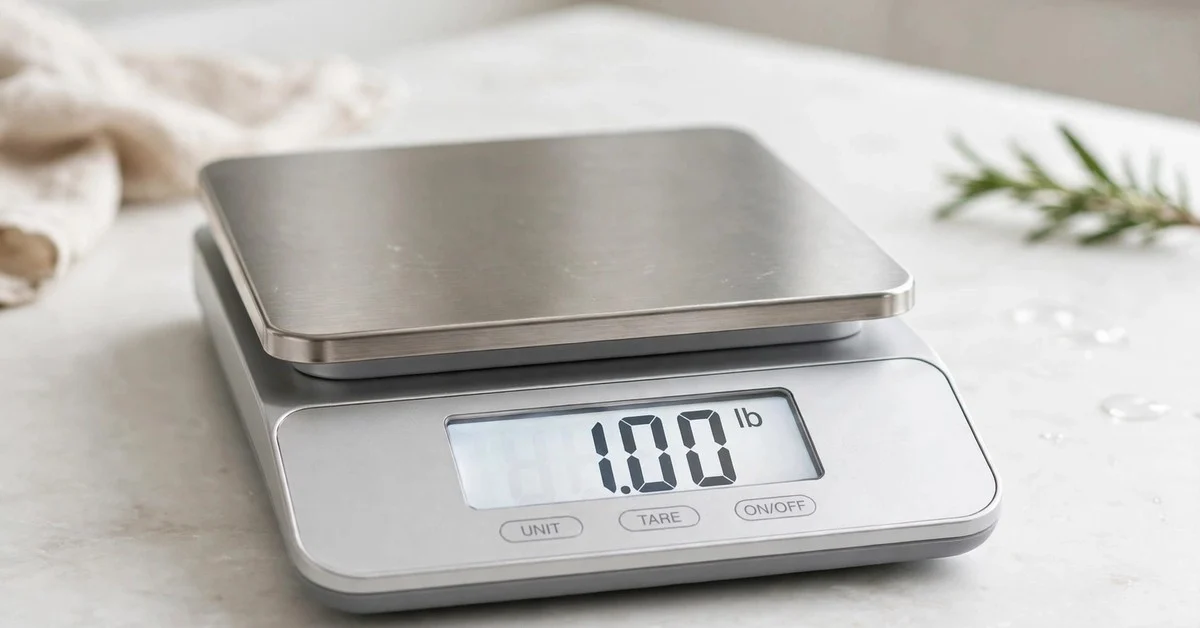
The package needs one more stamp or it doesn’t. The recipe says a pound of flour and your scoop looks close, but close is doing a lot of work in that sentence. One pound, 16 ounces, about 454 grams, is the weight where guessing starts to cost real money and real results, and it is also the weight your kitchen scale was born to measure. The trouble is that kitchen scales lie a little: they drift, their batteries sag, and a scale that read true last year can be an ounce off today.
The fix is an anchor: a household object you know weighs exactly one pound, kept where you can grab it, used to interrogate your scale whenever accuracy matters. This guide gives you the exact conversions, fifteen grocery-aisle objects that weigh about a pound, and the calibration routine that turns any of them into a reference standard for your kitchen.
The 1-pound anchor: calibrating your kitchen scale
Kitchen scales are precise but not permanently honest. A strain-gauge scale, which is what nearly every digital kitchen scale is, can drift with temperature, battery level, and plain age. An ounce of drift is invisible in daily cooking and decisive in two situations: baking, where a pound of flour measured as 15 ounces instead of 16 throws off hydration, and postage, where an ounce over the limit buys a surcharge. The calibration routine below takes ninety seconds and needs nothing you don’t already own.
Step one: pick your anchor. Choose one object from the list below whose weight is exact, not approximate: a 16-ounce tub of sour cream, a 16-ounce container of cottage cheese, a 1-pound bag of baby carrots, a 1-pound bag of frozen peas, a 16-ounce package of bacon, or a 1-pound box of crackers. “16 oz” or “1 lb” printed on the package is your certificate. Keep the chosen anchor unopened if you can; an opened package loses crumbs and grams.
Step two: zero and test. Set the scale on a hard, level surface, not the edge of the counter and never on a towel. Power it on, let it settle to zero, and place the anchor dead center. It should read 16.0 ounces or 454 grams. If it reads 15.7 or 16.4, your scale has drifted, and now you know by how much. Many scales have a calibration mode, but even without one, knowing the offset lets you correct every measurement mentally.
Step three: test the range. One point doesn’t prove a scale. Add a second known weight, two 1-pound bags of carrots should read 32 ounces, or check the low end with something small. Scales often drift more at the extremes of their range, so verifying at both 1 pound and a few ounces tells you whether the drift is a simple offset or a slope. Write the offset on a piece of tape stuck to the scale’s underside; future you will be grateful.
Step four: know when it matters. For weeknight cooking, skip the ritual; a quarter-ounce never ruined a stew. For bread, where flour is often measured by weight and 454 grams is the standard “pound” in many recipes, calibrate. For mailing packages near a postage threshold, calibrate. For portioning anything you sell or share by weight, calibrate. The anchor turns the scale from a guess with a display into an instrument.
The tare trick. Calibration’s quiet partner is the tare button. Weighing flour? Set the bowl on the scale, tare to zero, add flour to 454 grams. Weighing a pound of ground meat in its tray? Tare the tray, add meat to 16 ounces. The anchor verifies the scale; the tare button removes the container from the math. Together they are the whole of kitchen weighing, and both take seconds.
When to replace the scale. Calibration tells you the offset; it can’t fix a dying scale. Replace it when the reading wanders with nothing on the platform, when the same anchor reads differently five minutes apart, or when the low end goes blind, a scale that can’t register a nickel’s 5 grams has lost its fine range. Cheap scales also hate cold: a scale stored near the stove or in an unheated pantry will drift with the room. Fifteen to twenty dollars buys a new one, which is less than the postage overcharges a bad scale causes in a year of selling online. The anchor outlives every scale you’ll own; the scale is disposable, the habit isn’t.
Fifteen 1-pounders from the grocery aisles
Walk the store with a pound in mind and the shelves start volunteering references. Every item below weighs about a pound; the packaged ones say so on the label.
Dairy aisle
- A 16-ounce tub of sour cream. Exactly one pound, printed on the lid. Dense, compact, and already in the fridge door, it is one of the best calibration anchors on this list.
- A 16-ounce container of cottage cheese. Another exact pound. The tub’s wide footprint sits stably on a scale platform, which makes it ideal for the calibration test.
Produce aisle
- A 1-pound bag of baby carrots. Sold by the pound, labeled by the pound. The bag is light and crinkly around exactly 16 ounces of carrots, a good lesson in packaging versus contents.
- Three medium apples. A medium apple weighs about 5 to 6 ounces, so three of them land right around a pound. Produce workers think in this unit; now you can too.
- Two large onions. A large onion runs about 8 ounces, so two make the pound. The papery skins add almost nothing, which keeps the math honest.
Meat and packaged goods
- A 16-ounce package of bacon. Exactly one pound of bacon, and the flat package sits perfectly on a scale. Breakfast’s favorite calibration weight.
- A 15-ounce can of beans, unopened. The can plus its liquid runs about 1.1 pounds, just over the mark. It teaches the useful skill of feeling “a pound plus a bit.”
- A 1-pound bag of frozen peas. Exactly one pound, cold and lumpy. Freezer-aisle anchors have a bonus: the bag doubles as the household ice pack.
- A 1-pound box of crackers. Exactly one pound of crackers in a box that looks like much more. Like the pasta box, it demonstrates how air and packaging inflate volume without adding weight.
- A pack of 10 flour tortillas. About 1.2 pounds for the pack. Slightly over the pound, which makes it good practice for estimating past the anchor.
Bakery, frozen, and beyond
- A pint of ice cream. A pint is 16 fluid ounces of volume, and ice cream’s density puts the tub at about a pound of actual ice cream. The most enjoyable pound on this list.
- An empty wine bottle. A standard empty wine bottle weighs about 1.1 pounds of glass. Recycling day is full of these near-pound references.
- A 500-milliliter bottle of olive oil. Half a liter of oil plus its glass bottle runs about 1.1 pounds. The pantry holds this one year-round.
- A 16-ounce bike bottle full of water. Sixteen fluid ounces of water weigh just over a pound, plus the bottle. Cyclists carry this pound on every ride without thinking about it.
- A hardcover picture book. A typical children’s picture book weighs about a pound. It is the only item here measured in stories rather than servings.
One pound in numbers
| Unit | One pound equals |
|---|---|
| Ounces | 16 oz |
| Grams | 453.6 g |
| Kilograms | 0.454 kg |
| Fluid ounces of water (volume) | ~15.3 fl oz by volume* |
| Sticks of butter | 4 sticks |
| Cups of all-purpose flour (approx.) | ~3.6 cups |
*A subtlety worth knowing: 16 ounces of weight is not 16 fluid ounces of volume except for water-like liquids. Sixteen fluid ounces of water actually weighs about 16.7 ounces (1.04 pounds), because a fluid ounce of water weighs a touch more than an avoirdupois ounce. For water, think “a pint’s a pound” as a handy approximation; for everything else, weight and volume go their separate ways.
The pound in the wild: postage, portions, and produce
The calibrated pound earns its keep in three everyday arenas where an ounce either way costs money.
Postage. The pound is the most common price break in shipping. USPS Ground Advantage, for example, prices in bands where crossing from 15.9 ounces to 16.1 ounces jumps the rate, and private carriers build their own brackets around the pound. Sellers who weigh every package catch the ones that drift over; sellers who guess donate the difference. Your calibrated scale plus the anchor is the whole business: weigh, compare to 16 ounces, decide.
Produce. The per-pound price tag is a mental math exercise everyone runs: at $3.99 a pound, three apples at roughly a pound cost roughly four dollars. Knowing the pound by feel turns the produce aisle into honest arithmetic instead of register roulette. It also exposes the packaging tricks: the “value pack” priced per bag versus the loose fruit priced per pound can only be compared through the pound.
Portions. The pound is the natural unit of feeding people. A pound of dry pasta serves about four, which is why the 16-ounce box is dinner’s default. A quarter-pounder is 4 ounces of beef before cooking, the number in the name. A pound of ground coffee brews roughly forty 6-ounce cups at standard strength. Learn these three and the pound stops being abstract: it’s dinner for four, a burger’s name, and a week of mornings.
In all three arenas the pattern is the same: the pound is the boundary where estimation becomes transaction. Below it, guessing is harmless. At it and above it, someone is paying. That’s why the anchor matters, and why ninety seconds with a sour-cream tub is the cheapest insurance in the kitchen. Keep the anchor where you can grab it without thinking, a specific tub, a specific bag, always the same one, and the calibration becomes reflex instead of ritual.
Questions about pounds, scales, and portions
Why does my scale read differently on the counter versus the table?
Strain-gauge scales are sensitive to flex. A countertop with a slight bow, a scale sitting half on a tile edge, or a soft mat underneath all let the scale’s feet load unevenly, which reads as phantom ounces. Always weigh on a hard, flat, level surface with all four feet fully supported. If the reading changes when you rotate the scale, the surface is the problem, not the scale.
Is a pound of feathers the same as a pound of bricks?
Yes, on any scale you will ever own. The riddle plays on volume, not weight: a pound is a pound. The feathers fill a room and the bricks fit in a shoebox, but the scale reads 16 ounces for both. It is the same lesson as the cracker box on the list above: packaging and air change the look, never the weight.
How many grams should I use for “one pound” in a recipe?
454 grams is exact; 450 grams is the common kitchen rounding and works fine for nearly everything. Bread bakers sometimes use 500 grams and call it a pound for simplicity, which is actually 10 percent over, so check which convention your recipe follows before scaling. When in doubt, 454.
Can I calibrate a scale without a known weight?
Approximately. Coins are minted to tight tolerances: a US nickel weighs exactly 5 grams, so 91 nickels make about 454 grams, a pound. It is fiddly but genuine metrology in a pinch. Water is easier: 454 milliliters of water weigh 454 grams, so a measuring jug gets you a true pound without any special equipment.
Why do recipes say “a pound of pasta” instead of a volume?
Because a pound is exact and a box is not. Dry pasta settles, boxes vary, and “half the box” depends on the box. Sixteen ounces is sixteen ounces in every kitchen, which is why serious recipes specify weight. Your new calibration habit is what makes that specification trustworthy.
See also: what weighs 10 pounds.
See also: what weighs 2 pounds.
Keep the anchor handy
What weighs 1 pound? The sour cream tub, the bag of baby carrots, the package of bacon, three apples, the pint of ice cream: a whole grocery store of answers, each about 16 ounces. But the real prize isn’t the list, it’s the habit. Pick one exact-pound item, keep it where you can grab it, and spend ninety seconds checking your scale whenever the measurement matters. Baking gets more reliable, postage gets cheaper, and the quiet confidence of knowing your pound is a true pound carries into every recipe. Sixteen ounces, verified. That’s a pound you can trust.

I’m Owen Reeves, a content writer at MeasureZit.com, specializing in measurements, unit conversions, and mathematical concepts. I turn technical topics into clear, accurate content that’s easy to understand. My focus is precision, clarity, and genuinely useful information.










