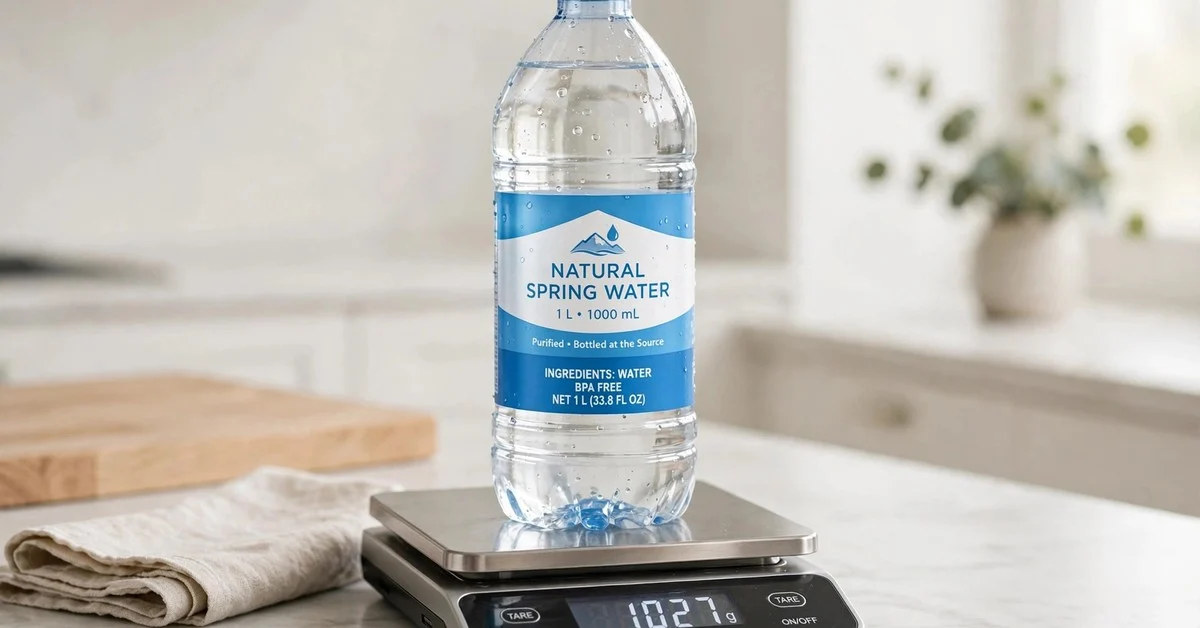
There is a small pleasure in holding a liter bottle of water in an airport in a foreign country and knowing, without checking, exactly how heavy it is. One liter of water weighs exactly 1 kilogram, or about 2.2 pounds. No conversion chart, no rounding, no asterisks. It is the tidiest fact in all of everyday measurement, and it is not a coincidence: the kilogram was originally defined as the mass of one liter of water, so the bottle in your hand is the definition made drinkable.
That single clean number unlocks the whole metric system in your head. A milliliter of water weighs a gram. A liter weighs a kilogram. A cubic meter, a thousand liters, weighs a full metric ton. And because most of the world buys drinking water by the liter, the kilogram stops being an abstraction and becomes something you carry, pour, and drink every day. This guide covers the exact conversions, fifteen everyday objects that weigh about a kilogram, and the hydration math: how many bottles a day your body actually asks for.
One liter, one kilogram: the numbers
At about 39°F (4°C), one liter of water weighs exactly 1 kilogram: 1,000 grams. In imperial terms that is 2.20462 pounds, usually rounded to 2.20, or 35.27 ounces. As a volume, the liter holds about 33.8 fluid ounces, which works out to roughly 4.23 US cups, 2.11 pints, or 1.06 quarts. So a liter bottle holds a touch more than a quart bottle, about two tablespoons more, and a little over four mugfuls.
The subunit math is what makes the metric system feel effortless. A 500-milliliter bottle, the small size at every checkout counter, weighs half a kilogram, about 1.10 pounds. Two of them make the liter. A 2-liter soda bottle weighs just over 2 kilograms, about 4.41 pounds, which is why it feels like a real handful next to the easy one-handed liter. Once the kilogram is fixed in your hand, grams and tons fall into place on either side of it.
The hydration math: how many bottles a day
The liter’s clean weight makes it the natural unit for the most common water math anyone does: how much to drink in a day. The old “8 by 8” rule, eight 8-ounce glasses, totals 64 ounces, which is about 1.9 liters, essentially two liter bottles. That rule was never scientific law, but the arithmetic shows why it stuck around: two liters is a memorable, achievable daily target, and two 1-liter bottles make it countable.
A more personalized rule takes half your body weight in pounds and drinks that many ounces. A 150-pound person aims for 75 ounces, which is about 2.2 liters; a 200-pound person aims for 100 ounces, about 3 liters. In bottle terms: the 150-pound drinker needs four and a half 500-milliliter bottles, or two 1-liter bottles plus a glass; the 200-pound drinker needs six small bottles or three liters. Notice what the math is really doing: it converts your body into bottles, so the day’s water becomes a small stack you can see.
The office day. Desk work in air conditioning is the lightest scenario: around 2 liters total, counting coffee and food moisture. Keep a 1-liter bottle at the desk and finish it twice. Each finished bottle is a kilogram of water moved through you, 2.2 pounds of the day’s supply handled. The bottle on the desk is also a clock: half gone by lunch means you are on pace.
The workout day. An hour of hard exercise can cost a liter or more in sweat, on top of the baseline 2 liters. Gym-goers should think in three bottles: the baseline two, plus one more for the session. That third bottle weighs a kilogram in the gym bag, 2.2 pounds of supply, and drinking it during the workout beats trying to catch up afterward.
The hiking day. This is where the weight math turns serious. A full day hike in warm weather can demand 3 to 4 liters, which is 3 to 4 kilograms, 6.6 to 8.8 pounds, of water in the pack before a single snack. Experienced hikers plan water like fuel stops: a liter per two hours of moderate hiking, more in heat or altitude. The pack gets lighter as the day goes on, which is the rare case where drinking your supplies is the plan.
One caution the math makes visible: carrying the day’s water and drinking the day’s water are different problems. Two liters for the office weighs 2 kilograms in the bag on the way in and nothing on the way home. Four liters for a hike starts at 4 kilograms and ends at zero. The liter-to-kilogram identity means you never need a scale to plan either trip.
Fifteen things that weigh about a kilogram
- A quart bottle of water. A quart is 0.946 liters, so a full quart bottle weighs about 0.95 kilograms. It is the closest American-bottle approximation of the liter, just a sip shy of the true kilogram.
- A liter of olive oil. Oil is less dense than water, so a liter of olive oil weighs about 0.92 kilograms. The big tin in the pantry is a near-kilogram you can lift any time, just a touch light.
- Two large grapefruits. A large grapefruit weighs about half a kilogram, so two of them land right around the kilogram. Breakfast delivers your reference weight with the morning juice.
- A 1-liter carton of soup or broth. The shelf-stable cartons of stock so many recipes start with weigh about a kilogram full. It is the liter of water in savory form, already in the pantry.
- A 1-liter bottle of shampoo. The big salon-size bottles weigh about 1.03 kilograms full. Anyone who has bought the economical size has carried a kilogram out of the store.
- A 1-liter carton of orange juice. About 1.04 kilograms, the juice’s dissolved sugars adding a whisper over water’s weight. The breakfast table holds this reference every morning.
- A half-gallon of ice cream. A half-gallon is 1.89 liters, and ice cream is less dense than water, so the tub lands around 1 kilogram, roughly 2.2 pounds. Dessert has been a kilogram all along.
- A full bottle of wine. A 750-milliliter bottle of wine plus its glass bottle weighs about 1.25 kilograms. Slightly over, which makes it a useful “kilogram plus a bit” anchor.
- A 2-pound bag of carrots. Two pounds is 0.91 kilograms, so the bag from the produce aisle sits just under the liter. Close enough to feel the kilogram, light enough to notice the gap.
- A 2-pound bag of dried beans. Also 0.91 kilograms, and denser-feeling than the carrots because the bag is smaller. Pantry staples are quiet kilogram teachers.
- A 2-pound bag of frozen berries. Another 0.91 kilograms, cold and lumpy. Anyone who has pressed a bag of frozen berries against a bump knows exactly how this weight feels.
- A pair of trail running shoes. About 0.8 kilograms for the pair. Runners feel this weight with every step, which makes it the most-carried kilogram on the list.
- A large golf umbrella. About a kilogram of canopy and shaft. It is the only item here you carry specifically because water is falling, which feels appropriate.
- A compact cordless drill, bare tool. Without the battery, a compact drill weighs about a kilogram. Tool owners know this weight as the thing that hangs off the belt all day.
- A 32-ounce sports bottle, full. Thirty-two fluid ounces of water weigh about 0.95 kilograms, plus a little for the bottle. Athletes carry this near-kilogram to every practice.
The liter around the world: bottle sizes and metric habits
Travel with the liter and you notice how differently the world bottles it. The 500-milliliter bottle is the global standard single serve: 16.9 fluid ounces in American labeling, sold at every checkout counter on earth. Europe adds the 1.5-liter bottle, the standard large size for water and soda, a liter and a half weighing 1.5 kilograms, noticeably heftier in the shopping bag than the American 2-liter’s 2 kilograms suggests it should be.
Metric packaging makes the liter’s tidiness a daily experience. Milk comes in 1-liter cartons, juice in 1- and 2-liter bottles, cooking oil in 1-liter tins. Prices compare cleanly: a 1.5-liter bottle at a given price is simple arithmetic against the 1-liter. Nobody converts; the units were designed to be lived in, not translated.
The 100-milliliter rule is the liter’s most famous descendant. Airport security’s liquid limit, 100 milliliters per container, is a tenth of a liter, a tenth of a kilogram of water. Every traveler who has decanted shampoo into a tiny bottle has done liter math. And in science classrooms everywhere, the graduated cylinder measures milliliters while the scale reads grams, and students watch 100 milliliters of water weigh exactly 100 grams, the definition demonstrating itself.
The American exception proves the rule’s value. The US gallon’s 8.34 pounds is a fact to memorize; the liter’s kilogram is an identity to use. Both work. But ask a European shopper how much their water weighs and they don’t calculate, they know: a liter, a kilogram, done. That’s what a designed measurement feels like from the inside.
And the liter has been quietly colonizing America for decades, one bottle at a time. The 2-liter soda bottle is the most metric object in the average US home, and everyone knows it weighs a little over 4 pounds without ever converting. Wine comes in 750-milliliter bottles, three-quarters of a liter, three-quarters of a kilogram of wine plus glass. Liquor splits into 1-liter and 1.75-liter bottles. Runners race 5Ks, five kilometers, and drink from 500-milliliter bottles at the aid stations. Each of these is a small beachhead where the liter-kilogram identity does its quiet work, and each one makes the next metric encounter a little less foreign. The US may never officially switch, but the liter already won the beverage aisle.
Questions about liters, kilograms, and daily water
Is a liter of water exactly 1 kilogram at any temperature?
Exactly at about 39°F (4°C), where water is densest. At room temperature it is a tiny fraction lighter, and at hot-tub temperatures a touch lighter still, but the difference is measured in fractions of a gram. For drinking, cooking, hiking, and every other real-world purpose, a liter of water is a kilogram, full stop.
How many 500-milliliter bottles should I drink per day?
Four, as a baseline for most adults in temperate conditions: four 500-milliliter bottles equal 2 liters, which covers the classic daily target. Add one more per hour of hard exercise or heavy sweating, and one more in serious heat. Fewer if your diet is rich in water-heavy foods like fruit, soup, and vegetables, which quietly contribute a liter or more a day.
Why do Europeans sell water by the liter instead of the gallon?
Because the liter and the kilogram were designed together. When a liter of water is a kilogram by definition, pricing, shipping, and nutrition all run on one clean number instead of two approximate ones. The gallon’s 8.34 pounds is a fine number, but it is a measured fact; the liter’s kilogram is a designed identity, and designed identities are easier to live with.
Does sparkling water weigh the same as still water?
For all practical purposes, yes. The dissolved carbon dioxide adds a negligible amount of mass, far less than a gram per liter. A liter of sparkling water is a kilogram just like the still kind. The bubbles change the mouthfeel, not the scale.
How much does the water I drink in a year weigh?
About 730 kilograms, or roughly 1,600 pounds, at two liters a day: nearly three-quarters of a metric ton of water moved through one person in a year. It is a startling number until you remember the body is mostly water already; you are not accumulating it, just borrowing it on the way through.
See also: how much a gallon of water weighs.
See also: how much a liter is.
One bottle, one kilogram, no excuses
How much does a liter of water weigh? Exactly 1 kilogram, about 2.2 pounds, 35.27 ounces: the cleanest number in everyday measurement and the key to the entire metric system. It is the quart bottle nearly full, the liter of olive oil, two grapefruits, the half-gallon of ice cream. And it turns the day’s drinking into bottle arithmetic: two liters for the desk, three for the gym, four for the trail, each bottle a kilogram you can count. Pick up a liter bottle anywhere in the world and you are holding the definition of the kilogram itself. Drink up; the math has never been easier.

I’m Dane Whitfield, a content writer at MeasureZit.com, where I specialize in creating clear, accurate articles on measurements, unit conversions, and mathematical concepts. I enjoy breaking down complex numerical topics into simple, practical explanations that readers can actually use. My goal is always precision and clarity helping people make sense of the numbers around them.