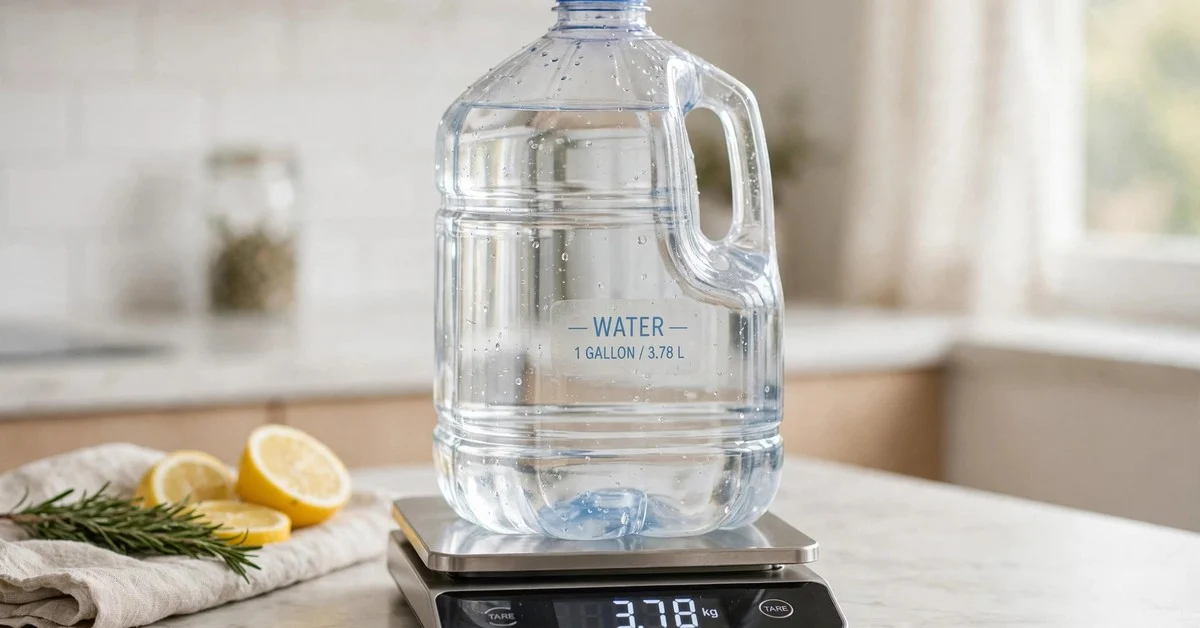
Halfway across the parking lot, your arm starts negotiating. The gallon jug of water felt fine in the store, but fifty steps from the car it has become a small argument between your fingers and your forearm. That argument has a number: a US gallon of water weighs 8.34 pounds, or 3.78 kilograms. It is one of the most useful weights in daily life to know by feel, because water shows up everywhere, in jugs, coolers, aquariums, humidifiers, and emergency supplies, and every one of those jobs begins with a lift.
The reason a gallon feels heavier than it looks is density. Water packs 8.34 pounds into a jug barely bigger than your head, with no air gaps and nothing to distribute the load except a thin plastic handle. This guide gives you the exact numbers, fifteen everyday objects that weigh about the same so you can calibrate your arm, and a practical haul test: how to carry water, from a single jug to a 5-gallon cooler, without wrecking your back.
The gallon of water, in exact numbers
A US gallon is defined as 231 cubic inches, and filled with water at room temperature it weighs 8.34 pounds. In metric terms that is 3.78 kilograms, or 3,783 grams. In ounces, 133.4 of them. The same jug holds 128 fluid ounces of volume, which divides neatly into 16 cups, 8 pints, or 4 quarts, and each quart of water weighs about 2.09 pounds, a handy subunit for building the full weight in your mind.
A quick note for travelers: the Imperial gallon used in the UK is larger, about 4.55 liters versus the US gallon’s 3.79, so an Imperial gallon of water weighs about 10 pounds. Every number in this article refers to the US gallon. Water’s weight also shifts a hair with temperature: it is densest at about 39°F, where the gallon weighs roughly 8.345 pounds, and a touch lighter at room temperature. The difference is a fraction of an ounce and never matters outside a laboratory.
The haul test: carrying water without wrecking your back
Knowing the number is only half the job; the other half is the lift. Water is uniquely punishing to carry because it sloshes. Every step you take sends a small wave across the jug, and that moving weight yanks at your grip in a way a solid 8.34-pound object never would. The haul test below walks through the three carries you will actually face, with form that keeps your back out of the negotiation.
The one-gallon carry. Grip the handle, not the neck: the handle sits at the jug’s balance point, while the neck forces your wrist into a bent, weak position. Keep the jug close to your thigh rather than swinging at arm’s length; every inch it drifts from your body multiplies the torque on your shoulder. Switch hands every minute or so on a long walk. If your fingers are going numb, you are gripping too hard, let the handle rest in the crook of your fingers instead of strangling it.
The two-gallon carry. Two gallons weigh 16.68 pounds, and the correct technique is one jug in each hand, arms hanging straight. The balanced load keeps your spine neutral, which is why carrying two jugs feels easier than its weight suggests while one jug plus nothing feels lopsided. This is the grocery-trip sweet spot: two gallons, two hands, one trip. Resist the urge to stack both in one hand unless the distance is under twenty steps.
The 5-gallon cooler bottle. Five gallons of water weigh 41.7 pounds, and this is where backs get hurt. Never lift a full cooler bottle with a bent back and straight legs; squat, hug the bottle to your chest, and stand with your legs. Better yet, don’t lift it at all: tip it onto its side and roll it, or use the two-person carry, one hand each on the neck. The bottle’s smooth plastic gives your hands almost no purchase, so dry hands or a towel make a bigger difference than raw strength.
The distance rule. For carries under a minute, grip strength is the limit, and almost any adult manages a gallon. Past three minutes, forearm endurance takes over, and the sloshing starts to win. Past ten minutes, switch to a backpack-style carrier or a cart: 8.34 pounds becomes a genuine workout when it hangs from one arm for a full walk home. And remember the shelf math: four gallons on a pantry shelf is 33.4 pounds of dead weight, so store water low and check that the shelf is rated for it.
Fifteen things that weigh about as much as a gallon of water
- A gallon of windshield washer fluid. At about 8.3 pounds, the blue jug in your garage is the closest possible stand-in: same size, same handle, nearly the same weight. If you have ever topped up the reservoir, you have already passed the haul test.
- A large cast-iron skillet. A 12-inch cast-iron skillet weighs about 8 pounds, and its single long handle loads your wrist almost exactly the way a water jug does. Anyone who cooks with iron knows this heft by heart.
- Ten cans of soup. A standard can of soup weighs about 13 ounces with the can, so ten of them total roughly 8.1 pounds. Picture two full grocery bags of cans, consolidated into one jug.
- A charged 5-pound fire extinguisher. The “5-pound” rating refers to the chemical inside; charged and ready, the whole unit weighs about 9 pounds. Wall-mounted in kitchens and garages everywhere, it is a fixed 8-to-9-pound reference you can lift any time.
- Two standard clay bricks. A common clay brick weighs about 4.5 pounds, so two of them land right around 9 pounds. Masons carry them all day; the rest of us can use a pair as a quick reality check on what a gallon demands.
- A box fan. The square 20-inch box fan so many homes own weighs about 8 to 10 pounds. Lifting it in and out of the window each season is an annual, unintentional weigh-in against the gallon.
- A cordless leaf blower. With the battery installed, a typical cordless leaf blower weighs about 7.5 to 8 pounds. Yard workers swing this weight one-handed for an hour, which says a lot about how manageable 8.34 pounds becomes with the right handle.
- A cordless stick vacuum. Most stick vacuums weigh 7 to 8 pounds, engineered to feel light while you push them around. Hold one still at your side, though, and the honest 8-ish pounds shows up fast.
- A cordless circular saw with battery. About 7.5 pounds of saw plus battery, and every carpenter has carried one up a ladder. The weight is compact and dense, like water, with nothing wasted on packaging.
- A loaded tool bag. A soft-sided tool bag with a drill, bits, a hammer, and a tape measure settles in around 8 to 9 pounds. Tradespeople sling this over a shoulder daily; the rest of us meet it when something breaks.
- A small bag of charcoal. The smaller bags of charcoal briquettes, around 8 to 10 pounds, are a summer staple. Hoisting one into the cart is the same lift as a water jug, minus the sloshing.
- Two 2-liter soda bottles. Each full 2-liter bottle weighs about 4.4 pounds, so two of them total roughly 8.8 pounds. Party hosts who have carried a bottle in each hand know this paired carry well.
- An 8-pound bag of grass seed. Sold for patching lawns, the bag weighs exactly what it says: 8 pounds of dense seed that pours like, well, water. Spring gardeners lift this one every year.
- A slow cooker full of stew. A 6-quart slow cooker with a full batch of stew inside weighs about 9 to 10 pounds. Carrying it to a potluck, both hands, careful steps, is the gallon-of-water experience with higher stakes.
- A full-size sledgehammer. The classic 10-pound sledge, head plus 36-inch handle, weighs about 9 to 10 pounds total. It is the most dramatic item on this list, and proof that 8.34 pounds can look very different depending on the package.
Water weight in the wild: five jobs that need the math
The gallon’s 8.34 pounds stops being trivia the moment water has to be stored, moved, or supported. Five everyday situations turn on this number.
The aquarium. A 10-gallon tank holds 83.4 pounds of water before glass, gravel, and equipment, and a 20-gallon tank holds about 167 pounds. That’s why aquariums live on dedicated stands, never on bookshelves or desks rated for books. Every new fishkeeper should do this multiplication before buying the tank, not after filling it.
Emergency storage. Preparedness guidelines suggest a gallon per person per day. A family of four for three days needs 12 gallons: just over 100 pounds of water. That weight decides where the supply lives, low, near a load-bearing wall or on a concrete floor, never on an upper-floor closet shelf. Water storage is a structural decision disguised as a shopping list.
The dehumidifier bucket. A 30-pint dehumidifier pulls 30 pints, 3.75 gallons, about 31 pounds of water from the air per day in damp conditions. Every bucket emptied is a 30-pound carry to the sink. It’s the invisible gallon: water you never poured, weighing as much as water you did.
The water heater. A 40-gallon tank holds about 334 pounds of water, which is why heaters sit on the floor, get strapped in earthquake country, and need two people plus a dolly to move. The tank you never think about is the heaviest water vessel in most homes.
The hot tub. A modest 400-gallon spa holds about 3,336 pounds of water, over a ton and a half, before a single person climbs in. That’s why decks and patios need engineering for hot tubs: the water alone weighs as much as a small car, and it never gets lighter.
Questions haulers ask about water weight
Why does a gallon of water feel heavier than a gallon of milk?
It shouldn’t, and mostly it doesn’t: water is 8.34 pounds per gallon while whole milk is about 8.6, so milk is actually the heavier of the two. What people feel is packaging. Milk jugs have broad, ergonomic handles molded for carrying; many water jugs, especially the thin store-brand kind, have flimsier grips that dig into the fingers. The hand reports the handle, not the liquid.
How many gallons can one person carry at once?
Two gallons, one in each hand, is the comfortable maximum for most adults: 16.68 pounds, balanced. Strong carriers manage three, with the third hugged against the body, but the sloshing makes it awkward past a short distance. Four gallons at once is 33.4 pounds of shifting liquid and a genuine strain; that is what carts are for. In an emergency water run, plan on two gallons per trip per person.
Will a gallon of water break a refrigerator shelf?
Almost certainly not by itself. Fridge shelves are typically rated for 25 to 35 pounds, and a gallon is 8.34. The risk comes from stacking: four gallons on one shelf is 33.4 pounds, plus the shelf’s own contents, which can exceed the rating on cheaper wire shelves. Spread water jugs across shelves and keep them low, where a spill does the least damage.
Does a gallon of ice weigh the same as a gallon of water?
A gallon of solid ice weighs slightly less, about 7.7 pounds, because ice is less dense than liquid water, which is why it floats. But a “gallon of ice” from a bag is mostly air gaps between cubes, so a gallon bag of ice cubes weighs noticeably less than 7.7 pounds. Only a solid, air-free block of ice a gallon in volume would hit the 7.7-pound figure.
How heavy is the water in a typical home aquarium?
A 10-gallon tank holds about 83.4 pounds of water alone, before the glass, gravel, and stand, which is why aquariums live on dedicated stands, not bookshelves. A 20-gallon tank is about 167 pounds of water. Anyone planning a tank should do this math first: water weight surprises more new fishkeepers than anything else in the hobby.
See also: how much a gallon of milk weighs.
See also: how big a gallon is.
Respect the jug
How much does a gallon of water weigh? 8.34 pounds, 3.78 kilograms, 133.4 ounces: a weight that sits exactly on the border between trivial and tiring. It is the windshield washer jug in your garage, the cast-iron skillet on your stove, ten cans of soup in a bag. Carry it by the handle, keep it close, balance two at a time, and never deadlift the 41.7-pound cooler bottle like a hero. The water doesn’t care how strong you are; it only cares how you lift it. Treat the humble gallon with a little technique, and the parking lot walk stops being a negotiation.

I’m Owen Reeves, a content writer at MeasureZit.com, specializing in measurements, unit conversions, and mathematical concepts. I turn technical topics into clear, accurate content that’s easy to understand. My focus is precision, clarity, and genuinely useful information.