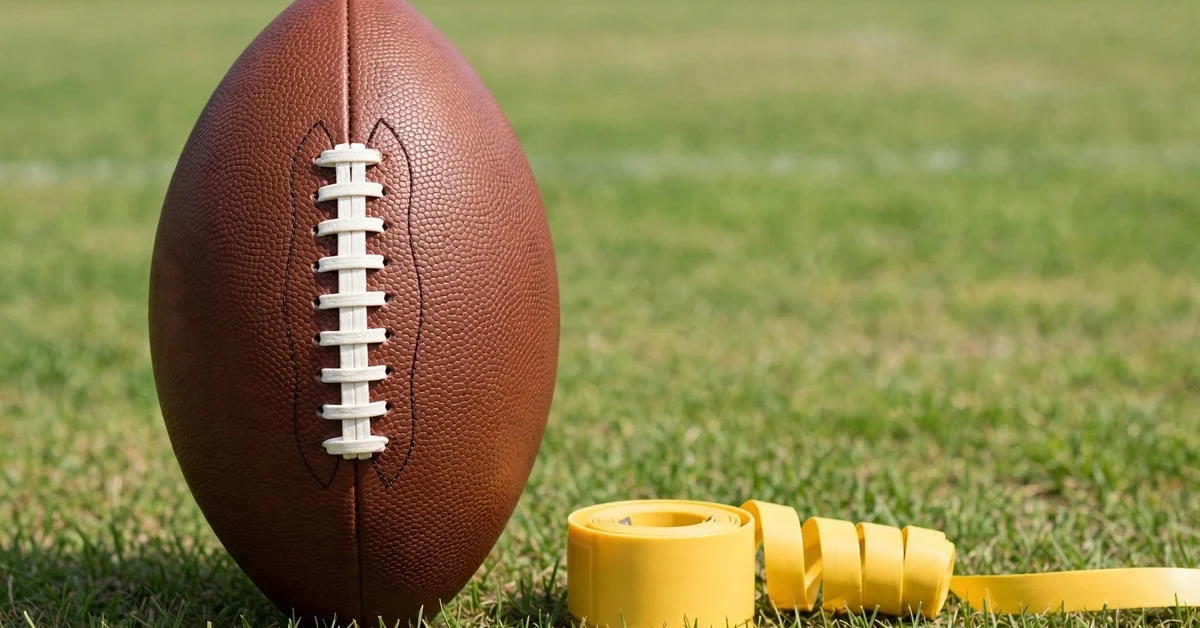
Catch a football for the first time and something feels off. On television it looks like a small torpedo, big enough to fill a quarterback’s whole hand twice over. In your hands it is smaller, denser, almost modest: a leather wedge about as long as a dinner plate is wide, pointed at both ends like it is in a hurry. Television lies about the size of nearly everything, and the football is one of its favorite fibs.
So how big is a football? An official NFL ball is 11 to 11.25 inches long, 28 to 28.5 inches around the long way, about 21 inches around the short way, and 14 to 15 ounces in weight. That is the whole animal: a prolate spheroid standardized to the human hand and the physics of a spiral. But “a football” is not one ball. Pee-wee leagues, high schools, Canadian fields, rugby pitches, and Australian ovals all play with their own version of the shape, each a rung on a ladder of sizes. This guide climbs that ladder, from the 10-inch pee-wee ball up through rugby’s fatter cousin, so you know exactly where the NFL’s 11 inches sits in the family.
Eleven inches, officially: what the rulebook actually says
The NFL rulebook describes the ball as a prolate spheroid with a short axis and specific tolerances, and the numbers are tighter than most fans realize. Length: 11 to 11.25 inches (about 27.9 to 28.6 centimeters). Long circumference, measured end to end around the points: 28 to 28.5 inches (about 71.1 to 72.4 centimeters). Short circumference, around the fat middle: 21 to 21.25 inches (about 53.3 to 54 centimeters). Weight: 14 to 15 ounces (about 397 to 425 grams). Inflation: 12.5 to 13.5 pounds per square inch.
Those tolerances exist because the ball is a compromise. It has to fill a quarterback’s grip firmly enough to control, yet stay slim enough to release cleanly. It has to be heavy enough to fly 50 yards without fluttering, yet light enough to catch without breaking fingers. Every fraction of an inch in the spec is a negotiated settlement between throwing, catching, and kicking, worked out over a century of Sundays.
College and high school play with the same official size 9 ball, so the Friday-night ball and the Sunday ball are the same animal. The visible difference is cosmetic: college balls carry white stripes near the ends for visibility, a feature the NFL dropped. In your hands, striped or plain, it is the same 11 inches.
The size ladder: one shape, many codes
Here is the part most guides skip: the American football is just one member of a whole family of oval balls, and lining them up is the fastest way to feel what 11 inches really means. The ladder below runs from the smallest organized ball a child will throw to the fattest oval in major sport. Lengths are end to end; “around” is the long circumference, measured over the points.
| Ball | Length | Around (long way) | Who uses it |
|---|---|---|---|
| Pee-wee (size 5) | ~10 in | ~25 in | Ages 9 and under |
| Junior (size 6) | ~10.5 in | ~26 in | Ages 10–12 |
| Intermediate (size 7) | ~11 in | ~27 in | Ages 12–14 |
| Official NFL / college / high school (size 9) | 11–11.25 in | 28–28.5 in | Ages 14 and up; 14–15 oz |
| Canadian (CFL) | ~11 in | ~28 in | Slightly fuller than the NFL ball |
| Rugby league | ~11 in | ~28–29 in | Slimmer profile than union |
| Australian rules (Sherrin) | ~10.6–11 in | ~28–29 in | AFL; red for day, yellow for night |
| Rugby union (size 5) | ~11–11.8 in | ~29–30 in | The fattest oval here; 14.5–16 oz |
| Gaelic football | ~8.6–8.9 in diameter | 27–28 in around | Round, like a soccer ball |
| Soccer (size 5) | ~8.6–8.9 in diameter | 27–28 in around | Round; 14–16 oz |
Read the ladder bottom to top and a pattern appears: the American game keeps its ball long and relatively slim, while the running codes let the ball fatten. Rugby union’s ball is the heavyweight of the oval world at up to 11.8 inches long and 30 inches around, built for a game where the ball is carried into contact and kicked from hand. The American ball, by contrast, is optimized for exactly one motion: the overhand spiral.
The youth rungs deserve attention because they show how carefully the sport scales. The pee-wee ball at 10 inches looks like a proper football that shrank in the wash, and that is the point: a nine-year-old can wrap a hand around it and actually throw a spiral instead of pushing the ball. The junior adds half an inch for ages 10 to 12. The intermediate reaches the full 11-inch length for ages 12 to 14 but stays slimmer and lighter around, so the grip never has to re-learn itself on the way up. By the time a player reaches the official ball, the only thing that changes is the fullness in the hand.
Cross-code, the surprises are all in the girth. A soccer ball and an American football carry nearly the same total “around” measurement, about 28 inches, but the soccer ball spends it on a sphere 8.6 to 8.9 inches across while the football stretches it into points. Hold one of each and you are holding the same circumference in two completely different geometries, which is why the football feels so much longer than it is.
Five things in your house that are about 11 inches
For the days when no ball is handy, these five anchors put the official length in your hands:
- A standard Frisbee. A classic flying disc measures 10.75 inches across, just a quarter inch shy of the football’s length. Set the ball next to a Frisbee and the disc’s diameter runs nearly end to end with it, a comparison that works in any park.
- A dinner plate. Most dinner plates run 10.5 to 11 inches in diameter, which makes the plate one of the closest everyday matches to the ball’s length. Lay the ball across a plate and the points come within a whisper of the rim on both sides.
- A 10-inch chef’s knife, blade only. The blade of a standard 10-inch chef’s knife runs a single inch shorter than the football. Cooks can picture the blade, then add a thumb’s width, and they have the ball’s length exactly.
- A sheet of legal paper, long edge. At 14 inches, the long edge of legal paper is the “longer” bookend: about three inches beyond the ball. Office workers can picture the paper, then trim a few inches in their mind, and land on 11.
- A personal-size pizza. The small pizzas sold for one person typically run about 10 inches across, an inch under the ball. Order one and you are looking at a football’s length rendered in crust and cheese, minus a bite.
The shape is the size: why it could never be round
The football’s dimensions only make sense together with its shape. A sphere 11 inches across would be enormous, a beach ball you could barely hold. The prolate spheroid takes the same rough volume and stretches it: long where the throw needs leverage, narrow where the hand needs to wrap. The 21-inch short circumference is the number your hand actually negotiates, and it is no accident that it matches a comfortable adult grip.
The pointed ends are aerodynamic engineering. A well-thrown spiral rotates around its long axis, and the taper lets air slip past with minimal drag, which is why a quarterback can send 11 inches of leather 50 yards downfield. Early footballs were rounder, closer to rugby balls, but as the forward pass became the center of the game, the ball slimmed and sharpened into the modern 11-inch form. The size followed the strategy.
Even the laces are a sizing decision. Raised white laces give the throwing hand a tactile index point, so the fingers find the same grip every time without looking. That consistency matters precisely because the ball is at the upper limit of what one hand can control: the laces are how the hand cheats a little extra purchase on 11 inches of smooth leather.
Anatomy of the 11 inches: what’s inside the ball
The 11 inches don’t happen by accident; they’re built, layer by layer. An official ball starts with four panels of pebble-grained leather, cut to a pattern and stitched inside out so the seams sit flush. Turned right-side out, the panels form the prolate spheroid, and the pebbled grain gives the surface its grip in rain and sweat. Inside sits a rubber bladder that holds the 12.5 to 13.5 psi of air, accessed through a small valve that every equipment manager knows by feel.
The laces are the final instrument: a single white lace threaded through eight cross-stitches along one seam. They add almost no weight and no size, but they change the ball completely, giving the fingers an index point for a consistent grip. Striped college balls add two white bands near the ends for visibility at night; the NFL ball goes without. Every component serves the same master: keeping those 11 inches consistent, ball after ball, game after game, so a quarterback’s muscle memory never has to adjust.
That consistency is why the manufacturing tolerances are so tight. A ball that drifted to 11.5 inches would change the grip; one that shrank to 10.5 would change the flight. The 11-inch standard survives because it sits exactly where the human hand and the physics of the spiral agree, and the ball’s construction exists to defend that agreement against leather, weather, and time.
Questions fans ask about football size
Is a Canadian (CFL) football bigger than an NFL ball?
Slightly, but your hands would struggle to prove it. The CFL ball runs about 11 inches long like the NFL ball, with a touch more fullness around the middle and fractionally different tolerances. Players who have handled both describe the Canadian ball as feeling a hair fatter, not longer. For any practical purpose, including settling arguments, treat them as the same size.
If intermediate and official balls are both about 11 inches long, what is the difference?
Length is only one dimension. The intermediate size 7 reaches the full 11-inch length but is slimmer around and lighter than the official size 9, which matters enormously to a 13-year-old’s hand. The youth ladder is really a girth and weight ladder disguised as a length ladder: each step up fills the hand a little more without changing the throwing motion the player has already learned.
Why is a rugby ball fatter than an American football?
Different jobs. Rugby’s ball is carried into tackles, passed sideways and backward, and kicked off the ground and from hand, so a rounder, fatter profile, about 11 to 11.8 inches long and 29 to 30 inches around, survives contact and flies predictably off the boot. The American ball sacrifices all of that versatility for one thing: the tightest possible spiral from an overhand throw, which demands the long, slim 11-inch profile.
Does cold weather actually shrink a football?
It effectively does. The air inside follows basic gas physics: as temperature drops, pressure drops with it, so a ball inflated to 13 psi indoors can measure well below the 12.5 psi minimum after an hour in freezing weather. The leather also stiffens. The result is a ball that feels smaller, harder, and deader off the foot and hand, which is why cold-weather games have their own ball preparation rituals.
Are college footballs exactly the same size as NFL balls?
Essentially yes. Both are built to the official size 9 standard: about 11 inches long, 28 inches around the long way, 14 to 15 ounces. The meaningful differences are cosmetic and procedural, white stripes near the ends on college balls for visibility, and different league approval stamps, not dimensional. A quarterback moving from Saturdays to Sundays holds the same 11 inches.
See also: how big a basketball is.
See also: how big a soccer ball is.
Carry the number with you
How big is a football? Eleven inches long, 28 inches around the long way, 21 around the middle, 14 to 15 ounces: the slimmest, sharpest member of a whole family of oval balls. It sits at the top of a youth ladder that starts at 10 inches for pee-wee players, stands shoulder to shoulder with the Canadian ball, and looks positively svelte next to rugby union’s 30-inch-around heavyweight. The dinner plate in your cabinet matches its length, the Frisbee in your garage misses it by a quarter inch, and the shape, pointed and laced, exists so those 11 inches can spiral 50 yards. Next time one spins through the air on screen, you will know exactly what is turning over out there, and how it compares to every other football on earth.

I’m Dane Whitfield, a content writer at MeasureZit.com, where I specialize in creating clear, accurate articles on measurements, unit conversions, and mathematical concepts. I enjoy breaking down complex numerical topics into simple, practical explanations that readers can actually use. My goal is always precision and clarity helping people make sense of the numbers around them.










