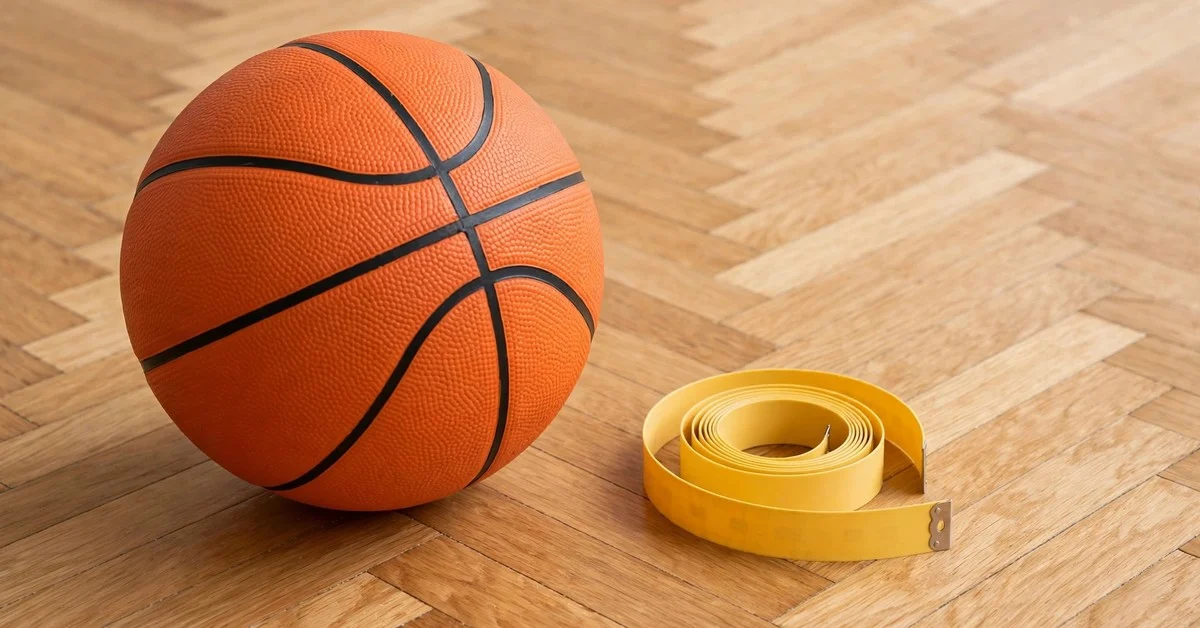
Your nine-year-old unwraps a basketball on his birthday, takes it to the driveway, and can’t get a shot to reach the rim. Not because he’s weak — because the ball is wrong. An adult-size basketball in a child’s hands is like an adult’s guitar in a child’s lap: the technique can’t form around the wrong tool. Youth leagues figured this out decades ago, which is why basketballs come in a ladder of sizes most parents have never heard of — and why buying “a basketball” without a number is a coin flip.
An official size 7 basketball measures 29.5 inches around, about 9.4 inches across, and weighs roughly 22 ounces. That’s the NBA and men’s college ball — and it’s too big for most kids under thirteen. Below it sit the size 6 (28.5 inches, women’s and youth), the size 5 (27.5 inches, young kids), and smaller rungs for beginners. This guide covers the official numbers, then works through the age-group chooser: size 5 vs. 6 vs. 7, and how to know which rung your player belongs on.
The official basketball, in numbers
The size 7’s 29.5-inch circumference wraps into a sphere about 9.4 inches in diameter — divide by pi and the geometry checks out at 9.39. It weighs about 22 ounces (624 grams), roughly the heft of a full wine bottle, and it’s inflated to bounce 52 to 56 inches when dropped from 6 feet onto a hardwood court. The rim it must pass through is 18 inches across, just under twice the ball’s diameter, leaving a little over 4 inches of clearance per side — the margin every shooter negotiates.
That 9.4-inch diameter explains the ball’s relationship with human hands. An adult’s outstretched hand spans about 8 to 9 inches from thumb to pinky, which is why most adults can nearly but not quite palm a size 7 — the ball was scaled to be gripped with two hands and controlled with fingertips, not clutched in one. The 22-ounce weight is the other half of the design: heavy enough to dribble true and hold its line in the air, light enough to shoot with proper wrist mechanics. Change either number and the game changes with it.
| Size | Circumference | Diameter | Weight | Ages |
|---|---|---|---|---|
| 7 (official) | 29.5 in | ≈ 9.4 in | ≈ 22 oz | 13+ (boys/men) |
| 6 | 28.5 in | ≈ 9.1 in | ≈ 20 oz | 9–12; women’s play |
| 5 | 27.5 in | ≈ 8.8 in | ≈ 17 oz | 5–8 |
| 4 | 25.5 in | ≈ 8.1 in | ≈ 14 oz | 4–7 |
| 3 | 22 in | ≈ 7.0 in | ≈ 10 oz | Under 5 |
The cover is part of the sizing story too. Official balls wear pebbled leather or composite with eight recessed panels, texture engineered so fingertips can read the ball’s spin in the dark of a fast break. That grip is why the size ladder matters as much as it does: a size 5 in small hands puts the seams where the fingers actually are, while a size 7 in those same hands turns the pebbles into decoration the player can’t reach. Size, weight, and cover work as one system, and all three scale down the ladder together.
Age-Group Ball Chooser: Size 5 vs. 6 vs. 7
Start with the player’s age, then confirm with the hand test. The size 5 (27.5 inches around, about 17 ounces) serves kids roughly ages 5 to 8. At this size a small child can get fingertips into the seams, lift the ball to shooting position without hunching the shoulders, and follow through with one smooth motion. The most common mistake is buying up “so he can grow into it” — a size 7 in a seven-year-old’s hands teaches pushing instead of shooting, a habit coaches spend years unteaching.
The size 6 (28.5 inches, about 20 ounces) is the bridge: standard for players around ages 9 to 12 and the official women’s game ball at every level. The single inch of circumference it gives up to the size 7 sounds trivial, but the two-ounce weight drop matters more — it’s the difference between a shot that reaches the rim with proper form and one that falls short and teaches bad compensation. If your player is between sizes, the hand test decides: have them hold the ball at chest height with fingers spread. If the fingertips reach the ball’s equator comfortably, the size fits; if they’re straining or the ball sits in the palms, drop a size.
The move to size 7 should follow strength, not birthdays. Most boys are ready around 13, but a smaller thirteen-year-old will shoot better — and enjoy the game more — on a size 6 for another season. Girls typically stay on the size 6 permanently, since it’s the women’s official ball from high school through the pros. Leagues are strict about this for good reason: the wrong ball doesn’t just make the game harder, it quietly rewires shooting mechanics. When you buy, check the ball’s printed size near the valve — reputable balls stamp it clearly — and match it to the league’s requirement list, not to what the neighbor’s kid uses.
The rim relationship deserves one more look, because it explains why the sport feels the way it does. At 18 inches across, the rim gives the 9.4-inch ball just over 4 inches of clearance per side — generous when you’re standing under it, microscopic when you’re shooting from 25 feet with a defender closing. Every shooting drill in basketball is really a drill about that clearance: arc the ball so it enters steeply, and the effective target grows; shoot flat, and it shrinks. The ball’s size and the rim’s size were chosen together, a century ago, and the ratio they settled on is why a swish feels like threading a needle from across the room.
15 Ways to Feel the Size
- An adult’s hand span. Thumb to pinky stretched wide runs 8–9 inches for most adults — just short of the ball’s 9.4-inch diameter, which is why palming it is a feat.
- A dinner plate (10.5 in). The plate clearly wins across — set the ball on one and the rim shows all around.
- A salad plate (8 in). The ball wins this one, overhanging the smaller plate — the two plates bracket the ball’s width.
- A medium cabbage head (≈ 8 in). One of the closest produce matches — hold a cabbage and you’re holding the ball’s diameter in green.
- A 5-gallon bucket (≈ 12 in across). Clearly bigger; the ball drops inside with inches to spare on every side.
- A beach ball (16 in). Nearly twice the width — the “much bigger” bookend that keeps 9.4 inches honest.
- A standard dodgeball (8.5 in). Just under the basketball — schoolyard memories make this one vivid.
- A size 6 ball (28.5 in around). One inch smaller in circumference — looks identical on the shelf, feels kinder in small hands.
- A size 5 ball (27.5 in). Two inches smaller around; in an adult’s hands it feels like the game shrunk slightly.
- A size 3 mini ball (22 in). Dramatically smaller — what looks regulation to a toddler looks like a toy to an adult.
- The 18-inch rim. Just under double the ball’s diameter — sight the ball against the rim and the 4-inch-per-side clearance becomes visible.
- A 2-liter soda bottle (12 in tall). Taller than the ball is wide — stand the bottle next to the ball for a quick height check.
- A shoebox (≈ 13 in long). Longer than the ball’s diameter; the ball won’t fit inside lengthwise without room to spare.
- A gallon milk jug (≈ 10 in tall). Slightly taller and much narrower — the jug’s familiar shape sharpens the ball’s roundness.
- A bathroom trash can (≈ 10 in across). Just wider than the ball — drop the ball in and it wedges near the top, a perfect width gauge.
Indoor Balls, Outdoor Balls, and Why It Matters
Size is only half the purchase — the other half is the cover. Indoor basketballs use full-grain or composite leather: softer, grippier, and tuned for hardwood, but they scuff and wear fast on asphalt. Outdoor balls use rugged rubber that survives concrete and laughs at weather, at the cost of a harder feel and less predictable grip. An indoor ball taken to the driveway dies young; an outdoor ball brought to the gym plays like a rock. Match the ball to the surface your player actually uses, and check the label — most balls print “indoor,” “outdoor,” or “indoor/outdoor” near the size marking.
For young players, the indoor/outdoor composite is usually the right call: durable enough for the driveway, decent enough for the school gym. Whatever you buy, the ball arrives under-inflated and needs a pump with a needle — the “proper” feel everyone talks about is 7.5 to 8.5 psi, firm enough that the ball bounces true but soft enough that fingertips can work the seams. A rock-hard ball teaches slapping; a mushy one teaches pushing. Pressure is part of size, in the sense that matters.
Measure It Yourself: The Tape-and-Scale Check
You can verify any basketball’s size with a soft tape measure and a kitchen scale — useful when a ball’s markings have worn off or a hand-me-down’s size is a mystery. Wrap the tape around the ball’s equator, keeping it level and snug but not denting the cover: 29.5 inches means size 7, 28.5 means size 6, 27.5 means size 5. Measure twice, rotating the ball 90 degrees, because older balls go slightly egg-shaped with use and a single reading can mislead by half an inch.
Weigh it next: a size 7 should read about 22 ounces, a size 6 about 20, a size 5 about 17. Weight is actually the more honest test for youth balls, because some cheap “size 6” balls are cut to the right circumference but built heavy — and heavy is what hurts young shooters’ form. If the circumference says size 6 but the scale says 22 ounces, you’ve got a mislabeled ball that will play like a size 7. The bounce test closes the loop: drop it from 6 feet onto a hard floor and look for 52 to 56 inches of rebound on a properly inflated official ball. Less bounce with correct pressure means a dead bladder, and no size marking fixes that.
Questions Parents Ask at the Sporting-Goods Store
What size basketball does a 10-year-old need?
A size 6 (28.5 inches around) is the standard for players roughly ages 9 to 12. It’s an inch smaller in circumference and about two ounces lighter than the official size 7, which lets developing hands grip the seams and shoot with proper form. Most youth leagues mandate the size 6 for this age group, so check the league’s rules before buying — the right ball is the legal one.
Is the women’s basketball really smaller?
Yes. Women’s play uses the size 6 at 28.5 inches in circumference — one inch smaller around and about two ounces lighter than the men’s size 7. It’s the official ball from high school through college to the WNBA. The smaller, lighter ball suits the women’s game without changing its fundamentals, and most girls stay on the size 6 permanently.
How do I know when my kid is ready for a size 7?
Use the hand test, not the birthday. Have the player hold the size 7 at chest height with fingers spread: if the fingertips reach the ball’s equator and they can shoot with proper wrist snap rather than pushing from the chest, they’re ready — usually around age 13 for boys. If shots fall short or form collapses, another season on the size 6 builds better mechanics than struggling early on the bigger ball.
Can one ball work for both indoor and outdoor play?
An indoor/outdoor composite ball is the practical compromise for kids who play everywhere — durable enough for asphalt, playable on hardwood. Pure indoor leather balls wear out fast on concrete, and pure outdoor rubber feels harsh in the gym. If your player is serious about indoor league play, though, a dedicated indoor ball for games plus a cheap outdoor ball for the driveway is the setup that lasts.
How much air should be in a basketball?
Between 7.5 and 8.5 psi for a standard ball — firm enough to bounce 52 to 56 inches when dropped from 6 feet, soft enough that your thumb leaves a slight give when you press hard. Check the recommended range printed near the valve, since youth sizes sometimes differ slightly. An under-inflated ball teaches bad dribbling habits just as surely as the wrong size does.
See also: how big a soccer ball is.
See also: how big a football is.
The Right Ball Teaches the Right Game
A basketball is 29.5 inches around only at the top of the ladder. Below it, the sizes step down deliberately — 28.5, 27.5, 25.5, 22 — each one matched to the hands and strength of the player it’s built for. The cabbage in your kitchen is close to the official ball’s width, the dinner plate beats it, and the size 6 sitting next to it on the shelf looks identical while playing completely differently. Buy by age, confirm with the hand test, match the cover to the court, and keep it at proper pressure. The right ball doesn’t just fit the player — it teaches them the game correctly from the first dribble. Years from now, when the shot looks effortless, nobody will remember the size printed by the valve. But the mechanics built on it will still be there, working quietly under every jumper.

I’m Owen Reeves, a content writer at MeasureZit.com, specializing in measurements, unit conversions, and mathematical concepts. I turn technical topics into clear, accurate content that’s easy to understand. My focus is precision, clarity, and genuinely useful information.










