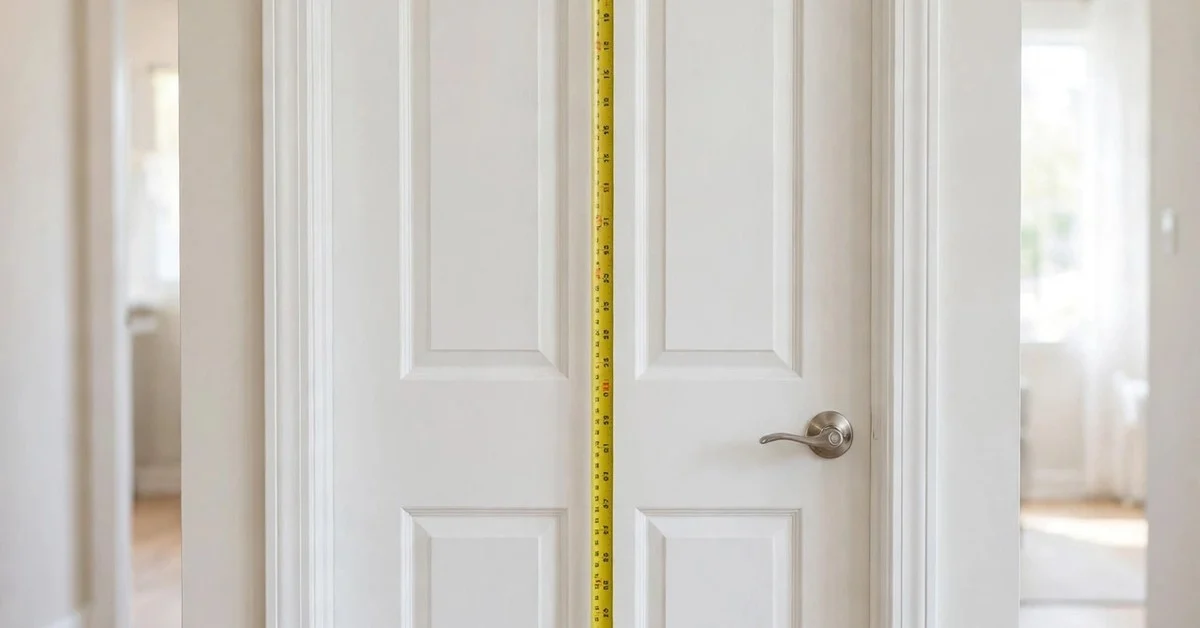
The delivery truck is in your driveway, two movers are carrying your new sofa up the walk, and it stops dead at the front door. Not stuck — stopped, with six inches of sofa on each side of a doorway that suddenly looks a lot smaller than it did in the showroom. Everyone has watched this scene, either as the buyer, the mover, or the neighbor pretending not to stare. The tragedy is that it was preventable with a tape measure and ninety seconds of arithmetic.
The standard door size in most American homes is 36 inches wide by 80 inches tall — 3 feet by 6 feet 8 inches. That rectangle is the gatekeeper for every piece of furniture you will ever own: what passes through it, what needs to be angled, and what has to be disassembled in the driveway. This guide covers the numbers, then runs the furniture-delivery test — the method movers use to answer “will it fit?” before the truck leaves the store.
The 36 × 80 Standard, in Numbers
The 36-inch width is exactly 3 feet — 91.4 centimeters — and it is the number that does the real work. The 80-inch height (203.2 centimeters, or 6 feet 8 inches) clears nearly every human and most furniture, so width is almost always the constraint. Interior passage doors in the same house often run narrower — 30 or 32 inches — which is why the sofa that sailed through the front door can jam at the bedroom.
Three related measurements surround every door, and mixing them up causes most ordering mistakes. The slab is the door itself: 36 × 80 inches. The rough opening — the framed hole in the wall — runs about 2 inches larger in each direction, roughly 38 × 82 inches, leaving room for the frame, shims, and leveling. The clear opening — the actual gap you walk through — runs about 2 inches smaller than the slab, roughly 34 inches, once the frame, hinges, and door stop take their share. When a mover asks “how wide is the door,” they mean the clear opening, not the slab.
| Measurement | Width | Height |
|---|---|---|
| Door slab (standard) | 36 in (91.4 cm) | 80 in (203.2 cm) |
| Rough opening | ≈ 38 in | ≈ 82 in |
| Clear opening | ≈ 34 in | ≈ 79 in |
| With door removed | ≈ 35.5 in | ≈ 79.5 in |
The Furniture-Delivery Test: Will Your Sofa Fit Through?
Professional movers answer the fit question with a three-step test you can run in the store aisle. Step one: measure the furniture’s smallest cross-section, not its biggest dimension. A sofa’s length is irrelevant — what matters is its height and depth, because sofas go through doors on end or on their side. A typical three-seat sofa stands about 36 inches tall and 38 inches deep; stood on end, its footprint becomes 38 inches wide by 84 inches long, and the 84-inch length must clear the 80-inch door height on the diagonal.
Step two: apply the diagonal rule. A rigid object can pass through a doorway if its cross-section’s diagonal fits the opening’s diagonal — and doorways are generous on the diagonal. The classic example is the queen box spring: 60 × 80 inches of rigid rectangle that should never fit through a 36-inch door, yet slides through on a careful angle because the doorway’s diagonal (about 87 inches for the clear opening) accommodates the pivot. The test is to measure the furniture’s two smallest dimensions, compute the diagonal, and compare it against the doorway’s clear diagonal with a couple of inches to spare for hands and wobble.
Step three: know your cheat codes, because movers always do. Taking the door off its hinges buys back roughly an inch and a half of clear width — the difference between stuck and through more often than you’d think. Popping off the door stop molding buys another half inch. Reclining sofa backs often detach with a lever pull, shedding 8 inches of depth instantly. And French-door refrigerators — exactly 36 inches wide, the same as the door — fit only with both refrigerator doors removed, a twenty-minute job that delivery crews do routinely. Measure twice, remove the door, and the “impossible” delivery becomes a Tuesday.
The most common failure isn’t the front door at all — it’s the second doorway. The sofa clears the 36-inch entry, turns the corner, and meets a 30-inch bedroom door or a 32-inch hallway pinch. Always trace the full path: front door, every turn, every interior door, to the final resting place. Hallway width matters as much as door width, because a long sofa needs swing room to make the turn. A 36-inch hallway with a 90-degree turn will defeat furniture that sailed through a 36-inch straight doorway.
15 Things Measured Against a 36 × 80 Door
- Three-seat sofa (≈ 84 × 38 × 36 in). Goes through on end or tilted — the delivery test’s defining case; measure height × depth, not length.
- Queen box spring (60 × 80 in). The legendary diagonal squeeze — fits a 36-inch door on the pivot, fights a 30-inch one.
- Upright piano (≈ 58 × 24 × 51 in). Only 24 inches deep, so it walks through upright with room to spare despite its imposing look.
- Dresser (60 × 18 × 36 in). The 18-inch depth is the hero — slides through straight with nearly a foot of clearance per side.
- French-door refrigerator (≈ 36 × 70 × 33 in). Exactly door-width; fits only with the fridge doors removed, a standard delivery-crew job.
- Top-load washer (≈ 27 × 27 × 42 in). Passes with inches to spare — the reason 30-inch laundry doors still work.
- Bookshelf (36 × 12 × 72 in). Tall but shallow; carries through upright like a ladder, 12 inches of depth barely registering.
- Recliner (≈ 38 × 40 × 42 in). Bulky but under the width limit — tilt it back and it threads through without disassembly.
- Gun safe (60 × 30 × 24 in). Heavy rather than wide; the 30-inch width fits, but the weight needs a dolly and a plan.
- Treadmill, folded (≈ 34 × 36 × 65 in). Folding decks are designed for doorways — the 34-inch folded width just squeaks through.
- Wardrobe / armoire (≈ 40 × 24 × 72 in). The 40-inch width fails the 36-inch door — disassemble or remove the door and stop molding first.
- Desk (60 × 30 × 30 in). Fits straight through; the 30-inch depth leaves comfortable hand room on each side.
- File cabinet (18 × 26 × 52 in). Narrow enough to carry through sideways with a full arm’s clearance.
- Wheelchair (≈ 26 in wide). The reason 36-inch doors became standard — 26 inches of chair in 34 inches of clear opening, with room to spare.
- Snowblower (≈ 28 in wide). Garage-to-driveway traffic fits easily, which is why exterior doors rarely cause seasonal grief.
The Hallway Turn Nobody Measures
Door width gets all the attention, but hallway geometry ruins more deliveries. A sofa that threads a 36-inch doorway can still get trapped making a 90-degree turn into a 36-inch hallway, because the turn needs the sofa’s length to swing through an arc the hallway doesn’t have. The rule of thumb movers use: the hallway should be at least as wide as the furniture is deep, plus a foot of swing room. For a 38-inch-deep sofa, that means a 48-inch hallway for comfortable turns — far wider than the 36-inch halls in most homes.
This is why delivery crews scout the route before lifting anything. They walk it empty-handed, open every door fully, note the tight turns, and decide the carry order — longest piece first, while arms are fresh. You can do the same scout with a tape measure and five minutes. Measure the narrowest doorway on the path, the narrowest hallway, and the tightest turn, then test your furniture’s smallest cross-section against the smallest of those three. The route is only as generous as its tightest point, and the tightest point is never the front door.
Measuring Your Own Doors in Two Minutes
You do not need the standard — you need your doors, because houses lie. Grab a tape measure and check three numbers on every doorway in the delivery path. First, the clear width: hook the tape on the inside of the frame on one side and read it at the other, ignoring the trim — that is the gap furniture must pass, and it is the number that matters. Second, the clear height from the floor to the underside of the frame’s top. Third, the hallway width at the tightest turn, measured wall to wall.
Write the three numbers on masking tape stuck to each doorframe and photograph them; delivery crews love this, and it settles arguments before they start. Pay special attention to doors that look standard but aren’t: a 34-inch slab in an older home, a frame that settled out of square so the top is narrower than the bottom, or a storm door that steals two inches you forgot about. The standard tells you what to expect. The tape tells you what you’ve got. Trust the tape.
One more measurement people skip: the door’s swing direction and its full arc. A door that opens into the hallway narrows the carry path by the door’s own width while it’s open — movers will either remove it or tie it back. And check what’s behind the door’s swing: a coat rack, a shoe bench, or a stack of boxes can silently steal the six inches your pivot needed. Clear the path completely before the truck arrives, not after the sofa is wedged.
Questions Movers Hear About Standard Doors
Will a couch fit through a 36-inch door?
Almost always. Sofas go through on end or tilted, so the relevant numbers are the sofa’s height and depth — typically 36 × 38 inches — not its length. A 36-inch door offers about 34 inches of clear opening, and tilting buys the rest. Only oversized sectionals with non-removable chaise sections routinely fail, and even those often pass with the door taken off its hinges.
How much wider is the opening if I remove the door?
Taking the slab off its hinges gains roughly 1 to 1.5 inches of clear width, and popping the stop molding adds about another half inch. On a 36-inch door that pushes the clear opening from about 34 inches toward 35.5. It sounds small, but delivery crews will tell you that inch and a half is the most valuable inch in the house — it resolves more stuck-furniture situations than any other single trick.
What’s the difference between a 36-inch door and a 32-inch door in practice?
Four inches of slab, but about four inches of clear opening too — roughly 34 versus 30 inches of walk-through space. That gap decides whole categories: queen box springs pivot through 36-inch doors and fight 32-inch ones, French-door refrigerators need the full 36, and wheelchairs need the 34-inch clear opening that only the 36-inch slab provides. When building or remodeling, the wider door costs little more and removes a lifetime of friction.
Are old houses’ doors the same 36 × 80 standard?
Often not. Pre-1950s homes commonly have 30- or 32-inch doors, non-standard heights, and openings that have drifted out of square over decades of settling. Measure every doorway on the delivery path in an older home rather than assuming the standard — and budget for the possibility that a piece fits the front door but not the bedroom. The standard is a modern convention, not a historical law.
Do exterior and interior 36-inch doors differ?
The slab dimensions match, but exterior doors run 1¾ inches thick versus 1⅜ for interior, with weatherstripping and a threshold that slightly reduce the clear opening. Exterior frames are also sturdier, which matters when you’re angling heavy furniture — an interior frame’s trim pops off more easily under impact. For delivery purposes, treat the front door’s clear opening as an inch narrower than the math suggests.
See also: interior door dimensions.
See also: how long 72 inches is.
Measure the Path, Not Just the Door
The standard door — 36 inches wide, 80 inches tall — is one of the most thought-through rectangles in your home: wide enough for a wheelchair, tall enough for nearly every adult, and sized so that a sofa, a washer, and an upright piano all pass with the right technique. But the door is only one link in the delivery chain. Run the furniture-delivery test before the truck arrives: measure the smallest cross-section, check the diagonal, trace the full path including every turn, and know that the door comes off its hinges. Ninety seconds with a tape measure beats an afternoon with a stuck sofa every time. And the next time a mover asks “how wide is the door,” answer with the three numbers that actually decide delivery day: the clear opening, the diagonal, and the tightest turn in the hallway. Tape those three numbers to the doorframe before the truck backs in, and watch the whole move go quiet and easy.

I’m Priya Sharma, a content writer at MeasureZit.com, specializing in measurements, unit conversions, and mathematical concepts. I turn technical topics into clear, accurate content that’s easy to understand. My focus is precision, clarity, and genuinely useful information.










