Introduction
A rug can make a living room feel warm and pulled together, or it can make the whole space look like a mistake. The difference is almost always size. Too small and the furniture floats awkwardly around it; too big and it swallows the floor like wall-to-wall carpet.
For most living rooms, an 8×10 rug is the safest choice: it holds a sofa, two chairs, and a coffee table with every leg on the rug. Small living rooms do better with a 5×7 or 6×9, while large or open-plan spaces usually need a 9×12 to look balanced.
This guide walks through every standard living room rug size, the two rules designers actually use, and how to match the rug to your room in minutes. Grab a tape measure and let’s get it right the first time.
Standard Living Room Rug Sizes
| Rug size | Feet | Inches | Centimeters | Area |
|---|---|---|---|---|
| 3×5 | 3 × 5 ft | 36 × 60 in | ≈ 91 × 152 cm | 15 sq ft |
| 4×6 | 4 × 6 ft | 48 × 72 in | ≈ 122 × 183 cm | 24 sq ft |
| 5×7 | 5 × 7 ft | 60 × 84 in | ≈ 152 × 213 cm | 35 sq ft |
| 6×9 | 6 × 9 ft | 72 × 108 in | ≈ 183 × 274 cm | 54 sq ft |
| 8×10 | 8 × 10 ft | 96 × 120 in | ≈ 244 × 305 cm | 80 sq ft |
| 9×12 | 9 × 12 ft | 108 × 144 in | ≈ 274 × 366 cm | 108 sq ft |
| 10×14 | 10 × 14 ft | 120 × 168 in | ≈ 305 × 427 cm | 140 sq ft |
| 12×15 | 12 × 15 ft | 144 × 180 in | ≈ 366 × 457 cm | 180 sq ft |
8 Standard Rug Sizes for Living Rooms
| # | Rug size | Approximate Area | Best for |
|---|---|---|---|
| 1 | 3×5 | 15 sq ft | Accent, not seating areas |
| 2 | 4×6 | 24 sq ft | Coffee table only |
| 3 | 5×7 | 35 sq ft | Small living rooms, apartments |
| 4 | 6×9 | 54 sq ft | Medium living rooms |
| 5 | 8×10 | 80 sq ft | Most living rooms (the standard pick) |
| 6 | 9×12 | 108 sq ft | Large and open-plan living rooms |
| 7 | 10×14 | 140 sq ft | Great rooms, sectionals |
| 8 | 12×15 | 180 sq ft | Very large spaces |
7 Layout Rules That Pick the Size for You
| # | Rule / Scenario | What it means |
|---|---|---|
| 9 | The front-legs rule | Sofa and chair front legs sit on the rug |
| 10 | The 18-inch rule | Leave ≈ 18 in of bare floor around the rug |
| 11 | Small living room (10×12 ft) | 5×7 or 6×9 |
| 12 | Standard living room (12×15 ft) | 8×10 |
| 13 | Large / open-plan living room | 9×12 |
| 14 | Sectional sofa layout | 9×12 or 10×14 |
| 15 | Coffee-table-only layout | 4×6 or 5×7 |
15 reference items total: 8 in Table A, 7 in Table B.
What Size Rug Fits Your Living Room?
Start with the room, not the rug. Measure your living room’s length and width, then subtract about 3 feet total (18 inches on each side) to find your maximum rug size. In a 12×15-foot room, that math gives you roughly 9×12 feet of rug, though most designers would still choose the 8×10 there for a balanced border.
Next, look at your furniture. The arrangement matters more than the room’s raw dimensions. A loveseat and one chair need far less rug than a full sectional with a chaise, even in the same room. Place your main pieces, then choose the smallest rug that still gets the front legs of every seat onto it.
Compared with the common mistake sizes, the right choice is obvious in hindsight. A 5×7 in a big room looks like a postage stamp under the coffee table, while a 9×12 crammed into a small apartment leaves no breathing room at the edges. The 8×10 sits between them as the size that fits the average living room the way the average shoe fits the average foot.
Easy ways to estimate the right rug size in everyday life
- Tape the outline: use painter’s tape to mark the rug size on your floor and live with it for a day.
- Apply the front-legs rule: if the sofa’s front legs and the chairs’ front legs reach the tape, the size works.
- Check the 18-inch border: about 18 inches of bare floor should show between the rug and each wall.
- Measure your sofa: most three-seat sofas run 6 to 7 feet, so the rug should be at least 2 feet wider.
- Count the seats: two seats or fewer can use 5×7; three to four seats want 8×10; five or more need 9×12.
- Photograph the tape: a phone photo of the taped outline reveals proportion mistakes your eyes miss in person.
1. The 3×5 Rug
At 15 square feet, the 3×5 is an accent rug, not a living room rug. It works beside a bed, in an entryway, or layered over a larger rug, but it cannot anchor seating. Placed under a coffee table, it leaves every chair leg stranded on bare floor, which is the classic “floating furniture” look designers warn against. Know this size mainly so you can rule it out. If a living room rug feels too small, it is usually because someone bought a 3×5 or 4×6 for a job that needed twice the area.
2. The 4×6 Rug
The 4×6 covers 24 square feet, enough for a coffee table with a little margin but not much else. In a tiny studio or a reading corner with a single armchair, it can work. In a real living room, it repeats the 3×5’s problem on a slightly bigger scale: the sofa’s front legs hang off the edge. Use it only when the seating area is genuinely compact. For most living rooms, the 4×6 is a stepping stone you will replace within a year.
3. The 5×7 Rug
The 5×7 is the smallest size that can honestly serve a living room. At 35 square feet, it fits under a coffee table with the front legs of a standard sofa resting on it, which satisfies the front-legs rule in small spaces. Apartments, condos, and cozy dens are its natural habitat. The limitation is chairs: armchairs usually end up half on and half off. If your living room is under about 12 feet wide, the 5×7 is a respectable, budget-friendly answer.
4. The 6×9 Rug
With 54 square feet, the 6×9 is the underrated middle child of rug sizes. It gives a medium living room noticeably more presence than the 5×7 without demanding the floor space of an 8×10. A sofa, coffee table, and one armchair fit comfortably with the front-legs rule satisfied. The 6×9 is also easier to find on sale than the 8×10 and simpler to maneuver through doorways. For rooms between 11 and 13 feet wide, it deserves more attention than it gets.
5. The 8×10 Rug
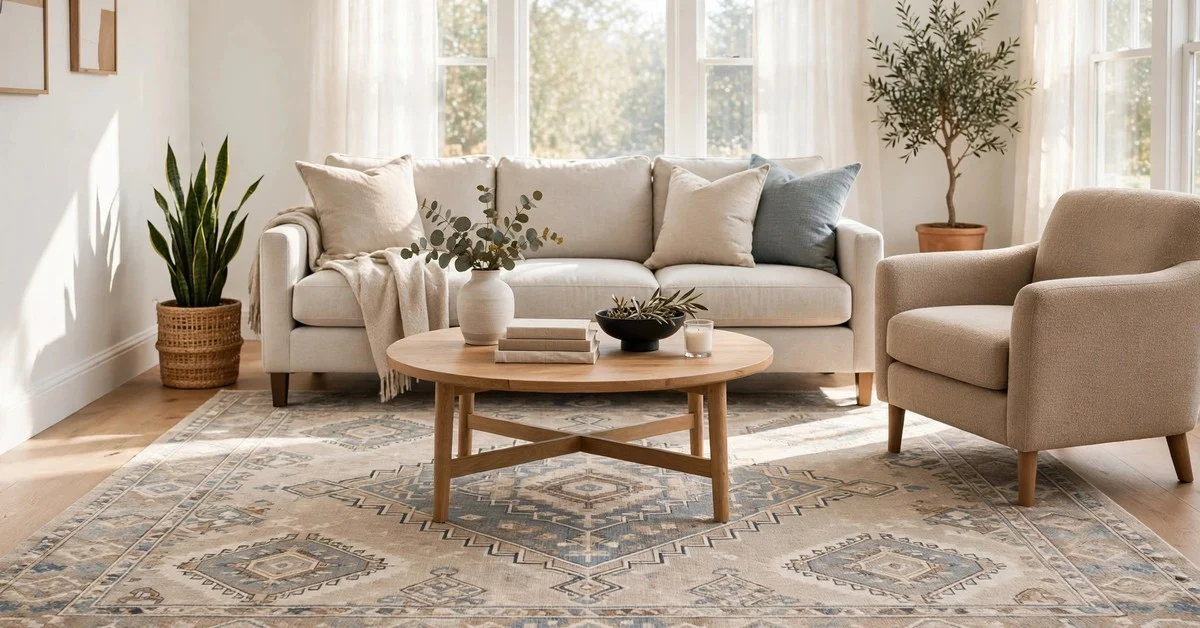
The 8×10 is the default answer to “what size rug for living room” for good reason. Its 80 square feet hold a three-seat sofa, two armchairs, and a coffee table with every leg on the rug, creating the unified, intentional look you see in design magazines. It suits rooms from about 12×15 feet upward and leaves the balanced 18-inch border of bare floor that designers aim for. When in doubt, buy the 8×10. It is the size most living rooms were furnished around.
6. The 9×12 Rug
At 108 square feet, the 9×12 is built for large living rooms and open-plan spaces where an 8×10 would look lost. It anchors sectionals, multiple seating zones, and rooms wider than 14 feet. The extra area also forgives placement mistakes: with this much rug, the front-legs rule takes care of itself. The trade-offs are price, weight, and delivery hassle. But in a big room, nothing else looks right, and a too-small rug is the most expensive mistake because you will replace it.
7. The 10×14 Rug
The 10×14 is a statement size at 140 square feet, meant for great rooms, lofts, and sprawling sectionals. It can define an entire living zone inside an open floor plan, holding a sectional, chairs, coffee table, and even a side table or two. Few standard rooms need it, which is why it is harder to find in stores. Before buying, tape the outline and check your doorways: getting a 10×14 into the room and flat on the floor is a two-person job.
8. The 12×15 Rug
At 180 square feet, the 12×15 approaches wall-to-wall territory. It suits very large living rooms, ballroom-scale spaces, and rooms where the rug is meant to be the floor’s main event. In ordinary homes it overwhelms, leaving almost no bare floor border. Treat it as a special-order size for special rooms. If your living room genuinely needs 180 square feet of rug, you probably already know it.
9. The Front-Legs Rule
This is the single most useful rule in rug sizing: the front legs of the sofa and every chair should rest on the rug, while back legs may sit on bare floor. It connects the furniture into one visual group, which is the whole point of a living room rug. Test it with painter’s tape before buying. If the front legs reach the tape outline, the size works; if they fall short, go one size up. The rule alone answers “what size rug for living room” in most real homes.
10. The 18-Inch Rule
Designers like to see about 18 inches of bare floor between the rug’s edge and the wall. That border frames the rug like a mat frames a photograph and keeps the room from feeling carpeted. In small rooms you can shrink the border to about a foot, but less than that and the rug starts to look like wall-to-wall flooring. The 18-inch rule is also a quick size calculator: subtract 3 feet from each room dimension and you have your ideal rug size.
11. The Small Living Room (10×12 Feet)
In a 10×12-foot living room, the math points to a 5×7 or 6×9 rug. The 5×7 leaves generous bare floor and suits a loveseat plus coffee table; the 6×9 fills the space more confidently with a full sofa. An 8×10 would leave only about a foot of border here, which feels cramped. Small rooms punish oversized rugs, so resist the urge to size up. The right small rug beats the wrong big one every time.
12. The Standard Living Room (12×15 Feet)
This is the classic American living room, and the 8×10 rug was practically designed for it. The rug’s 10-foot side runs along the sofa wall, leaving about 2.5 feet of bare floor at each end and 2 feet on the long sides. A sofa, two chairs, and a coffee table all fit with legs on the rug. If your room matches these dimensions, you can stop researching: buy the 8×10.
13. The Large and Open-Plan Living Room
Rooms wider than 14 feet, or living areas that flow into dining spaces, need the 9×12. Anything smaller looks like an island lost in an ocean of floor, and the furniture group loses its visual anchor. The 9×12 also handles the extra furniture large rooms invite: sectionals, extra chairs, bigger coffee tables. In open plans, the rug’s job doubles as a room divider, marking where the living zone ends and the rest begins.
14. The Sectional Sofa Layout
Sectionals eat floor space, so they usually need a 9×12 rug, sometimes a 10×14 for large L- or U-shaped sectionals. The goal is the same front-legs rule, applied to a much bigger footprint: the chaise, the corner, and the main run should all touch the rug. Measure the sectional’s full length including the chaise before choosing. A sectional hanging halfway off its rug is one of the most common living room mistakes, and it always looks accidental.
15. The Coffee-Table-Only Layout
Some rooms keep seating light: a coffee table between two small chairs, or a bench and a side table. Here a 4×6 or 5×7 rug under just the table is honest and proportionate. The key is that the rug still relates to the furniture around it; a tiny rug floating in a big empty room looks lost no matter what sits on it. For secondary seating areas, reading corners, and sunrooms, the coffee-table-only approach saves money and looks deliberate.
FAQs
What is the most popular living room rug size?
The 8×10 is the best-selling living room rug size by a wide margin. It fits the average living room, holds a full seating group, and hits the price-to-impact sweet spot. If you poll interior designers for one default answer, this is it.
Should all furniture legs be on the rug?
Ideally yes for the main pieces, but the front-legs rule is the practical minimum: front legs on, back legs off is a classic designer look. All legs off looks disconnected, while all legs on looks the most formal and pulled together. Small rugs that catch only the coffee table usually look like a mistake.
How much bare floor should show around a living room rug?
About 18 inches on each side is the designer target. In small rooms, 12 inches is acceptable. Less than that and the rug reads as wall-to-wall carpet; much more and the rug can look undersized for the space.
Round or rectangular rug for a living room?
Rectangular rugs suit nearly every living room because sofas, rooms, and coffee tables are rectangular. Round rugs work under round coffee tables in small or square seating areas, but they rarely anchor a full sofa arrangement as well. When in doubt, go rectangular.
See also: how big a 5×7 rug is.
See also: how big an 8×10 rug is.
Final Thoughts
What size rug for living room dilemmas all resolve the same way: measure the room, apply the front-legs rule, and leave about 18 inches of bare floor. For most homes that means an 8×10, with the 5×7 and 6×9 covering smaller spaces and the 9×12 handling large ones. The painter’s tape trick costs nothing and prevents the most common decorating regret. Get the size right and the rug disappears into the room in the best way: everything simply looks like it belongs.
Approx. word count: 2516

I’m Owen Reeves, a content writer at MeasureZit.com, specializing in measurements, unit conversions, and mathematical concepts. I turn technical topics into clear, accurate content that’s easy to understand. My focus is precision, clarity, and genuinely useful information.