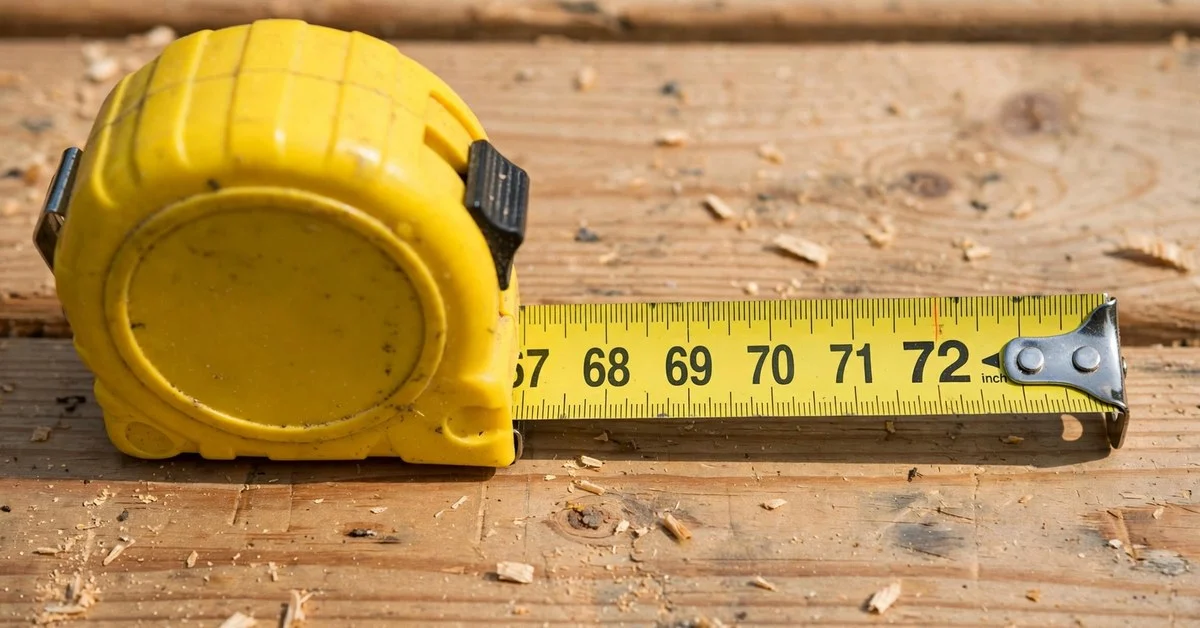
Think of the tallest person you actually know — not a basketball player on TV, a real person you’ve stood next to. Maybe a cousin, a coworker, the friend everyone asks to reach the top shelf. If they’re “six feet tall,” they’re 72 inches from floor to crown, exactly six feet, which works out to 182.88 centimeters or about 1.83 meters. It’s the classic tall-person benchmark, the height where “tall” officially begins in most people’s minds. And it’s everywhere once you start looking: in concert halls, on football fields, in your own closet. Six feet is also the quiet standard behind backboards and harps, armoires and stock tanks — objects that all converged on 72 inches independently. Unlike tidy metric numbers, 72 divides beautifully into halves, thirds, quarters, and sixths, which is why builders, musicians, and ranchers each landed on it for their own reasons. This guide maps 72 inches through the most familiar six-foot object of all — the human body — with fifteen six-footers below and a field guide to reading the height on real people.
Six Feet on Stage and Court
Performance spaces are full of six-foot standards, because stages and courts are built for bodies — and bodies top out around here.
A regulation basketball backboard measures 72 inches wide by 42 inches tall. That six-foot width is why the backboard looks so commanding from the stands: it’s literally as wide as a tall man is tall. The rim hangs 10 feet up, but the board itself is a perfect 72-inch rectangle of glass or acrylic, and every bank shot in every gym on Earth kisses the same six feet of surface.
A concert harp stands about six feet tall, roughly 71 to 73 inches of curved wood and 47 strings. Harpists tilt this towering instrument back onto their shoulder to play, and the full height is functional — those long bass strings need the length to resonate. When the orchestra tunes, the harp rising a full six feet behind the violins is impossible to miss.
A baby grand piano stretches about five to six feet long, nose to tail. The “baby” is relative — at six feet of polished black lacquer it still dominates a living room. That length houses the strings that give the piano its voice: longer strings, deeper bass. When movers warn you about the stairs, they’re talking about six feet of very heavy music.
Six Feet at Home
Your house is quietly full of six-foot verticals and horizontals. Builders and furniture makers love this length because it clears a tall person’s head, spans a wide wall, and still fits through a standard doorway on the diagonal.
A 72-inch armoire is the classic full-height wardrobe — six feet of doors, drawers, and hanging space. It stands a head above most adults, which is exactly why it works: the top shelf holds the stuff you rarely need, everything else lives at arm’s reach. In bedrooms without built-in closets, this is the six-foot solution.
A 72-inch curtain rod is the standard width for dressing a wide window or a pair of windows. Designers hang the rod 4 to 6 inches beyond the window frame on each side, so a 72-inch rod typically dresses a window around 60 inches wide. Extended to its full six feet with finials, it makes the whole wall feel grander.
A 6-foot picture window is the wide-format glass that turns a living room wall into a landscape. At 72 inches wide it frames a view the way a cinema screen frames a film — big enough that your eyes stop seeing “window” and start seeing “outside.” New builds use this width to sell the view before they sell the house.
A 6-foot-wide reach-in closet is the standard double-door closet in bedrooms across the country. Seventy-two inches of hanging rod fits about 36 shirts shoulder to shoulder, or a split of his-and-hers with room to spare. If your closet feels cramped, measure it — there’s a good chance it’s a few inches shy of the full six feet.
Six Feet Where You Lie Down
Some of the most exact 72-inch objects are the tables you stretch out on. Clinics and spas build to six feet because that’s the length of the people lying on them.
A massage table runs about 72 to 73 inches long — six feet of padded vinyl on folding legs. The length fits everyone up to a tall adult with room for the face cradle at one end. Portable models fold to half that length, which tells you something: six feet is the human length, and everything else is just packaging.
An exam table in a doctor’s office measures about 72 inches long. The paper roll, the stirrups, the step stool — all of it is arranged around a six-foot platform, because medicine, like massage, is built around the body. Next time you’re sitting on that crinkly paper, you’re perched on exactly 72 inches.
Six Feet in the Wild
Out in nature, six feet is a serious amount of animal. These are the creatures that make you take a step back — not because they’re the biggest, but because they’re suddenly, unexpectedly, person-sized or more.
A giraffe’s neck alone measures about six feet long. Not the giraffe — just the neck. That six-foot column of vertebrae (only seven of them, the same number as in your neck) lifts the animal’s head into the acacia trees. When a giraffe lowers its head to drink, it’s folding six feet of neck down to the water like a construction crane in reverse.
A red kangaroo — the big males — stands about six feet tall. That’s a marsupial looking you in the eye, with hind legs that can cover 25 feet in a single bound. Tourists always underestimate them until one stands up from the grass, and then the six feet of muscle and claw suddenly commands respect.
A moose carries its shoulders about six feet off the ground, with antlers spreading wider than a tall man is tall. A bull moose at the shoulder is eye-to-eye with a six-foot human, and it outweighs him by half a ton. If you ever meet one on a trail, you’ll understand viscerally what six feet of animal means.
An elephant’s trunk stretches six to seven feet long — a six-foot nose with 40,000 muscles in it, strong enough to uproot a tree and delicate enough to pick up a single leaf. It’s the most extreme six feet in the animal kingdom: longer than a tall human is tall, attached to the front of its face.
Six Feet in the Studio and the Spare Room
A 72-inch folding room divider is the classic three-panel screen — six feet wide when open, tall enough for genuine privacy. It splits studios, hides clutter, and creates a dressing corner in bedrooms without built-ins. The 72-inch width is the standard because it covers a person with room to spare on each side. Fold it flat and it disappears behind a door.
A 6-foot ballet barre is the studio standard, a smooth wooden or metal rail at hip height for warm-ups and practice. Barres run four to eight feet, but six is the sweet spot for a home studio — long enough for real combinations, short enough to mount on a bedroom wall. Dancers measure their space in barres the way carpenters measure in studs.
Reading a Six-Foot Body: Height in Real People
Here’s the signature skill for this length: learning to read 72 inches on a living person. Forget the tape — bodies carry their own measurements, and a six-footer is the easiest body to decode because the proportions are so well documented.
Start at the top. A six-foot person’s eyes sit about 67 to 68 inches off the floor — roughly 94 percent of total height. That means if you’re 5-foot-6 and you have to tilt your head up slightly to meet someone’s gaze, they’re probably around six feet. Eye level is the fastest height test there is: no measuring, no asking, just notice where you have to look.
Drop to the shoulders, about 59 inches up — just under five feet. A six-footer’s shoulder line clears the average kitchen counter (36 inches) by nearly two feet, which is why tall people look slightly folded over standard counters. Their hips sit around 38 to 40 inches, and their inseam runs 32 to 34 inches — the reason “long” sizes exist in menswear and tall women hunt the long rack.
The head itself is about 9 to 10 inches from chin to crown. Artists have used the “seven and a half heads” rule for centuries: a well-proportioned six-foot body is about seven and a half head-heights tall. Count heads in a photograph and you can estimate anyone’s height without a single measurement.
Finally, the arm-span confirmation: a six-foot person’s fingertip-to-fingertip span is about 72 inches. Watch someone with their arms out — if each arm looks like three feet and the chest adds the middle, you’re looking at six feet of wingspan on six feet of person. It’s the same 72 inches, worn two different ways.
The ultimate trick, though, is calibrating against yourself. Whatever your height is, it’s your permanent reference. If you’re 5-foot-6 (66 inches), a true six-footer’s crown sits exactly six inches above yours — half a foot, unmistakable in person. If you’re 5-foot-2, the gap is ten inches, nearly a full head. Memorize the difference between your height and 72 once, and every six-footer you meet becomes a walking calibration mark. Photographers use this instinctively: put the known-height person next to the unknown object and the whole image becomes measurable. You can do the same at a glance — in stores, on sidewalks, anywhere. Your own body is the ruler; six feet is just the most useful mark on it.
Six-Foot Questions From Real Life
How can I tell if someone is really six feet tall?
Use the eye-level test. Stand on flat ground and notice where their eyes fall relative to yours — if you’re 5-foot-8 (68 inches) and their eyes are noticeably above yours, they’re likely six feet or more, since a six-footer’s eyes sit around 67 to 68 inches. For a harder check, stand back to back: the crown of a true six-footer reaches 72 inches, which is four inches above the top of a standard 68-inch refrigerator. No tape needed, just a fridge and some honesty.
Is six feet considered tall for a woman?
Very. The average American woman stands about 5-foot-4, so a six-foot woman is roughly eight inches above average — around the 99th percentile. She’ll be the tallest person in most rooms and will have spent a lifetime hearing about it. Clothing is the real friction: inseams, sleeve lengths, and dress proportions are all cut for shorter frames, which is why tall women’s specialty lines exist.
Why does six feet feel so much taller than five-foot-ten?
Because of thresholds. Five-ten is “tall-ish”; six feet is “tall” — it’s a round number, a cultural benchmark, and the height where you start ducking under low doorframes and tree branches. Psychologically, crossing from the fives to the sixes feels like entering a new category. Physically it’s only two inches, but socially it’s a promotion — the same reason 99 cents feels cheaper than a dollar. Ask anyone who’s grown from 5’11” to 6’0″ in their teens: the compliments started before the growing stopped.
Do I need a 72-inch curtain rod for a 72-inch window?
No — you need a wider one. Curtain rods should extend 4 to 6 inches beyond the window frame on each side so the curtains can stack clear of the glass. For a 72-inch window, look at an 84- to 96-inch rod. A 72-inch rod on a 72-inch window leaves the curtains permanently covering the edges of the glass, which shrinks the light and the view.
What’s the best way to photograph a six-foot-tall piece of furniture for a listing?
Put a person next to it. Buyers can’t parse “72 inches tall” from a photo, but they instantly understand a bookcase that reaches the top of your head. Shoot straight-on (not from above, which shortens everything), include a full human figure for scale, and mention the exact inches in the description. The person does the emotional work; the number closes the deal.
See also: how long 48 inches is.
See also: how long 6 feet is.
Six Feet, Personified
Seventy-two inches isn’t really about inches at all — it’s about people. It’s the tall friend, the harpist behind the violins, the backboard above the rim, the moose at the treeline. Read it in eye levels and shoulder lines, in arm spans and head counts, and six feet becomes the most intuitive measurement you own. After all, you’ve been looking at six-foot bodies your whole life — in doorways, on stages, across dinner tables. Now you know exactly what you’re seeing: 72 inches, personified, standing right in front of you. Measure the next one you meet — the eyes, the shoulders, the span. You’ll be right.

I’m Priya Sharma, a content writer at MeasureZit.com, specializing in measurements, unit conversions, and mathematical concepts. I turn technical topics into clear, accurate content that’s easy to understand. My focus is precision, clarity, and genuinely useful information.










