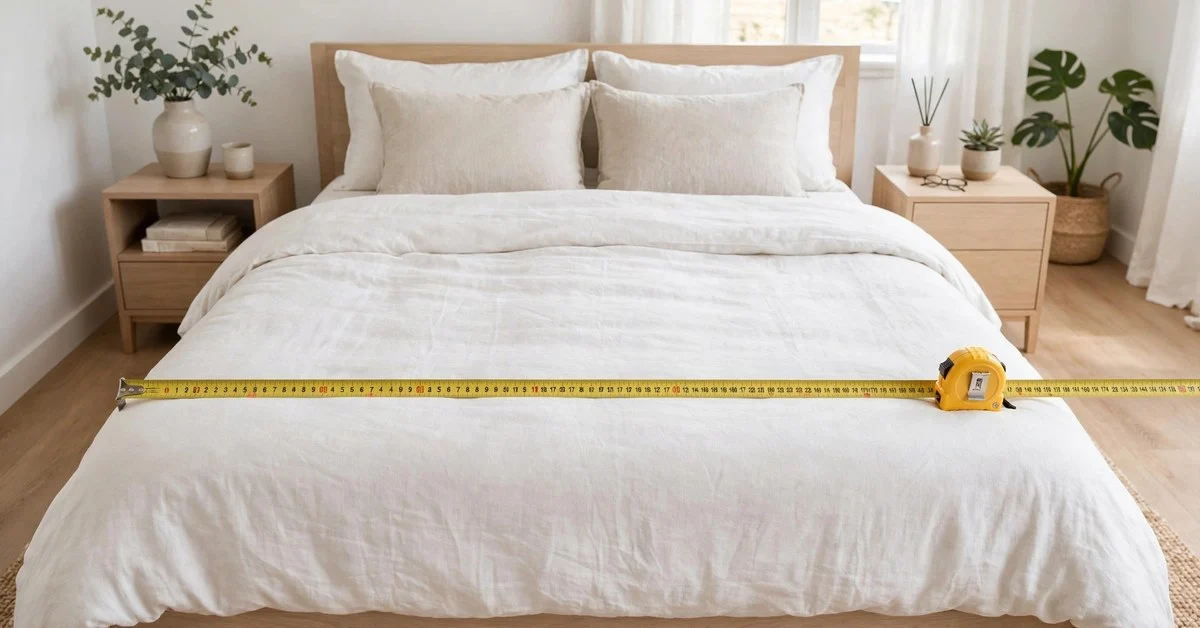
The smartest ten minutes in mattress shopping cost about three dollars: a roll of painter’s tape, a tape measure, and the willingness to look slightly ridiculous. You tape a 60-by-80-inch rectangle on your bedroom floor, and suddenly the abstract question “will a queen fit?” becomes a physical fact you can walk around. Couples discover the nightstands will not fit. Renters discover the closet door clips the bed’s corner. Tall shoppers lie down inside the rectangle and learn, before spending a cent, whether their feet hang off. A queen size bed measures 60 inches wide by 80 inches long — 5 feet by 6 feet 8 inches — the most popular mattress size in America. This guide is built around that taped rectangle: a floor-plan walkthrough for your actual room, the exact dimensions in every unit, fifteen everyday objects that match the footprint, and the comparisons that decide queen versus everything else.
The floor-plan walkthrough: taping out a queen in your room
Start with the rectangle. A queen is 60 inches wide and 80 inches long, so unroll painter’s tape and mark those dimensions on the floor where the bed would go — headboard wall first, since the head of the bed rarely moves. Use the blue tape, not the beige: it peels off cleanly and you will be repositioning it. Mark all four corners, then run the tape along all four sides so you have a complete outline, not just corner ticks. Step back and look at it. This is the single most informative moment in the whole process — most people are surprised, in one direction or the other, by how much floor 60 by 80 actually claims.
Now walk the clearances, because the rectangle is only the beginning. You need about 24 inches of walking space on each side of the bed for making it and getting in and out — tape those strips too, extending the outline to roughly 108 inches wide in total. At the foot, leave 24 to 36 inches if you want a bench or trunk, or if the bedroom door swings toward the bed. Then test the door swings: open every door in the room — bedroom door, closet door, bathroom door — and watch where the arcs fall relative to your taped rectangle. A closet door that swings into the bed’s corner is the classic queen-room failure, and it is invisible until you tape it out. Finally, lie down inside the rectangle. If you are up to about 6 feet 4 inches, the 80-inch length covers you; if your feet cross the tape, you have learned something valuable for thirty cents’ worth of tape.
The walkthrough also settles the furniture question. Place your nightstands — real ones, dragged in from wherever they live — at the taped head corners. Standard nightstands are about 24 to 28 inches wide, so two of them plus the 60-inch bed need roughly 110 to 116 inches of wall. If your wall is 120 inches (10 feet), it fits with breathing room; if it is 108, it fits but snugly. Do the same with the dresser: a 60-inch dresser needs its own wall, and the taped rectangle shows you which walls remain. When the tape comes up, you will know three things no spec sheet can tell you: the bed fits, the doors clear, and the furniture has a home. That is a ten-minute investment against years of squeezing past a bed that is six inches too big for the room.
Queen dimensions: 60 by 80 inches, decoded
| Measurement | Inches | Centimeters |
|---|---|---|
| Width | 60 | 152.4 |
| Length | 80 | 203.2 |
| Width in feet | 5 | — |
| Length in feet | ≈ 6.67 | — |
| Sleeping surface area | ≈ 33.3 sq ft | ≈ 3.1 sq m |
The two numbers to internalize: 60 inches wide — each of two sleepers gets 30 inches of personal space, the width of a standard office chair — and 80 inches long, which is 6 feet 8 inches of legroom. The 80-inch length is shared with the king, which is why tall sleepers often choose the queen over nothing: it is the shortest bed that still fits most tall people. In metric, 152.4 by 203.2 centimeters, and the sleeping surface covers about 3.1 square meters — roughly the floor area of a small bathroom, devoted entirely to sleep.
Fifteen household stand-ins for 60 by 80
Every item below matches the queen’s 60-inch width or 80-inch length within a few inches — objects you can picture to feel the footprint before you tape it.
- A 60-inch round area rug. Round rugs are sold by diameter, and 60-inch models are common — an exact match for the bed’s width. Lay one’s diameter across your mental image of the bed and the widths align perfectly.
- A 60-inch bathroom vanity. Double-sink vanities are standard at 60 inches wide — exactly the queen’s width. Your bathroom’s centerpiece is as wide as your bed.
- A 60-inch storage bench. The benches that sit at the foot of beds commonly run 48 to 60 inches, with 60 the full-size choice — an exact width match. The bench made for the bed’s foot is as wide as the bed itself.
- A 60-inch media console. Consoles built for 55-inch TVs run about 60 inches wide — precisely the queen’s width. The TV stand in your living room knows the bed’s width.
- A 60-inch round patio table. Outdoor dining tables commonly come in 60-inch diameters — an exact width match. The table that seats six on the patio is as wide as the bed is across.
- A 6-foot-8 person’s height (80 inches). Stand a very tall person — 6 foot 8 — next to the bed’s length and they match it inch for inch. Human height is the most intuitive gauge there is, and this one nails the length exactly.
- An 80-inch-tall bookcase. Tall bookcases run 72 to 84 inches high, and 80-inch models are common — an exact length match. Tip it mentally onto its side and you have the bed’s length.
- Standard 84-inch curtain panels. Ready-made curtains are famously sold in 84-inch lengths — four inches longer than the bed. Hang them mentally beside the bed and the curtains stretch just past the mattress’s foot.
- A 60-inch garden bench. Outdoor benches run 48 to 72 inches long, with 60 a standard size — an exact width match. The bench on the porch is as long as the bed is wide.
- An 80-inch pantry cabinet. Tall kitchen pantry cabinets run 72 to 84 inches high, with 80 common — an exact length match. Your kitchen storage is as tall as your bed is long.
- A 60-inch-wide dresser. Wide dressers commonly run 60 inches — exactly the queen’s width. The dresser against your bedroom wall is already speaking the bed’s language.
- A 60-inch deck box. The large outdoor storage boxes for cushions and pool gear run 48 to 60 inches long, with 60 the big size — an exact width match. Patio storage and bedroom sleep, dimensionally united.
- An 80-inch dining table. Dining tables that seat eight run about 80 inches long — an exact length match. The table that hosts Thanksgiving dinner is as long as the bed you will nap on afterward.
- A 60-inch picture window. Wide picture windows are commonly sold in 60-inch widths — an exact width match. The window lighting your living room is as wide as the bed is across.
- A full-size pickup truck’s width (about 80 inches). Full-size pickups run roughly 80 inches wide excluding mirrors — an exact length match. The truck in the driveway is as wide as the bed is long, which explains why moving a queen mattress in a pickup bed works so well.
Queen vs. the field
The queen’s dominance makes sense only in comparison. Against the full (double) at 54 by 75 inches, the queen adds six inches of width and five of length — about nine extra square feet of sleeping surface. For couples, that is the difference between elbows touching all night and actual personal space; it is the most cost-effective sleep upgrade in bedding. Against the king at 76 by 80, the queen gives up sixteen inches of width but keeps the identical 80-inch length — tall sleepers lose nothing in legroom. The king demands a 12-by-12-foot room minimum; the queen is comfortable in 10 by 10. Against the twin XL at 38 by 80, the queen is simply two sleepers’ worth of width at the same length — which is why guest rooms so often graduate from twin to queen.
The room-size math is what actually decides. A 10-by-10-foot bedroom (120 by 120 inches) fits the queen plus 24 inches of clearance on three sides with room for two nightstands — the practical minimum, and it works. A 10-by-12 room adds comfort: space for a dresser and easy bed-making access. Below 10 by 10, the queen starts to dominate — the taped walkthrough will show you the doors clipping and the clearances vanishing, and that is your signal to consider a full. The queen is America’s default bed because it is the largest size that fits a standard bedroom without negotiation. Tape it out, walk it, and you will feel exactly why.
Queen-size planning questions
What is the smallest room a queen bed fits in?
A 10-by-10-foot bedroom is the practical minimum. The 60-by-80-inch bed plus about 24 inches of walking space on each side and at the foot consumes most of the floor, leaving just enough for two nightstands. In a 9-by-10 or smaller room, the taped walkthrough will show door swings clipping the bed and clearances under 18 inches — at that point a full-size bed (54 by 75) is the smarter choice. Always tape it before you buy; room dimensions on a floor plan do not account for door swings and baseboards.
Will a queen mattress fit up my stairs?
Usually yes, with technique. A queen mattress is 60 by 80 inches of flexible rectangle — it bends around stairwell turns that a rigid box spring cannot. The classic move is the “taco”: fold or roll the mattress slightly (only for mattresses designed to flex — most foam and hybrid queens tolerate this, traditional innersprings less so) and carry it on edge. Measure the stairwell’s narrowest point, including the handrail: you need about 62 inches of clearance to pivot the 60-inch width. When in doubt, a split queen box spring (two 30-by-80 halves) solves the rigid part of the problem.
What size sheets fit a 60×80 mattress?
Queen sheets — they are made for exactly this size. Buy fitted sheets labeled “Queen” with a pocket depth matching your mattress thickness: standard is 14 to 16 inches, deep-pocket runs 18 to 22 for pillow-top mattresses and toppers. Flat sheets and duvet covers labeled queen will fit with the usual overhang. The one trap: “queen” and “full/queen” are sometimes combined on flat sheets and comforters, which is fine, but fitted sheets must be true queen — a full fitted sheet will not stretch over 60 inches of width.
How much bigger is a queen than a full?
Six inches wider and five inches longer — 60 by 80 versus 54 by 75. That sounds modest until you do the area: the queen offers about 33.3 square feet of sleeping surface against the full’s 28.1, roughly 18 percent more room. For two sleepers, each person gains three inches of width — the difference between sleeping back-to-back and sleeping with breathing room. It is the single most noticeable standard upgrade in bedding for the money.
Can two adults sleep comfortably on a queen?
Yes — it is the standard couple’s bed for a reason. Each sleeper gets 30 inches of width, about the width of a crib mattress per person, and the 80-inch length fits sleepers up to about 6 foot 4. Couples who are both restless sleepers, who co-sleep with kids or large dogs, or where one partner is significantly larger sometimes graduate to a king for the extra 16 inches of width. But for the large majority of couples, the queen’s balance of space and room-fit is exactly right.
See also: king bed dimensions.
See also: full bed dimensions.
Tape it, walk it, sleep on it
The queen bed’s dimensions — 60 inches wide, 80 inches long — have made it America’s default because they solve the bedroom equation better than any other size: room for two, legroom for the tall, and a footprint that fits a 10-by-10 room without a fight. But “fits on paper” and “fits your room” are different things, separated by door swings, nightstands, and the walk to the bathroom at 3 a.m. That is what the painter’s tape is for. Ten minutes, three dollars, one rectangle on the floor — and you will know, with your own feet, whether the queen belongs in your room. The objects above give you the mental picture; the tape gives you the proof. When both agree, buy the mattress with confidence and enjoy the most popular bed size in the country for exactly the reasons it got popular.

I’m Dane Whitfield, a content writer at MeasureZit.com, where I specialize in creating clear, accurate articles on measurements, unit conversions, and mathematical concepts. I enjoy breaking down complex numerical topics into simple, practical explanations that readers can actually use. My goal is always precision and clarity helping people make sense of the numbers around them.