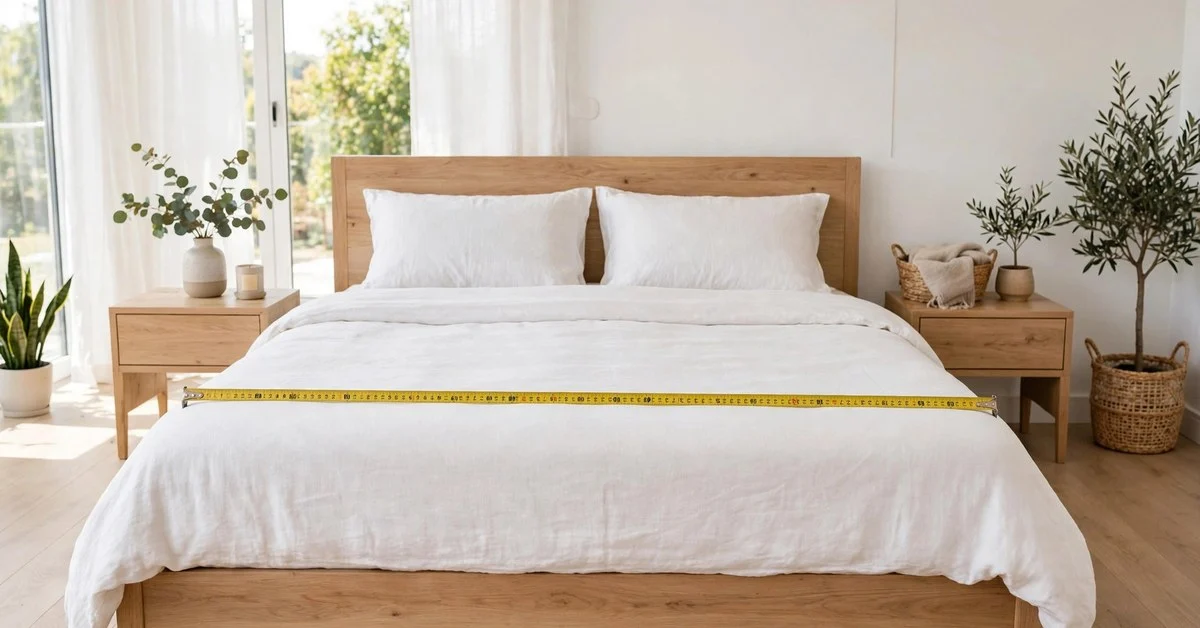
A couple moves into their first apartment, buys a full-size bed because the bedroom is small, and discovers at 2 a.m. what the spec sheet never told them: 54 inches of width split two ways is not very much bed per person. A full size bed measures 54 inches wide by 75 inches long (137.2 × 190.5 cm) — sixteen inches wider than a twin, six inches narrower than a queen, and the most misunderstood size on the sales floor. Salespeople call it “plenty for two,” spec sheets call it a double, and your shoulders at midnight will call it something else entirely. Whether that is generous or cramped depends entirely on how many people sleep in it, which is why this guide leads with the math that matters: the space-per-sleeper numbers for solo sleepers, couples, and guest rooms. You will also get every conversion, fifteen everyday objects matched to 54 × 75, and an honest verdict on the question every buyer asks — is a full actually big enough for two?
Full bed numbers, converted every way
The full — Americans also call it the double — is defined by two numbers. Here they are in the units you will meet on tape measures, furniture tags, and bedding labels.
| Measurement | Inches | Feet and inches | Centimeters |
|---|---|---|---|
| Width | 54 | 4 ft 6 in | 137.2 |
| Length | 75 | 6 ft 3 in | 190.5 |
| Sleeping surface | 4,050 sq in | 28.1 sq ft | 2.61 sq m |
| Width per sleeper (two) | 27 | 2 ft 3 in | 68.6 |
Two numbers in that table do all the talking. The 75-inch length matches a twin exactly — anyone who fits a twin lengthwise fits a full. The 54-inch width is the whole story: four and a half feet, or one and a half yards, of side-to-side space. Like the twin, add 2 to 4 inches per side for the frame when you plan the room, so the real-world footprint runs about 57 × 78 inches.
The 27-inch question: what each sleeper actually gets
This is the signature math of the full-size bed, and it decides the purchase. Divide the 54-inch width by the number of sleepers and you get the personal-space budget — the strip of mattress that is actually yours.
One sleeper: 54 inches of sprawl
A solo adult on a full gets the entire 54 inches — nine inches more width than a twin sleeper, and more rolling room than most people use. Side sleepers can starfish, back sleepers can spread out, and there is still mattress left over. For one person, the full is genuinely luxurious: the width of a loveseat, all yours, at a price well below a queen. If you sleep alone and your room can take a 10-by-10-foot layout, the full is the sweet spot between the twin’s economy and the queen’s footprint.
Two sleepers: 27 inches each
Here is the number that ends arguments: 27 inches per person. For context, a standard crib mattress is 28 inches wide — so each adult in a shared full gets less width than a baby gets in a crib. A twin bed gives its single sleeper 38 inches; a queen gives each of two sleepers 30 inches. The full’s 27 sits at the bottom of the adult range. Couples who sleep still, back-to-back, often find it fine. Couples with a sprawler, a blanket thief, or different schedules usually do not. The honest rule: a full works for two when it is temporary — guests, naps, the first apartment — and a queen earns its keep when it is nightly.
The guest-room verdict
For a guest room, the full is arguably the best bed size made. Guests usually sleep solo, which means they get the full 54-inch sprawl, and the smaller footprint leaves the room feeling generous rather than bed-dominated. When a couple visits for a weekend, the 27-inch math applies — but for two or three nights, most couples manage happily, especially with the 75-inch length giving everyone legroom. The full lets a 10-by-10 guest room keep a reading chair and a real walkway, which a queen would eat. Buy the full for the guests; buy the queen for yourselves.
Fifteen everyday stand-ins for 54 by 75
Fifteen real objects, each checked against the full’s 54-inch width or 75-inch length. Stand them next to the bed in your mind and the numbers turn physical.
- A full-size futon mattress (54 × 75 in). The exact match — futons are built on the same standard. If you have ever slept on a full futon, you have slept on full dimensions; the only difference is the frame it sits on.
- A queen bed (60 × 80 in). The upgrade, quantified: six inches wider, five inches longer. Those eleven inches of difference are what $200 to $400 extra buys, and at 2 a.m. they feel like a lot more than eleven inches.
- A twin bed (38 × 75 in). The same 75-inch length, sixteen inches narrower. Picture a twin, then add a large throw pillow’s width to each side — that is the full. Same legroom, roomier shoulders.
- A bath towel (30 × 54 in). A standard bath towel’s 54-inch length matches the bed’s width exactly. Lay one across the mattress and it spans edge to edge — a weirdly perfect ruler you already own.
- A shower curtain (72 × 72 in). Three inches shy of the bed’s length on each axis. Your shower curtain is essentially a square preview of the mattress, minus a hand’s width.
- A loveseat (about 58 in wide). Four inches wider than the bed. Sit two people on a loveseat and watch the shoulder negotiation — that is the documentary version of sharing a full every night.
- A pickup truck bed (50 in between the wheel wells). Four inches narrower than the mattress. The flat load floor of a short-bed pickup is the closest most garages come to a full-size bed, which is also why moving a full mattress in a pickup works: it fits between the wells with room to breathe.
- Three coach airplane seats (about 54 in combined). Three economy seats at roughly 18 inches each span exactly the bed’s width. Next flight, look at your row: that is your mattress, side to side — and a reminder of why the middle seat is the worst one.
- A park bench (72 in long). Three inches short of the bed’s length. The classic six-foot park bench is the outdoor twin of the mattress — lie down on one (we have all thought about it) and you are three inches from full-size.
- Two king pillows end to end (72 in). King pillows run 20 × 36 inches; two laid end to end span 72 inches, three short of the bed’s length. It is also a buying tip: two king pillows across a full leave a small gap, which is why standard pillows (20 × 26) fit it better.
- Two sleeping bags side by side (about 60 in). Standard rectangular bags are roughly 30 inches wide each, so a pair overlaps the full by six inches. Campers know this width intimately — it is the “we fit in the tent, barely” measurement.
- A gathered hammock (about 54 in wide). A double hammock’s fabric width lands right around the bed’s width. The comparison is about honesty: a hammock wraps you; a shared full just feels narrow. Same inches, different physics.
- A dining bench (about 60 in long). Six inches longer than the bed is wide. The bench that seats three at the table is a decent preview of the mattress’s width — sit three across it and you feel the 27-inch question in your shoulders.
- A queen air mattress (60 × 80 in). The inflatable twin of the queen bed: six inches wider and five longer than the full. If your guests sleep fine on the air mattress, they will sleep fine on the full — the real bed is only slightly smaller.
- A 4 × 8 plywood sheet (48 × 96 in). Six inches shy of the bed’s width, twenty-one past its length. Anyone who has wrestled plywood through a doorway knows the handling lesson transfers directly: the full turns corners about as easily as a sheet of plywood does.
Where the full sits in the bed lineup
Line up the standard sizes and the full’s position is obvious — and so is its trade-off. Twin: 38 × 75. Twin XL: 38 × 80. Full: 54 × 75. Queen: 60 × 80. King: 76 × 80. The full is the only size that pairs a short length (75, shared with the twins) with a medium width (54). That makes it the right answer in exactly two situations: a solo sleeper who wants sprawl without a queen’s footprint, or a small guest room that occasionally hosts two. It is the wrong answer for a tall couple’s primary bed — the queen costs more and eats more floor, but the extra six inches of width and five of length are the cheapest sleep quality money buys. Note the length trap: at 75 inches, the full fits sleepers up to about 6-foot-1 comfortably. Taller than that, and the queen’s 80 inches matters more than any width math. One more wrinkle before you commit: because the full is less popular than the queen, in-store bedding selection runs thinner — fewer colors, fewer thread counts, and duvet covers that sell out in the patterns you actually want. Online selection is fine, but if you like choosing sheets in person, the queen’s popularity is a quiet point in its favor.
Couples and hosts ask these first
Is a full size bed big enough for two adults?
For a night or a weekend, yes. For every night, it depends on the couple. The math is 27 inches of width per person — workable for still sleepers, tight for sprawlers. Most couples who try a full as a primary bed upgrade to a queen within a couple of years, not because the full is broken but because 30 inches each (the queen’s share) is the threshold where elbows stop negotiating.
What is the difference between a full and a double bed?
In the United States, nothing — “full” and “double” are two names for the same 54 × 75-inch size, and bedding labeled either one fits. Watch out internationally: a UK double is 53 × 75 inches (a touch narrower), and European doubles vary by country. If you buy bedding abroad, check the centimeter label, not the name.
What room size does a full bed need?
A 10-by-10-foot room is the comfortable minimum: the framed bed (about 57 × 78 inches) plus a 30-inch walkway on one long side and the foot, with room left for a dresser or a chair. In a 9-by-12 room, put the bed’s head on the short wall and the layout breathes better. Below about 90 square feet of room, the full starts to dominate — that is twin territory.
Can a tall person sleep on a full?
Up to about 6 foot 1, yes — the 75-inch length matches a 6-foot-3 person end to end, so a 6-foot-1 sleeper keeps a couple of inches past the feet. Past 6-foot-2, feet hit the footboard, and the queen’s 80-inch length becomes the real upgrade — more important than the width difference. Tall solo sleepers should cross-shop the twin XL (38 × 80) too: narrower, but longer.
What size sheets fit a full bed?
Full-size sheets, made for 54 × 75-inch mattresses. A standard flat sheet runs about 81 × 96 inches. The gotcha is mattress depth: modern fulls run 10 to 14 inches thick, and older “full” fitted sheets were cut for 8-inch mattresses. Check the pocket depth on the package against your mattress thickness before you buy, especially with a topper.
See also: twin bed dimensions.
See also: queen bed dimensions.
Honest math for a shared bed
The full size bed dimensions — 54 by 75 inches — tell two different stories, and the sleeper count picks which one you hear. One sleeper hears luxury: 54 inches of width, room to roll, a guest room that feels generous. Two sleepers hear negotiation: 27 inches each, less than a crib mattress per person, fine for weekends and thin for decades. Measure your room, count your sleepers, and let the 27-inch question decide. Get that number right and the full is one of the smartest buys in the bedroom — get it wrong and no throw pillow arrangement will fix it. The tape measure takes thirty seconds; the mattress lasts a decade.

I’m Owen Reeves, a content writer at MeasureZit.com, specializing in measurements, unit conversions, and mathematical concepts. I turn technical topics into clear, accurate content that’s easy to understand. My focus is precision, clarity, and genuinely useful information.










