The delivery app asks how many pizzas, and suddenly you are doing catering math for your own living room: two adults, a teenager, a seven-year-old who eats like a teenager. One 12-inch or two? A 12 inch pizza measures 12 inches across (30.5 cm), covers about 113 square inches, and comfortably feeds 2 to 3 people — the classic medium at most pizza chains, the size that anchors family pizza night across the country. But “feeds 2 to 3” hides all the real questions: how hungry is everyone, how many slices does that actually mean each, what happens when the teenager invites a friend, and when does the second pie become the smart call instead of an extravagance? This guide is a servings planner first and a size guide second. You will get the dimensions in every unit, a mouth-by-mouth breakdown of what one 12-inch covers, fifteen everyday objects for scale, and the area math that settles medium-versus-large once and for all.
Twelve inches, measured every way
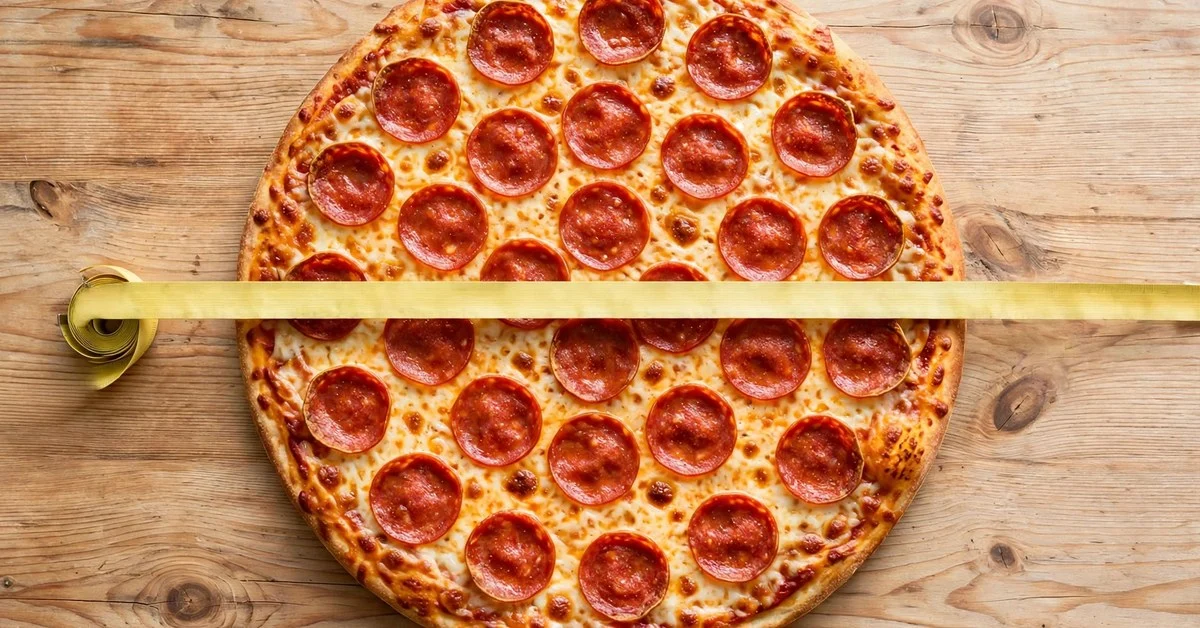
Pizza sizes are sold by diameter, so “12 inch” means 12 inches straight across the middle, crust to crust. Every other number flows from that one.
| Measurement | Inches | Centimeters | Feet |
|---|---|---|---|
| Diameter | 12 | 30.5 | 1.0 |
| Radius | 6 | 15.2 | 0.5 |
| Area | 113.1 sq in | 729.7 sq cm | 0.79 sq ft |
| Circumference | 37.7 | 95.8 | 3.14 |
The number that matters most at order time is the area: 113 square inches of actual pizza. And here is the serving foundation everything below builds on — most pizzerias cut a 12-inch into 8 slices, which means each slice carries about 14 square inches of pizza. Two slices is a snack, three is a light meal, four is dinner. One more useful figure: the crust ring. On a typical 12-inch, about an inch of the edge is crust with little topping, so the loaded middle is closer to 10 inches across — roughly 79 square inches of the good stuff. That is why the last slice always looks smaller than you remember; the topping zone was never the full 12 inches. Hold that thought; the servings planner runs on it.
How many mouths does a 12-inch feed? The servings planner
Forget “feeds 2 to 3” — appetites are not interchangeable. Here is the 12-inch broken down by who is actually at the table, assuming the standard 8-slice cut.
Two adults, average appetite: one pizza, perfectly
This is the 12-inch’s home turf. Four slices each, about 56 square inches of pizza per person — a full dinner with no doggy bag and no one eyeing the last slice. If both of you are genuinely hungry after a long day, add a side (breadsticks, a small salad) rather than a second pizza; the sides cost less and the pizza math stays clean. Total: one 12-inch.
Two adults plus a teenager: order the second pie
Three people, eight slices — the math already fails before appetite enters the picture. Give the teenager three slices, each adult two and a half, and someone is doing division at the table. Two 12-inch pizzas (16 slices) give everyone four to five slices with margin, and the per-square-inch price of the second pie is usually the cheapest food on the order. Total: two 12-inch pizzas.
Family of four with young kids: one pizza plus sides
Two adults at three slices each plus two kids at one slice each totals eight slices exactly — the whole pizza, no margin. It works, but only with a side dish absorbing the variability: a salad, wings, or garlic knots. Without sides, the safer call is a 12-inch plus a 10-inch small, or stepping up to a single 14-inch large (154 square inches, about 36% more pizza). Total: one 12-inch plus sides, or size up.
Kids’ party: count slices, not kids
Children aged 6 to 10 reliably eat two slices each at a party, where pizza competes with cake, snacks, and chaos. That makes one 12-inch good for four kids — but parties have stragglers and second-helping moods, so plan one pizza per three kids and round up. Eight kids means three 12-inch pizzas (24 slices), which also covers the two adults supervising. And order at least one plain cheese: the fancy toppings always have leftovers, the cheese never does. Total: one 12-inch per 3 kids, rounded up.
Game night with friends: the two-pizza rule
Four adults grazing over three hours will out-eat four adults at dinner, because grazing has no natural stop — the box stays open, hands keep wandering back, and half a pizza can vanish during a single board game. Two 12-inch pizzas (16 slices, four each) is the baseline; five or six grazers need three. The move experienced hosts learn: order two to start and have the third ready to reorder at halftime, because delivery takes 30 to 45 minutes and hunger does not wait. Cold pizza reheats fine, but running out mid-game does not. Total: two 12-inch pizzas for four grazers.
Fifteen 12-inch stand-ins from around the house
Twelve inches is a common size in the wild. Fifteen real objects, each about a foot across, to calibrate your eyes before the box arrives.
- A lazy Susan (12 in diameter). The turntable in the middle of the dining table is usually exactly pizza-sized. Spin it and you are looking at the footprint of your dinner.
- A cake stand (12 in plate). The pedestal plate that holds celebration cakes matches the pizza exactly — which makes sense, since both are built to present a round foot-wide centerpiece.
- A large salad bowl (12 in diameter). The big serving bowl from the nesting set, the one that holds salad for six. Its rim is the pizza’s rim.
- An embroidery hoop (12 in). The largest standard hoop size. Crafters know this circle well — stretch the fabric and you have outlined a medium pizza.
- A bar-stool seat (about 13 in round). An inch wider than the pizza. Sit on one and the seat under you is essentially the pie you are about to eat — a fitting preview.
- A nursery pot (12 in diameter). The big plastic pot that a small tree or large shrub comes in from the garden center. Its rim is a perfect 12-inch circle.
- A round wall mirror (12 in). The small decorative round mirror in the hallway. Its face is the pizza’s face — check your reflection, then order dinner.
- A round serving tray (12 in). The handled tray that carries drinks to the patio. Set the pizza on it and the crust meets the rim all around.
- A 12-inch desk fan. The compact oscillating fan, measured by blade diameter. Its circular grille is the pizza’s exact outline — a summer-night coincidence.
- A drum practice pad (12 in). The rubber disc drummers thwack silently. Same diameter as the pizza, wildly different dinner conversation.
- A glass cloche (12 in). The dome cover for cheese boards and cake plates. Lift it and the circle it was guarding is pizza-sized.
- A pendant light shade (12 in). The drum shade hanging over the dining table. Look up: the shade’s width is tonight’s pizza width.
- A bamboo steamer (12 in). The stacked baskets for dumplings. The bottom tier is a 12-inch circle — savory round food, different continent.
- A snare drum (14 in — two inches wider). The contrast that proves the rule: a snare is noticeably bigger than your pizza. If the drum looks right, the medium will look small.
- A charger plate (13 in). The decorative plate under the dinner plate at formal settings — one inch wider than the pizza. Your pie would sit inside it with a finger of room to spare.
The area math that decides medium vs. large
Here is the single most useful pizza fact you will read: area grows with the square of the diameter, so small diameter bumps buy big pizza gains. A 10-inch small covers about 79 square inches; the 12-inch medium covers 113 — that is 44% more pizza for a 20% wider pie, and the price gap at most shops is far smaller than 44%. Going the other way, the 14-inch large covers 154 square inches, about 36% more than the 12-inch, and the 16-inch extra-large covers 201 — nearly double the medium. Put concrete numbers on it: if a 12-inch costs $14 and a 14-inch costs $17, you are paying about 12.4 cents per square inch for the medium versus 11 cents for the large. The larger pie is cheaper food and more food. So the ordering rule writes itself: when a 12-inch feels like “almost enough,” the step up is not a little more pizza, it is more than a third more. Compare the menu prices per square inch — divide the price by the area — and the larger size wins on value almost every time. The 12-inch is the right call when it truly fits the headcount; the moment it does not, upsize instead of doubling up, because two mediums cost more per square inch than one large in nearly every shop.
Ordering questions, answered
How many slices are in a 12 inch pizza?
Eight, at most pizzerias — the standard cut. Each slice carries about 14 square inches of pizza. Some shops will cut it into 6 extra-large slices or 10 smaller ones on request, and square-cut (tavern-style) shops produce a dozen-plus small pieces, but 8 triangular slices is the default you should plan around.
Is a 12 inch pizza enough for three adults?
It is tight but doable: eight slices across three people is two or three slices each, which satisfies average appetites but leaves no margin for a hungry day. The honest test is the teenager test — if anyone at the table eats like a teenager, order the second pizza or step up to a 14-inch. With a side salad or wings, one 12-inch covers three adults comfortably.
What is the difference between a 12 inch and a 14 inch pizza?
Two inches of diameter and 36% more pizza — about 113 versus 154 square inches. The 14-inch feeds 3 to 4 people where the 12-inch feeds 2 to 3, and it is usually cut into 8 or 10 slices. If the price difference on the menu is less than about a third, the large is the better buy per square inch.
How big is the box a 12 inch pizza comes in?
A 12 × 12-inch square, plus a little margin — figure 12.5 inches square in practice. That matters for two reasons: it needs a full foot of counter space, and two 12-inch boxes side by side need 25 inches of fridge shelf, which most fridges cannot offer. Plan the landing zone before the delivery arrives, and if you are stacking boxes, put a sheet of parchment between them — the bottom box’s steam will sog the top box’s crust otherwise.
How many calories are in a 12 inch pizza?
A whole 12-inch cheese pizza runs roughly 1,600 to 2,000 calories depending on crust thickness and cheese load — about 200 to 250 per slice across 8 slices. Peppers, mushrooms, and other vegetable toppings barely move the number; meats and extra cheese move it a lot. Two slices is a reasonable 400-to-500-calorie meal for most adults.
Should I order one 12-inch or two 10-inch pizzas?
One 12-inch, almost always. A 12-inch covers about 113 square inches while two 10-inch pizzas cover about 157 combined — so the pair is more food, but it also costs nearly twice the price of a single medium at most shops. Unless you need two different topping sets (one vegetarian, one meat), the single 12-inch is the better value, and it arrives in one box instead of two.
See also: how big a 14 inch pizza is.
See also: how big a 16 inch pizza is.
One pie or two? Now you know
So how big is a 12 inch pizza? Twelve inches across, 113 square inches, eight slices — and now you know exactly how far those eight slices stretch: perfect for two adults, workable for three with sides, and the starting unit for every bigger headcount. Count mouths, count appetites, and let the servings planner do the rest. The worst pizza order is not the wrong size — it is the second emergency order at full delivery fee because the first one ran out, arriving forty minutes after everyone already filled up on chips. Plan it once, order it once, and eat without doing math at the table. Your future self — the one not driving back out for a second pie — says thanks.

I’m Priya Sharma, a content writer at MeasureZit.com, specializing in measurements, unit conversions, and mathematical concepts. I turn technical topics into clear, accurate content that’s easy to understand. My focus is precision, clarity, and genuinely useful information.