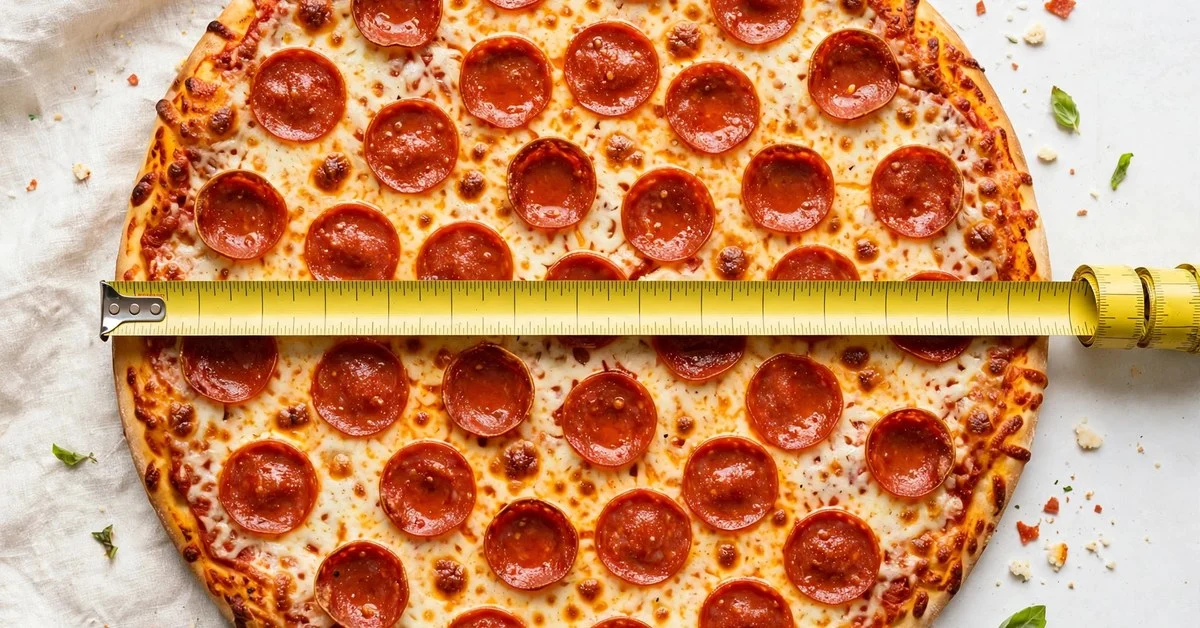
The birthday party has fourteen confirmed guests, the game starts in an hour, the doorbell will not stop ringing, and the pizza app wants a number right now. Too little and you are the host who ran out; too much and you are eating leftovers until Thursday. A 16 inch pizza measures 16 inches across (40.6 cm), covers about 201 square inches, and feeds 5 to 6 people — the extra-large, the biggest standard pie on most menus, and the undisputed value king of pizza ordering. The trap is thinking of it as “a bit bigger than a large.” It is not: a 16-inch holds nearly double the pizza of a 12-inch medium. This guide is a party quantity calculator first — pizzas per headcount for every crowd size — plus every conversion, fifteen everyday objects for scale, and the value math that makes the XL the smartest pie on the menu.
Sixteen inches in every unit
Sixteen inches of diameter is a foot and a third. Everything else — the area that feeds the crowd, the circumference that barely clears the oven — derives from it.
| Measurement | Inches | Centimeters | Feet |
|---|---|---|---|
| Diameter | 16 | 40.6 | 1.33 |
| Radius | 8 | 20.3 | 0.67 |
| Area | 201.1 sq in | 1,297 sq cm | 1.40 sq ft |
| Circumference | 50.3 | 127.7 | 4.19 |
The headline number is 201 square inches — more pizza than two 10-inch smalls combined (157 square inches), in a single box. Most shops cut the 16-inch into 12 slices, so each slice carries about 16.8 square inches: bigger than a medium’s slice, which is why two XL slices satisfy where two medium slices merely snack. And note the oven reality behind the circumference: at just over 50 inches around, an XL barely fits a standard 24-inch-wide home oven — there are only a few inches of clearance per side, which is why delivery beats homemade at this size.
The crowd calculator: pizzas per headcount
This is the section to bookmark. The planning unit is the slice: a 16-inch cut into 12 gives each eater’s share, and appetites fall into three bands — light (2 slices), average (3 slices), hungry or grazing (4 slices). Run your headcount through the band that fits.
Five to six people: one XL does it
The classic use case. Six average appetites at 2 slices each is exactly 12 slices — one pizza, nothing left, nobody short. Five people get a little margin: two slices each with two slices floating for the hungriest guest. This is the dinner-party sweet spot, the family-with-teens solution, the small team lunch. Order one XL, add a salad if you want insurance, and you are done. Total: one 16-inch pizza.
Eight to ten people: two XLs, no anxiety
Ten average eaters need 30 slices; two XLs provide 24. That looks short — until you remember parties are never all-average. In practice, a mixed group of ten (a few light eaters, a few hungry ones) lands right around 24 slices, especially with drinks and snacks in play. The failure mode here is the all-teenager party: ten hungry teens at 4 slices each need 40 slices, which is three XLs plus change. Know your crowd’s band and round up, because the cost of one extra pizza is always less than the cost of running out. Total: two 16-inch pizzas for a mixed ten.
Twelve to fifteen people: three XLs and a system
At this size you are catering, so think in waves. Three XLs give 36 slices — 12 to 15 average eaters at 2 to 3 slices each. Order all three at once if the group eats together; stagger them (two now, one in 45 minutes) if arrivals are spread out, because a fresh hot pizza at 8 p.m. beats a lukewarm one from 7. Variety matters more at scale: make at least one of the three a plain cheese or pepperoni, the universal acceptables, and let the third be the adventurous one. And clear a landing zone — three 16-inch boxes need four feet of counter. Total: three 16-inch pizzas for twelve to fifteen.
Twenty-plus: the per-person formula
Past fifteen, stop counting pizzas and start counting slices. The formula: guests × slices per person (use 3 for mixed crowds, 4 for hungry ones) ÷ 12 slices per XL, then round up. Twenty mixed guests: 20 × 3 = 60 slices ÷ 12 = 5 XLs. Twenty hungry guests: 20 × 4 = 80 ÷ 12 = 6.7, round up to 7. Always round up — the seventh pizza costs less than the embarrassment of a bare table, and leftover XL reheats beautifully. For thirty people, you are at 8 to 10 XLs, and it is worth calling the shop ahead: large orders get fresher timing and sometimes a volume discount the app will not show you. Total: (guests × 3) ÷ 12, rounded up.
The topping split rule
However many pizzas the calculator gives you, split the toppings by thirds: one third plain cheese, one third pepperoni (or the crowd’s favorite meat), one third whatever the adventurous want. Cheese is the universal donor — vegetarians, picky kids, and the guest with the mysterious dietary restriction all eat it. The most wasted pizza at every party is the fourth specialty pie nobody asked for; the least wasted is always cheese. When in doubt, convert the wild card to cheese.
Fifteen things as wide as an XL
Sixteen inches is an uncommon household size, which is exactly why it needs calibrating. Fifteen real objects at or near 16 inches.
- A 16-inch car wheel (rim diameter). Sixteen-inch wheels are one of the most common sizes on the road — check your own car. The metal rim inside the tire is exactly your pizza’s diameter.
- A 16-inch round wall mirror. The medium round mirror from the home-decor aisle. Its face is the pizza’s face, frame and all.
- An oversized station clock (16 in). The big round clocks in school hallways and train stations run about 16 inches across. Your XL is station-clock-sized — dinner is served on schedule.
- A wedding cake drum board (16 in). The thick foil-covered board under a tiered wedding cake. Same diameter as the pizza — celebration food, same scale, different frosting.
- A wheelbarrow wheel (16 in). The standard wheelbarrow tire is 16 inches in diameter. Roll one next to the pizza box and the match is exact — the most working-class ruler on this list.
- A toaster oven (about 16 in wide). A standard countertop toaster oven spans roughly 16 inches. Your XL pizza would not fit inside it — which tells you something about both appliances.
- A medium moving box (16-in side). The ubiquitous medium box measures about 18 × 18 × 16 inches. One of its faces is pizza-sized — picture the box, and you have the pie.
- A classic teddy bear (16 in tall). The traditional plush bear stands about 16 inches. Stand it next to the box: bear and pizza, same height, very different party roles.
- A 5-pound fire extinguisher (about 16 in tall). The red canister in the kitchen or garage. Its height is the pizza’s width — safety equipment doubling as a dinner ruler.
- A dreadnought guitar’s lower bout (about 16 in). The wide lower curve of an acoustic guitar spans roughly 16 inches. Players know this curve by feel; now they know it as pizza.
- A blender (about 16 in tall). A standard countertop blender with the jar on. Its height matches the pizza’s diameter — the appliance that makes the drinks is the size of the food.
- A large nursery planter (16 in). The big pot a small ornamental tree comes in. Its rim is a 16-inch circle — garden-center precision.
- A dartboard (17.75 in — a touch wider). The regulation bristle dartboard is just under two inches wider than your pizza. If the board looks right, the XL will look a shade smaller.
- An 18-inch lazy Susan (two inches wider). The large turntable is a couple of inches past the pizza on every side. Your XL would spin on it with room to spare.
- A hiking backpack (about 18 in tall — two inches taller). A day pack stands a couple of inches taller than the pizza is wide. The pack you take on trails is roughly one XL pizza tall.
Why the XL wins the value math
Now the money argument, because the XL is not just big — it is cheap. Area grows with the square of the diameter, so the jump from the 14-inch large (154 square inches) to the 16-inch XL (201) is a 30% gain in pizza for what is usually a 10 to 15% gain in price. Against the 12-inch medium (113 square inches), the XL delivers 78% more pizza — nearly double — for typically far less than double the price. Run the per-square-inch test on your local menu: a $14 medium is about 12.4 cents per square inch, while a $19 XL is about 9.4 cents. The XL is the cheapest pizza on the menu by the only measure that matters, which is why the calculator above keeps landing on XLs for groups: one XL beats two mediums on price, on box count, and on counter space. The only thing the XL loses on is the fridge — a 16-inch box needs a 16-inch square of shelf, which is a problem the next article’s leftovers section will solve.
Party hosts ask
How many 16 inch pizzas for 20 people?
Five for a mixed crowd, seven if they are hungry. The formula is guests × 3 slices ÷ 12 slices per pizza, rounded up: 20 × 3 = 60 ÷ 12 = 5. Teenagers and grazing adults push toward 4 slices each, which gives 80 ÷ 12 = 6.7, rounded up to 7. When the cost of being wrong is an empty table, round up.
Will a 16-inch pizza fit in a standard home oven?
Barely — and only on the middle rack. A standard home oven cavity is about 22 to 24 inches wide, so a 16-inch pizza plus its pan leaves just a few inches of clearance on each side. That is why many pizzerias bake XLs in deck ovens and why homemade 16-inch pizzas often get divided into two smaller ones. If you are reheating, a 16-inch rarely fits on a standard baking sheet — go straight to the oven rack with foil underneath.
Is a 16 inch pizza really twice a 12 inch?
Nearly — 78% more, to be exact (201 versus 113 square inches). It is close enough that the “two mediums versus one XL” debate has a clear winner: the XL gives you almost the pizza of two mediums for much less than twice the price, in one box instead of two.
Will a 16 inch pizza fit in my oven?
For reheating slices, yes. For baking a whole XL from scratch, barely — a standard 24-inch-wide oven interior leaves only a few inches per side, and the pizza plus a peel will not turn. This is why 16-inch pizzas are delivery food, not homemade food, unless you own a dedicated pizza oven.
How do I keep multiple XLs hot at a party?
Stack the boxes and throw a clean bath towel over the pile — the insulation holds heat for 30 to 45 minutes. For longer events, stagger the order so a fresh pizza arrives mid-party rather than letting everything go lukewarm. Never microwave a whole pizza; reheat slices in a 375°F oven for 5 minutes or in a dry skillet, which re-crisps the crust.
What is the cheapest way to feed a crowd with pizza?
Order XLs, all cheese or pepperoni, from a local shop rather than a chain app — local shops routinely beat chain per-square-inch pricing on the 16-inch, and many offer a standing discount on orders of five or more. Skip the stuffed crust and extra toppings at scale; they add cost per pizza without adding slices.
See also: how big a 12 inch pizza is.
See also: how big a 14 inch pizza is.
Feed the crowd without the guesswork
So how big is a 16 inch pizza? Sixteen inches across, 201 square inches, twelve slices — the pie that feeds five to six and scales to fifty with one formula: guests times three slices, divided by twelve, rounded up. Remember the two numbers that make it the party default: 78% more pizza than a medium, at the lowest price per square inch on the menu. Count the heads, pick the band, split the toppings by thirds, and the only leftover will be the one you planned for. The host who does the math before ordering is the host whose table never goes bare — and whose guests remember the party, not the pizza shortage. That is the whole game.

I’m Dane Whitfield, a content writer at MeasureZit.com, where I specialize in creating clear, accurate articles on measurements, unit conversions, and mathematical concepts. I enjoy breaking down complex numerical topics into simple, practical explanations that readers can actually use. My goal is always precision and clarity helping people make sense of the numbers around them.