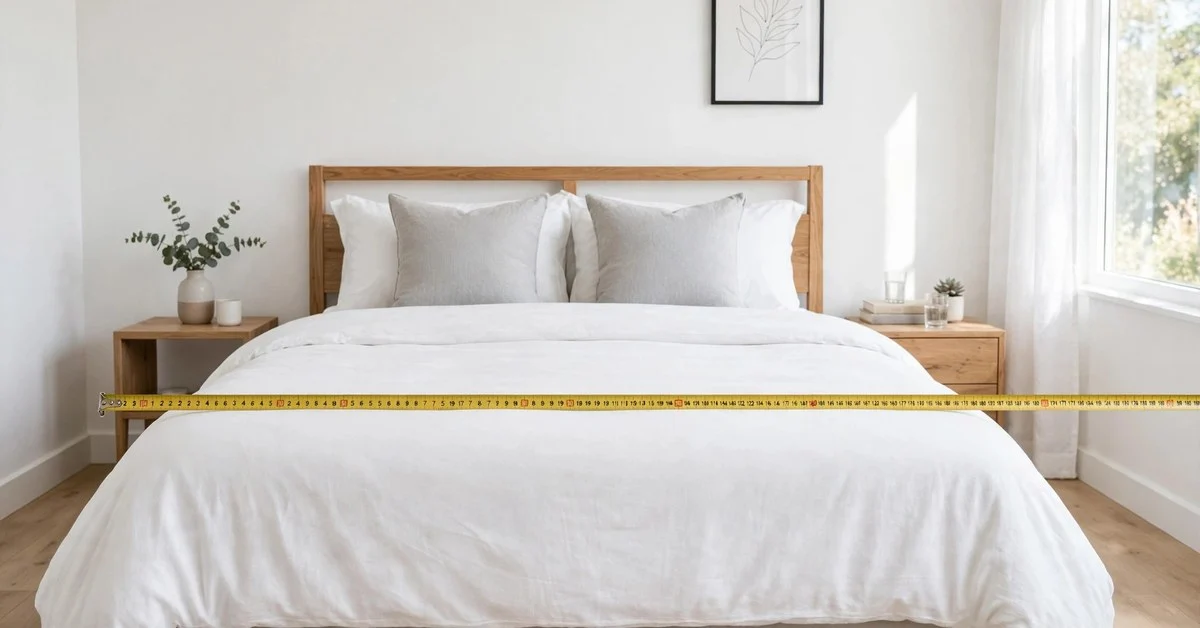
Every mattress delivery crew has a story about the king that would not go. The stairwell that was two inches too tight. The hallway corner where a $3,000 mattress spent twenty minutes wedged at a 45-degree angle while the neighbors watched. The third-floor walk-up that ended with the mattress going back on the truck. A king size bed measures 76 inches wide by 80 inches long — 6 feet 4 inches by 6 feet 8 inches — the widest standard mattress sold in America today, and a rigid, heavy, floppy rectangle that does not negotiate. The bedroom is rarely the problem; the route to the bedroom is. This guide runs the king through the delivery gauntlet — the doorways, stairs, and corners between the truck and your bedroom — plus the exact dimensions, fifteen everyday objects that match its footprint, and the honest comparison with its rival, the California king.
The delivery gauntlet: doorways, stairs, and corners
Run the gauntlet before you order, in this order. First, the doorways. Measure every doorway on the route from the front door to the bedroom: front door, hallway doors, bedroom door. Interior passage doors are typically 28, 30, 32, or 36 inches wide, and the door slab can be removed from its hinges in about two minutes with a screwdriver and a hammer — an old mover’s trick that buys you an extra inch or two of clearance. A king mattress carried on edge presents its 80-inch length horizontally and its thickness (about 10 to 14 inches) as the width passing through the door, so the doorway width is rarely the blocker; the height is. On edge, the mattress stands 76 inches tall, and standard doorways are 80 inches high — it clears, but barely, so watch for low-hanging light fixtures in the hallway.
Second, the corners. This is where kings die. A rigid 76-by-80-inch rectangle pivoting around a hallway corner needs the hallway to be wide enough to swing it — and most residential hallways are 36 to 42 inches wide. Walk the route with a tape measure and check the tightest turn: the inside corner where two hallways meet, or where the hallway meets the bedroom door. The practical test is the cardboard template trick — cut a 76-by-80-inch rectangle from cardboard boxes, tape it together, and have two people “carry” it through the route. If the cardboard makes it, the mattress makes it. If the cardboard wedges, you have three options: a split king (two 38-by-80-inch twin XL halves that navigate like normal mattresses), a bed-in-a-box king that arrives compressed in a carton, or choosing delivery professionals and letting them solve it.
Third, the stairs. Stairwells add a vertical turn to the problem: the mattress must pivot from horizontal carry to angled climb, and landings are often barely 36 inches deep. Measure the landing depth and the ceiling height above the stairs — a low stairwell ceiling will block the 76-inch height as the mattress tilts upward. Elevators have their own math: measure the cab’s interior depth and the door width, and confirm the 80-inch length fits diagonally if it will not fit straight. Fourth, the final approach: the bedroom door swing, the space to rotate the mattress flat once inside, and the path to the frame. Many delivery failures happen six feet from success, in the bedroom doorway itself. Run the full gauntlet with the cardboard template, and delivery day becomes boring — which is exactly what you want.
King dimensions: 76 by 80 inches, decoded
| Measurement | Inches | Centimeters |
|---|---|---|
| Width | 76 | 193.0 |
| Length | 80 | 203.2 |
| Width in feet | ≈ 6.33 | — |
| Length in feet | ≈ 6.67 | — |
| Sleeping surface area | ≈ 42.2 sq ft | ≈ 3.9 sq m |
The defining fact about a king is not just its size but its construction: it is literally two twin XL mattresses (38 by 80 inches each) side by side. That is why the split king exists — buy the two halves separately and you own a king that navigates stairs like a twin. Each sleeper gets 38 inches of width, a full twin’s worth, which is why kings are the answer for couples who want space, families with midnight-migrating kids, and anyone sharing the bed with a large dog. In metric, 193 by 203 centimeters of sleeping surface — nearly four square meters.
Fifteen things that match the king’s footprint
Each item below lands within a few inches of the king’s 76-inch width or 80-inch length — the scale of the biggest standard bed.
- Two twin XL mattresses side by side (76 inches). This is not a comparison; it is the definition. Two 38-by-80-inch twin XLs make exactly a 76-by-80 king. If you have slept in a dorm, double that bed’s width in your mind and you are lying on a king.
- A 6-foot-4 person’s height (76 inches). Stand a 6-foot-4 person next to the bed’s width and they match it inch for inch. Human height remains the most intuitive gauge, and this one is exact.
- A 76-inch apartment sofa. Apartment-size sofas run 68 to 80 inches wide, and 76-inch models are common — an exact width match. The couch in a city living room is as wide as the king is across.
- An 80-inch wardrobe. Modular wardrobes like the popular 80-inch-tall systems match the bed’s length exactly. Your closet tower is as tall as the bed is long — a useful image when judging bedroom wall space.
- A split king box spring (two 38×80 halves). The foundation that solves the delivery gauntlet: two rigid 38-by-80-inch halves that navigate stairs and corners like twin mattresses, then sit side by side under the king. Measure your stairwell against 38 inches, not 76, and the problem shrinks dramatically.
- A 6-foot-tall person (72 inches). Four inches narrower than the bed, a 6-foot person lying across the width gives you the “almost there” gauge — the bed stretches a couple of inches past their head and feet on each side.
- A California king bed (72×84 inches). The king’s great rival: four inches narrower, four inches longer. Same ballpark, different shape — the comparison every king shopper must make, covered in detail below.
- A queen bed (60×80 inches). Sixteen inches narrower, exactly the same length. The step-up reference that defines the king’s value: everything about legroom stays identical; only the width grows.
- A 75-inch TV. The next step up in television sizes measures 75 inches diagonally — one inch under the bed’s 76-inch width. A playful cross-category gauge: the big living-room screen’s diagonal is nearly as long as the king is wide.
- A queen sleeper sofa (about 80 inches wide). Sleeper sofas run 78 to 84 inches wide, with 80 typical — an exact length match. The sofa’s width is the bed’s length, a neat mental rotation for showroom shoppers.
- A 72-inch bookcase. Tall bookcases commonly stand 72 inches high — four inches under the bed’s width. Tip it mentally on its side and you have a slightly conservative width gauge.
- A 6-foot-6 person’s height (78 inches). Two inches wider than the bed, a 6-foot-6 person gives you the generous-side gauge — the bed ends just short of their full height.
- A 72-inch credenza. Long low credenzas run 60 to 72 inches wide, with 72 the grand size — four inches under the bed’s width. Mid-century furniture and maximum bedding, dimensionally adjacent.
- A twin bed (38×75 inches). Exactly half the king’s width and five inches shorter. Each sleeper on a king gets precisely one twin’s worth of width — “two twins stitched together” is the actual construction, not marketing.
- A 76-inch king headboard. Headboards built for king beds run 76 to 80 inches wide — an exact width match by design. The furniture made for the bed is, inevitably, the bed’s width.
King vs. California king: the four-inch trade
This is the great debate in big-bed shopping, and it comes down to four inches in each direction. The standard (Eastern) king is 76 by 80: four inches wider, four inches shorter. The California king is 72 by 84: four inches narrower, four inches longer. Everything else — the room requirements, the delivery gauntlet, the bedding hunt — is nearly identical. So the decision is purely anatomical: do you need width or length?
Take the standard king if either sleeper is broad, if kids or pets share the bed, or if nobody in the household tops 6 foot 2. The extra four inches of width gives each sleeper 38 inches instead of 36 — and in bed, two inches per person per night adds up to real comfort. Take the California king if anyone is over 6 foot 2 and sleeps stretched out: the 84-inch length gives a 6-foot-6 sleeper six inches of clearance instead of two, which is the difference between feet on the mattress and feet on the footboard. Side sleepers who sprawl usually prefer the king; tall back-sleepers usually prefer the Cal king. There is one practical tiebreaker: bedding. Standard king sheets, duvets, and frames are everywhere; California king bedding is a specialty size with fewer options and higher prices. If the household is not genuinely tall, the standard king’s width — plus its easier shopping — wins.
Delivery-day questions, answered
Will a king mattress fit through a standard doorway?
On edge, yes — with care. Carried on its side, a king presents its 76-inch height against the doorway’s 80-inch height (it clears) and its 10-to-14-inch thickness against the doorway’s 28-to-36-inch width (it clears easily). The doorway is rarely the problem; the turn into the doorway from the hallway is. Remove the door slab from its hinges for an extra inch or two, take down hallway light fixtures that hang low, and walk the route first with a cardboard template.
What is a split king and should I get one?
A split king is a king sold as two 38-by-80-inch twin XL halves — same total sleeping surface, dramatically easier delivery. Each half navigates stairs, corners, and elevators like a normal twin mattress. Couples also gain independent adjustability if they buy split adjustable bases. The downsides: a slight center seam (mostly solved with a king-size mattress topper or a bridge pad) and the need for split-king sheets. If your stairwell is tight or your hallway corners are sharp, the split king is not a compromise — it is the correct answer.
How big a room do you need for a king bed?
A 12-by-12-foot bedroom is the practical minimum: the 76-by-80-inch bed plus 24 inches of walking space on each side and at the foot, plus two nightstands. In an 11-by-12 room it fits but the clearances get tight; below that, the taped walkthrough will show the bed dominating the floor. Remember the frame adds width too — upholstered frames can add 4 to 6 inches per side beyond the mattress, so measure the frame’s footprint, not just the mattress.
Can a king mattress bend around a tight stairwell?
It depends on the mattress type. Foam and hybrid kings flex significantly — the classic “taco” fold lets two people bend the mattress into a U-shape around a landing, though you should check the manufacturer’s guidance first. Traditional innerspring kings flex very little and can be damaged by forced bending; for those, the stairwell either fits the rigid 76-by-80 rectangle or it does not. When in doubt, the cardboard template test with a rigid template gives you the honest answer for an innerspring.
Do king sheets fit a California king?
No — and this is the most expensive bedding mistake in the category. A standard king fitted sheet is cut for 76 by 80 inches; a California king is 72 by 84. The king sheet will be too wide and too short on a Cal king mattress, popping off the corners. Buy sheets labeled specifically for your type: “King” or “Eastern King” for 76×80, “Cal King” or “California King” for 72×84. When registering for wedding gifts or outfitting a guest room, double-check which king you own before anyone shops.
See also: queen bed dimensions.
See also: California king bed dimensions.
Survive the gauntlet, enjoy the bed
The king size bed — 76 inches wide, 80 inches long — is the most bed you can buy in a standard size: two twin XLs side by side, 38 inches of width per sleeper, room for the kids, the dog, and the Sunday-morning sprawl. Its only real enemy is the route to the bedroom, and that enemy is entirely defeatable: measure the doorways, walk the corners with a cardboard template, know your stairwell, and keep the split king in your back pocket. Do that work before you order and delivery day is uneventful; skip it and you become the crew’s story. The bedroom itself is the easy part — 12 by 12 feet, two nightstands, and the biggest standard sleep surface in America. Run the gauntlet, win the bed.

I’m Owen Reeves, a content writer at MeasureZit.com, specializing in measurements, unit conversions, and mathematical concepts. I turn technical topics into clear, accurate content that’s easy to understand. My focus is precision, clarity, and genuinely useful information.










