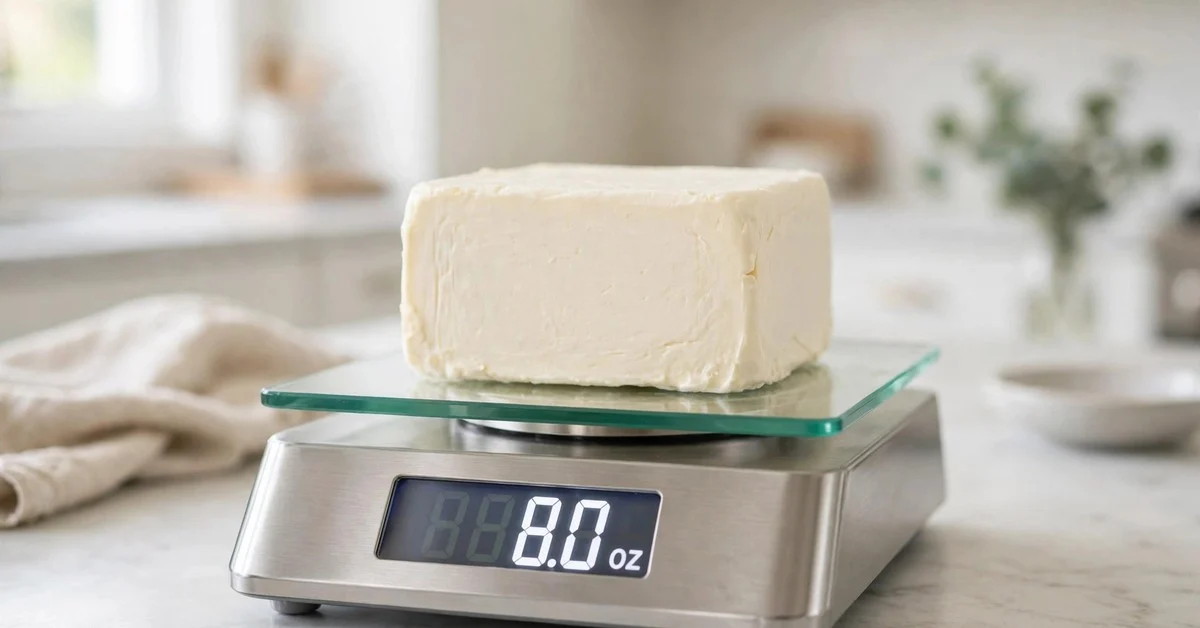
Pick up the foil-wrapped brick in the dairy aisle — cream cheese, 8 ounces, printed right on the label. Feel its cool, dense weight in your palm: that is half a pound, 226.8 grams, the friendliest weight in the kitchen. Eight ounces is exactly half a pound, which makes it the pivot point of the entire ounce ladder — everything below it is measured in fractions of a pound, everything above in multiples. Recipes call for 8 ounces of cream cheese, chocolate, or meat; steaks are sold as 8-ounce cuts; and packaged foods from coffee to chips use it as a standard size. It is substantial enough to feel like a real quantity but small enough to hold in one hand: the Goldilocks of kitchen weights. We will tour the dairy case, the restaurant menu, and the coin jar — fifteen references in all, one cream-cheese brick as our guide, and the half-pound math that connects them.
The cream-cheese guide: why 8 oz is the half-pound pivot
The dairy aisle is quietly organized around the number eight. Cream cheese comes in 8-ounce bricks. Sour cream is sold in 8- and 16-ounce tubs. Cottage cheese too. The pattern is not accidental: 8 ounces is half a pound, and the half-pound is the unit American home cooking actually thinks in. Recipes say “half a pound of ground beef,” never “eight ounces,” but the package the butcher hands you says 8 OZ — the same quantity, two languages, and the cream-cheese brick is the Rosetta Stone between them.
The 8-ounce size also anchors the restaurant steakhouse. Menus list 6-ounce “petite” cuts and 12-ounce “house” cuts, but the 8-ounce sirloin is the standard single serving — the cut the kitchen portions by default and the price the menu is built around. The 8-ounce steak became the benchmark because it is the largest portion that reads as one serving of meat: below it you are having a light dinner, above it you are having a feast. When a menu offers no size at all, you are almost certainly getting eight ounces.
And the half-pound teaches the weight-volume split at its most practical. Eight ounces of cream cheese is a dense brick barely bigger than your fist. Eight ounces of flour is two full cups. Eight ounces of honey is about three-quarters of a cup. Eight fluid ounces of water is exactly one cup — the one case where the numbers agree, because a fluid ounce of water weighs almost exactly an ounce. The cream-cheese brick looks like it should be a cup of something, but it is half that volume at the same weight. Density does the talking; the scale just reports it.
The 8-ounce size also rules the world of small kitchen packaging for a reason of pure logistics: it is the largest unit that still ships and stores like a small thing. Coffee bags at 8 ounces, chip bags at 8 ounces, chocolate bars scored into 8-ounce blocks — all sized to fit the hand, the shelf, and the recipe. It is the unit the packaged-food world counts in, the same way the kitchen counts in its own eight ounces.
There is a final, practical reason the size endures: it doubles and halves into every other unit cleanly. Half of 8 is 4 (the butter stick), double is 16 (the pound), half again is 2 (the perfume bottle). The whole ounce ladder in this series hangs on the 8-ounce pivot — learn this weight and every other article becomes a doubling or a halving. Whether it lands in a cheesecake or on a grill, the 8-ounce brick is the unit the kitchen measures in — and now it is yours too.
Fifteen things that weigh eight ounces
1. A block of cream cheese
The signature anchor of this article: exactly 8 ounces (226.8 grams), printed on the foil, the dense white brick that fits in one hand. This is the kitchen’s definitive 8-ounce reference — labeled, standardized, and present in nearly every refrigerator. Grab one and feel its satisfying density: that cool heft is half a pound, no approximation.
2. An 8-ounce steak
The restaurant industry’s standard single serving — the sirloin or ribeye most menus portion by default. Picture the cut on the plate: about the size of your palm and an inch thick. That is half a pound of beef, and it is the cut every other steak size is measured against: the 6-ounce is “petite,” the 12-ounce is “hearty,” the 8-ounce is just dinner.
3. Two sticks of butter
Two standard sticks total 8 ounces — one full cup, each stick contributing 4 ounces, the wrapper markings confirming the math. Picture the two foil rectangles side by side: that golden pair is half a pound. Bakers meet this quantity constantly — “two sticks” is recipe shorthand — and it is the 4-ounce article’s content doubled exactly.
4. A $10 roll of quarters
A standard $10 roll of quarters contains 40 coins weighing exactly 226.80 grams — eight ounces with zero rounding, at 5.67 grams per coin. Hold the paper-wrapped cylinder and feel its dense, compact weight — that is exactly half a pound. It is the precision backbone of the ladder: forty quarters per half-pound, and bank tellers have been hefting this reference for generations.
5. Half a pound of ground beef
Eight ounces of ground beef is literally half a pound — the standard small package at the butcher counter. Hold the wrapped package and feel its cool, dense weight: that is the half-pound in its most literal form. It is also the bridge between the two languages — the butcher says “half a pound,” the label says “8 oz,” and now you speak both.
6. A large apple
A large apple weighs about 240 grams — roughly 8.5 ounces, just over our target. Hold one and feel its firm, round heft — that is essentially half a pound. The apple is valuable because it is a naturally portioned half-pound with no packaging: the produce aisle’s answer to the cream-cheese brick.
7. A cup of granulated sugar
A US cup of granulated sugar weighs about 200 grams — roughly 7 ounces, a little under our target. Picture the measuring cup mounded with sparkling white crystals: that cup is just shy of eight ounces. It is another volume-weight lesson — a cup of sugar and a cup of flour weigh different amounts, and neither is 8 ounces by volume.
8. A smartphone
Most modern smartphones weigh around 200 grams — roughly 7 ounces, just under half a pound. The phone in your pocket is a daily 8-ounce reminder: hold it and feel its familiar glass-and-metal weight. Larger models with cases creep right up to the mark — the device you touch most is secretly a scale weight.
9. A tall energy-drink can
A standard tall energy-drink can holds about 8.4 fluid ounces — just over 8 ounces of liquid plus the slim aluminum can. Hold it and you are holding slightly more than half a pound of liquid. This is the “just over” reference from the beverage aisle, and its size is standardized worldwide — the same can in every country.
10. A billiard ball
A regulation billiard ball weighs about 170 grams — roughly 6 ounces, clearly under our target. Grip the smooth, heavy sphere and feel its density — then imagine it about a third heavier. That mental addition lands you at eight ounces, and pool players carry this reference in their hands every game.
11. A paperback book
A typical paperback novel weighs about 250 grams — roughly 8.8 ounces, just over half a pound. Hold your current read and feel its weight — that is a touch more than eight ounces. This reference is useful because it is always within reach: the nightstand teaches the half-pound while you sleep next to it.
12. A cup of cooked rice
A US cup of cooked rice weighs about 200 grams — roughly 7 ounces, just under our target. Picture the bowl: a mounded cup of steaming white rice, nearly half a pound. Rice triples in weight when cooked — a third of a cup dry becomes a cup cooked — which makes it the dinner-table demonstration of how water changes everything.
13. An 8-ounce water bottle
Small water bottles are commonly sold in 8-ounce sizes — the half-cup hydration standard for kids’ lunches. Grab one and feel its light but real weight — that is half a pound of water. This reference is useful because water is the one substance where fluid ounces and weight ounces nearly agree.
14. A can of condensed soup
A standard can of condensed soup holds 10.5 ounces — about 2.5 ounces over our target. Hold the can and feel its dense, compact weight — then imagine it a bit lighter. That small subtraction lands you at eight ounces, and the pantry icon draws the upper boundary of the half-pound neighborhood.
15. A TV remote
A typical TV remote weighs about 100 grams — roughly 3.5 ounces, less than half our target. Pick up the remote and feel how insubstantial it is — then double that feeling and add a bit more. That mental doubling lands you near eight ounces, and the couch teaches the lesson every evening.
Eight ounces in numbers
The compact reference — the ounce ladder’s pivot:
| Unit | 8 ounces equals |
|---|---|
| Grams | 226.8 g |
| Pounds | 0.5 lb |
| Butter sticks | 2 sticks |
| Quarters | 40 coins |
| Cups (water) | 1 cup |
Notice the pattern: forty quarters per half-pound, and every other unit in the series is a doubling or halving of this one. Learn the pivot and the ladder memorizes itself.
Questions from the restaurant table
Why is 8 ounces the standard steak size?
Because it is the largest portion of meat that reads as a single serving — below it is a light dinner, above it is a feast. Restaurants built their pricing, plating, and portion expectations around the 8-ounce cut, with 6-ounce “petite” and 12-ounce “house” options bracketing it. When a menu lists no weight at all, the kitchen is almost certainly portioning eight ounces.
Is 8 oz the same as half a pound?
Yes, exactly. There are 16 ounces in a pound, so 8 ounces is precisely one half of a pound — the most intuitive fraction in the imperial system. It is the weight where ounces and pounds meet: say “eight ounces” in the kitchen, “half a pound” at the butcher, and everyone understands both.
What does 8 oz of chicken look like?
Eight ounces of chicken is about the size of your palm or a deck of cards — roughly one large chicken breast. It is the standard “one serving” of meat in most nutrition guides. Once you can picture the 8-ounce steak, you can judge any meat portion: palm-sized is eight ounces, two palms is a pound.
Is 8 oz of water the same as 8 fluid ounces?
Very close. Eight fluid ounces of water weighs about 8.3 ounces, so the two are nearly interchangeable — the one case where the volume ounce and the weight ounce almost agree. For any other liquid, the gap widens: 8 fluid ounces of honey weighs about 12 ounces. Water is the exception that proves the rule.
Why does cream cheese come in 8-ounce bricks?
Because the half-pound is the unit home baking thinks in — cheesecake recipes call for multiples of the 8-ounce brick, and the dairy industry standardized around the recipe. It is the same logic as the butter stick: package the unit the recipes use, and the package becomes the measuring tool.
See also: how much 12 oz is.
See also: what 1 oz looks like.
The half-pound close
Eight ounces is the cream-cheese brick, the 8-ounce steak, two sticks of butter, a $10 roll of quarters — 226.8 grams that sit exactly where the ounce ladder pivots into pounds. The brick taught the deeper lesson along the way: eight ounces of cheese is a fist-sized brick, eight ounces of flour is two full cups, and the scale reports the weight while density decides the volume. Pick a reference and test it this week — grab the cream-cheese brick instead of the scale, picture the steak on the menu, heft the roll of quarters. Once eight ounces has a feeling attached, the rest of the ladder is simple arithmetic: halve it for the butter stick, double it for the pound. And the next time a recipe says “half a pound,” you will know exactly how much that is — in every sense of the word.

I’m Priya Sharma, a content writer at MeasureZit.com, specializing in measurements, unit conversions, and mathematical concepts. I turn technical topics into clear, accurate content that’s easy to understand. My focus is precision, clarity, and genuinely useful information.










