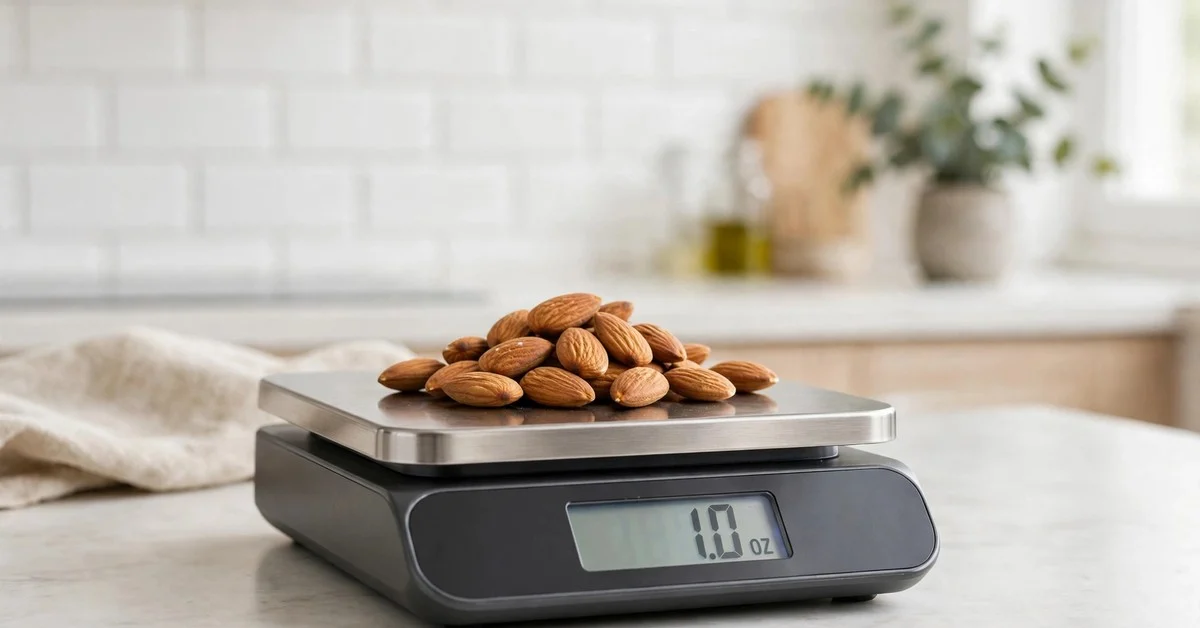
Watch a good bartender work the well on a Friday night and you will see a unit of measurement in motion. No scale, no measuring cup — just a steel jigger flipped twice, a glint of liquid, and a pour that lands within a gram of intention, hundreds of times a night. The unit they are thinking in is the ounce, and the smallest coin of that currency is one: a single ounce, 28.35 grams, about as heavy as five quarters sitting in your palm. It is the weight of a cheese stick, a slice of bread, a modest handful of almonds — and the difference between a balanced cocktail and a ruined one. Step behind the bar for a few minutes and the ounce stops being a number on a nutrition label. It becomes something your hand knows. Along the way you will learn why the ounce comes in two incompatible flavors — weight and volume — and why bartenders, bakers, and jewelers all have strong opinions about which one you mean.
The shot-glass school: how bartenders think in ounces
Every bartender’s education starts at the jigger — the little hourglass of steel with a 1-ounce cup on one end and a 2-ounce cup on the other. The small end even has a name: the pony. A pony of whiskey, a pony of vermouth, a pony of lime juice. Trainees pour water into the pony side hundreds of times until the weight and the meniscus line live in muscle memory, because in a rush there is no time to look.
The discipline is exact for a reason. A classic daiquiri is 2 ounces of rum, 1 ounce of lime, and 3/4 ounce of syrup — shift any of them by half an ounce and the drink falls apart. Bitters are measured in dashes, about 1/32 of an ounce each, so roughly thirty dashes make a full ounce; a bartender who over-dashes an Old Fashioned has added a measurable fraction of an ounce of pure bitterness. Even the “free pour” — pouring straight from the bottle without the jigger — is just a trained ounce: bartenders count “one-one-thousand, two-one-thousand” as the bottle glugs, each count calibrated to a quarter ounce.
Here is the part that surprises newcomers: the ounce the bartender pours is a fluid ounce (a volume, about 29.6 milliliters), while the ounce on your bag of almonds is a weight ounce (28.35 grams). They only match for water, where one fluid ounce weighs about 1.04 ounces. Pour an ounce of honey and you have poured nearly 1.5 weight-ounces, because honey is dense. Pour an ounce of flour and you have barely half a weight-ounce, because flour is mostly air. The bar runs on volume; the kitchen runs on weight; the word “ounce” covers both, and mixing them up is how recipes die.
Keep that split in mind as you read the fifteen references below — every one of them is the weight ounce, the 28.35-gram kind, unless noted otherwise.
The jigger itself is a small piece of history. Before it, bartenders measured with their eyes and their reputations — the “two-finger” pour, the “short” pour — and every bar poured differently. The double-ended steel jigger standardized the craft in the late nineteenth century, and the 1-ounce/2-ounce pairing won because cocktail recipes of the era were built on exactly those ratios: two parts spirit, one part everything else. The tool shaped the recipes, and the recipes kept the tool. A century and a half later, the pony end is still one ounce, still the coin of the realm.
Training the free pour is where the ounce becomes reflex. New bartenders practice with water and a jigger beside them: pour while counting, then check the jigger — over, under, adjust, repeat, hundreds of times per shift. Within weeks the count is calibrated: four slow counts, one ounce, every time. Veterans can pour a perfect ounce into a shaker tin while taking an order and watching the door. It looks like flair; it is really just the ounce, moved from the head to the hand through repetition. That is the same journey this article is offering you — minus the Friday-night rush.
From the bar rail to the kitchen: fifteen one-ounce things
1. Five US quarters
Five quarters weigh 28.35 grams — within a hundredth of a gram of a true ounce, since each quarter is minted at 5.67 grams. It is the gold standard pocket reference: identical coins, available everywhere, mathematically perfect. Drop five into your palm and close your eyes — that slight, unmistakable pressure is one ounce.
2. A bartender’s pony pour
The small end of the jigger holds exactly one fluid ounce — about 30 milliliters, which for watery liquids like juice or spirits weighs just over an ounce. It is the unit the whole bar economy runs on: one pony of lime in a margarita, one pony of simple syrup in a mojito. If you have ever watched a jigger flip, you have watched an ounce being measured.
3. A string cheese stick
Individually wrapped mozzarella sticks are portioned at 28 grams — one ounce by design, the number printed on the wrapper to prove it. The thin white cylinder, about as long as your hand, is the lunchbox ounce. Two sticks make two ounces, which is why the math of this list keeps doubling so neatly.
4. A standard slice of sandwich bread
A typical slice of sandwich bread weighs about 28 grams — diet plans have used “one slice equals one ounce” as shorthand for decades. Pick up a single slice and notice its featherweight feel: that is the ounce in its most familiar edible form, sitting in your kitchen right now.
5. Two tablespoons of butter
Two level tablespoons of butter weigh about 28 grams — and butter wrappers are printed with tablespoon lines, so you can cut exactly this without a scale. When a recipe calls for an ounce of butter, picture two tablespoon-sized pats melting in the pan: that small golden pool is your ounce, pre-measured by the packaging.
6. Twenty-three almonds
Snack labels define an almond serving as one ounce — about 23 whole nuts. Pour them into a cupped palm and study the pile: a modest handful with room to spare. It is the dieter’s ounce, and once you have seen it, every “1 oz serving” on a nutrition label becomes concrete.
7. One slice of deli turkey
A typical slice of deli turkey or ham lands right around 28 grams — sandwich shops build portions on this assumption. Picture the thin, flexible slice you would lay on bread, roughly the size of your hand: that single layer is an ounce of protein, and stacking slices is literally counting ounces.
8. Two tablespoons of peanut butter
Two level tablespoons of peanut butter weigh about 32 grams — just over an ounce. The dense, sticky spoonful is a lesson in how weight concentrates: that small glossy mound carries real heft compared with, say, two tablespoons of flour. Your morning toast is an ounce lesson in disguise.
9. A single-serve chip bag
The little 1-ounce bags sold at checkout counters hold about fifteen chips — the weight printed on the foil. Tear one open and the meager-looking pile is the ounce made visible: an ounce of thin, airy chips looks like far less food than an ounce of almonds, which is why eyeballing portions takes practice.
10. A small dinner roll
A petite dinner roll — the kind served beside restaurant entrées — weighs about 28 to 35 grams. Hold one warm from the basket and feel its lightness: that is roughly an ounce of bread. Compare it with the sandwich slice above and you start sensing how shape fools the eye while weight tells the truth.
11. A first-class letter
The classic envelope with a few sheets of paper was designed around the 1-ounce postage rate — for generations, “one ounce” and “one letter” were practically synonyms at the post office. If you have ever mailed a letter, you have held an ounce: that thin, papery lightness is the postal standard in action.
12. A single shot of espresso
A single espresso shot is one fluid ounce — about 30 milliliters, weighing roughly 30 grams. Watch the barista pull it: the small amber stream filling the tiny cup is the ounce as a volume, the coffee world’s answer to the bartender’s pony. Doubles (2 oz) are the café standard, which is why singles feel almost quaint.
13. An AA battery
A standard alkaline AA weighs about 23 grams — roughly four-fifths of an ounce, the “just under” marker. Every brand targets the same chemistry and size, so the weight barely varies. Hold one the next time you change the remote’s batteries: slightly less than an ounce, teaching your hand the neighborhood.
14. A slice of American cheese
One wrapped slice of American cheese weighs about 21 grams — close to three-quarters of an ounce. Peel it from its plastic and feel how insubstantial it is: that is the scale of the ounce. Pair it mentally with the bread slice — bread plus cheese is a sandwich layer of about 1.7 ounces.
15. A golf ball, for contrast
A regulation golf ball weighs 45.9 grams — about 1.6 ounces, the “step up” that draws the ceiling of this list. It is noticeably heftier than everything above, small enough to hold between two fingers yet dense with presence. If the five quarters felt almost weightless, the golf ball has real authority — and the gap between them is the territory of the ounce.
The ounce in numbers
One reference table, worth memorizing, since every other weight in this series is built from it:
| Unit | 1 ounce equals |
|---|---|
| Grams | 28.35 g |
| Pounds | 0.0625 lb |
| Kilograms | 0.0283 kg |
| Fluid ounces (water) | ≈ 0.96 fl oz |
| Tablespoons (butter) | 2 tbsp |
And the ladder that unlocks the rest of the series: 2 ounces is ten quarters, 4 ounces is a stick of butter, 8 ounces is half a pound. Learn the single ounce cold and the bigger weights are just multiplication.
Last call: questions about the ounce
Why do bartenders call one ounce a pony?
The term comes from the small end of the double jigger — the 1-ounce cup opposite the 2-ounce “jigger” end. “Pony” has meant something small in American slang since the 1800s (a pony glass, a pony keg), so the little cup inherited the name. Order “a pony of rye” at an old-school bar and you will get exactly one ounce, possibly with a nod of respect.
How many dashes of bitters make an ounce?
About thirty. A dash from a bitters bottle is roughly 1/32 of an ounce — a few drops — so it takes around thirty dashes to fill the pony end of a jigger. This is why recipes say “two dashes” rather than a fraction of an ounce: at that scale, drops are the practical unit and the ounce is just the math underneath.
Is a single espresso shot really an ounce?
By the traditional Italian definition, yes — a single shot is about 25 to 30 milliliters, essentially one fluid ounce. Modern specialty cafés often pull slightly larger singles, but the 1-ounce standard is what the tiny demitasse cup was sized around. It is the coffee bar’s pony: small, exact, and the base unit everything else scales from. Order a single-origin espresso at a serious café and watch the cup — the barista is still pouring to that century-old ounce.
Why is deli meat sliced to land near an ounce a slice?
It is no accident — delis calibrate slicer thickness so portions come out in clean ounce increments, because customers order “a quarter pound” or “half a pound” and the counter math has to work. Four slices at an ounce each is a quarter pound; the slice is the physical coin of that arithmetic. Change the thickness and the whole pricing conversation gets harder.
Does one fluid ounce of everything weigh one ounce?
Only water comes close, at about 1.04 weight-ounces per fluid ounce. Honey runs near 1.5, olive oil about 0.96, and flour barely 0.5 — density decides. This is the single most useful ounce fact in any kitchen: volume measures space, weight measures mass, and the word “ounce” does double duty for both. When precision matters, weigh; when it does not, pour.
See also: how much 2 oz is.
See also: how many ounces are in a cup.
Settling the tab
One ounce is five quarters, a pony pour, a cheese stick, a slice of bread — 28.35 grams of small, exact, everywhere weight. The bartender’s lesson is the one worth keeping: the ounce is not a number you memorize but a quantity you calibrate, pour by pour, handful by handful, until your hand knows it the way a jigger knows it. Test one reference today — drop five quarters in your palm, or watch the pony end of a jigger fill — and the smallest coin of the weight system is yours. From here the ladder climbs fast: double it for two ounces, quadruple it for the butter stick, and keep going. Every bigger weight in the kitchen and the bar is just this one, multiplied.

I’m Priya Sharma, a content writer at MeasureZit.com, specializing in measurements, unit conversions, and mathematical concepts. I turn technical topics into clear, accurate content that’s easy to understand. My focus is precision, clarity, and genuinely useful information.










