Stand at the fragrance counter in duty-free and pick up the bottle the salesperson hands you — not the grand 3.4-ounce flacon, the smaller one, the one that fits in a jacket pocket and costs half as much. Turn it over. It almost certainly says 2 FL OZ, or 60 ml. That is the travel-size standard of the perfume world, and it is also one of the most useful small weights in the kitchen: two ounces, 56.7 grams, about as heavy as a tennis ball or — here is a good one — a single large egg, which the USDA grades at exactly 2 ounces per egg. Two ounces is the weight of the everyday upgrade: double the snack, half the butter stick, the portion that turns an ingredient into a meal component. Follow the little glass bottle and you will learn the weight without ever touching a scale. We will tour the fragrance counter, the kitchen drawer, and the coin jar — fifteen references in all, one little flacon as our guide, and the ladder of math that connects them.
The perfume-bottle guide: why 2 oz rules fragrance
Perfume bottles come in a strict hierarchy — 1 oz, 1.7 oz, 2 oz, 3.4 oz — and the 2-ounce bottle occupies the sweet spot. The big 3.4-ounce (100 ml) flacon is the “I’m committed” purchase; the 2-ounce (60 ml) is the “I’m serious but I travel” purchase. It holds roughly 600 to 900 sprays, depending on the atomizer — at four sprays a day, that is five to seven months of daily wear. Houses price it to move: the per-milliliter cost usually beats the 1-ounce bottle, while the absolute price stays well under the flagship size.
The 2-ounce bottle also lives at a regulatory boundary. Airline carry-on rules cap liquids at 3.4 ounces (100 ml) per container, so the 2-ounce bottle sails through security with room to spare — it became the de facto travel fragrance size years before “travel size” was a marketing category. Mini and rollerball sizes (0.17 to 0.5 oz) are for purses; the 2-ounce is for the trip itself.
And the liquid inside teaches the ounce lesson beautifully. Sixty milliliters of perfume weighs about 48 to 54 grams — a touch under 2 weight-ounces, because fragrance is mostly alcohol, which is lighter than water. So the bottle labeled 2 FL OZ actually weighs a little less than 2 OZ on a scale. Volume ounces and weight ounces diverge again, exactly as they do in the kitchen: the label measures space, the scale measures mass, and only water lets you pretend they are the same.
The 2-ounce size also sits at the center of fragrance economics. Perfume comes in concentrations — parfum at 20 to 30 percent oils, eau de parfum at 15 to 20, eau de toilette at 5 to 15 — and the concentration decides how many sprays a day you need, which decides how long the bottle lasts. A 2-ounce eau de parfum at four sprays daily runs five to seven months; the same bottle in a lighter eau de toilette, needing six sprays for the same presence, empties in four. Houses know this math intimately, which is why the 2-ounce eau de parfum is the industry’s volume driver: big enough to feel like a real purchase, concentrated enough to last, priced in the sweet spot where gift-buyers and self-buyers meet.
There is a final, practical reason the size endures: decanting. Fragrance enthusiasts split 2-ounce bottles into 5- and 10-milliliter atomizers — a 2-ounce bottle yields roughly six to twelve decants — and the entire sample-trading community prices around it. The little glass flacon is not just a product; it is a currency. Whether it sits on a dresser for half a year or gets divided among a dozen collectors, the 2-ounce bottle is the unit the fragrance world counts in — the same way the kitchen counts in its own two ounces.
Fifteen things that weigh two ounces
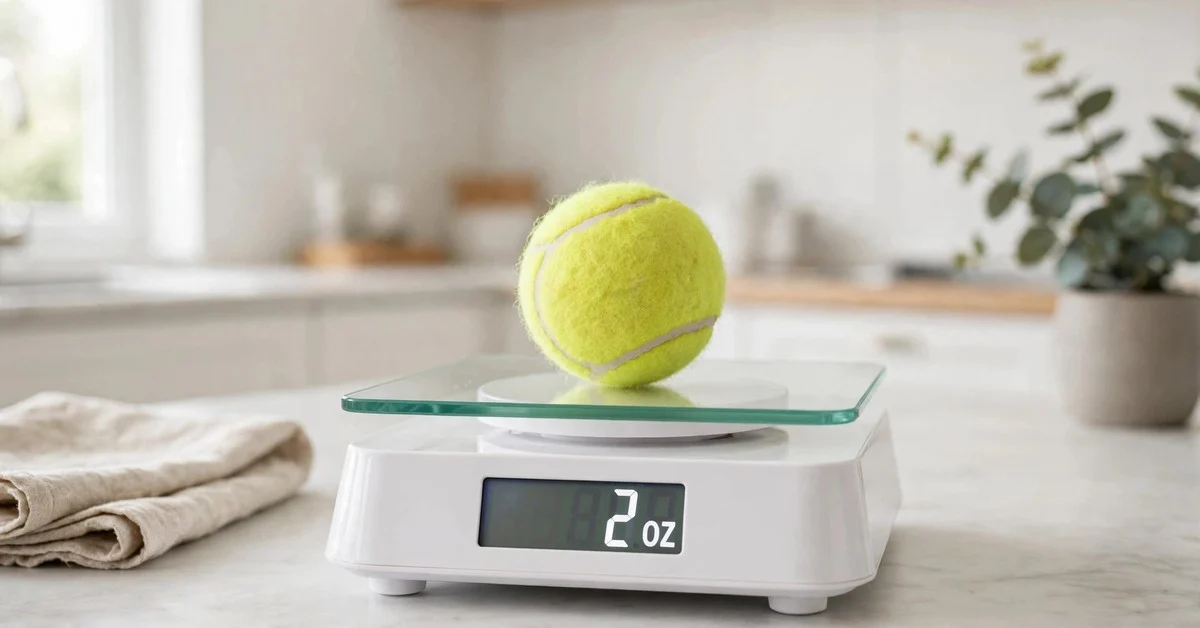
1. A tennis ball
Regulation tennis balls weigh 56.0 to 59.4 grams — most land near 57.7, essentially 2 ounces dead on. The International Tennis Federation polices the weight tightly, so balls are identical worldwide. Bounce one in your hand: that solid, lively weight is two ounces, and the ball is a free reference sitting in a million junk drawers.
2. A 2-ounce perfume bottle
The 60-milliliter travel flacon — the signature anchor of this article. Hold the little glass rectangle and feel its cool, compact weight: roughly two ounces of liquid plus the glass. It is the rare labeled 2-ounce object you encounter outside the kitchen, and the one that teaches the fluid-ounce versus weight-ounce split without a lecture.
3. Ten US quarters
Ten quarters weigh exactly 56.70 grams — a mathematically perfect two ounces at 5.67 grams per coin. A closed fistful of change with satisfying heft and zero approximation. Cashiers and vending-machine regulars can calibrate a hand to two ounces in seconds: count ten, feel the weight, remember it.
4. A large egg
Here is the sleeper fact of this list: the USDA grades large eggs at 24 ounces per dozen — exactly 2 ounces (56.7 grams) per egg. “Large” is a regulated weight class, not a guess. Everyone has held an egg, which makes this the most universal 2-ounce reference in existence: one egg, two ounces, every morning.
5. Half a stick of butter
A standard stick is 4 ounces, so half a stick — four tablespoons — is exactly 2 ounces, with the wrapper’s markings doing the measuring. Bakers meet “half a stick” constantly; it is recipe shorthand across thousands of dishes. The foil-wrapped half rectangle is two ounces you can cut with a knife instead of weighing.
6. Two string cheese sticks
Each stick is 1 ounce by design, so two side by side are 2 ounces with barely any rounding. Hold the pair and you are holding the unit in its most literal form: one plus one. Kids’ lunchboxes have been teaching this addition for years — and four sticks make four ounces, no scale required.
7. Two slices of sandwich bread
Two standard slices run about 56 grams together — two ounces almost exactly. The sandwich you make for lunch is built on a 2-ounce foundation of bread before the fillings arrive, which quietly explains why a full sandwich feels substantial. Lift the top two slices off the loaf and feel them together: that everyday lightness is two ounces.
8. A 2-fl-oz travel shampoo bottle
Hotel minis and travel kits include 2-fluid-ounce bottles — about 60 milliliters of shampoo or lotion. Squeeze one and you are holding two ounces of liquid plus a few grams of plastic. Like the perfume bottle, it is a labeled volume-ounce reference from the world of travel, and it flies through airport security without a second glance.
9. A small lime
A small lime weighs about 67 grams — roughly 2.4 ounces, the “just over” marker. Its bright green firmness is easy to picture in the produce aisle. Hold one and you are feeling slightly more than two ounces; pair it mentally with the golf ball below — one over, one under — and two ounces sits clearly between them.
10. Two AA batteries
Two AAs total about 46 grams — roughly 1.6 ounces, the “just under” marker. Drop the pair in your palm and feel their cylindrical solidity. It is a neat density lesson too: two ounces of metal feels nothing like two ounces of bread — same weight, completely different volume.
11. A golf ball
A regulation golf ball weighs 45.9 grams — about 1.6 ounces, four-fifths of our target. The rules cap the weight tightly, so every conforming ball is nearly identical. Hold one and imagine it about a quarter heavier: that mental addition lands you at two ounces, and golfers carry this reference in their pocket every round.
12. Half a cup of ground coffee
Half a cup of ground coffee weighs about 56 grams — roughly 2 ounces (a tablespoon of grounds runs about 7 grams, and eight tablespoons make the half cup). Picture the scoop heaped with dark grounds: that small fragrant mound is two ounces. Brewers who measure by scoops meet this quantity every single morning.
13. Two slices of deli turkey
Two typical slices run about 56 grams — two ounces, the standard hearty sandwich portion. Lay them on bread and you have added two ounces of protein without touching a scale. Nobody weighs deli meat at home; everybody can count slices. Two slices, two ounces, done.
14. A thick slice of pound cake
A generous slice of pound cake — about an inch thick — weighs roughly 56 grams. Pound cake is dense, so a modest-looking slice carries real weight; hold it and feel how its density surprises your hand. Two ounces of cake looks like far less than two ounces of bread, which is why eyeballing portions takes practice.
15. A single chicken wing
One wing — drumette or flat — weighs about 50 grams, roughly 1.8 ounces, very close to target. Party platters are portioned by count because wings are remarkably consistent. Anyone who has eaten wings knows exactly how one feels between the fingers: that meaty two-bite morsel is about two ounces of food.
Two ounces in numbers
The compact reference — the ounce ladder’s second rung:
| Unit | 2 ounces equals |
|---|---|
| Grams | 56.70 g |
| Pounds | 0.125 lb |
| Tablespoons (butter) | 4 tbsp |
| Quarters | 10 coins |
| Fluid ounces (water) | ≈ 1.92 fl oz |
Notice the pattern: 1 ounce is five quarters, 2 ounces is ten, 4 ounces is twenty. The coin math never breaks, which is why it is the precision backbone of this whole series.
Questions from the fragrance counter
Why is 2 oz the standard travel perfume size?
It sits under the 3.4-ounce airline liquid limit with comfortable margin, holds five to seven months of daily sprays, and prices below the flagship 3.4-ounce flacon while beating the 1-ounce bottle on per-milliliter cost. Houses converged on it because travelers — the duty-free audience — want exactly that combination: security-friendly, long-lasting, and not a thousand-dollar commitment. It is the rare product size shaped as much by airport regulation as by marketing.
How many sprays are in a 2-ounce perfume bottle?
Roughly 600 to 900, depending on the atomizer — most dispense 0.07 to 0.1 milliliters per spray, and 60 milliliters divided by that gives the range. At four sprays a day, a 2-ounce bottle lasts about five to seven months. Heavy sprayers who do eight a day will empty it in roughly three months. Either way, the 2-ounce bottle outlasts the 1-ounce by enough margin that the price premium almost always pays for itself.
What is the difference between 2 oz and 60 ml on a perfume label?
They are the same volume stated two ways: 2 US fluid ounces equals 59.15 milliliters, rounded to 60 ml on labels. The catch is that “2 oz” here means fluid ounces (volume), not weight ounces — the perfume inside weighs a little under 2 weight-ounces because alcohol is lighter than water. Same number, different physical quantity. It is the same trap as the kitchen ounce — one word, two meanings — and it catches shoppers in both aisles.
Can you fly with a 2-ounce perfume bottle in carry-on?
Easily. The TSA and international equivalents cap containers at 3.4 ounces (100 ml), and a 2-ounce bottle is well under. It still has to go in the quart-size bag with your other liquids, but the size itself raises no flags — which is precisely why the fragrance industry standardized around it for travelers. Pack it upright and cap it tight; a leaking flacon will scent your entire carry-on for weeks.
Why does a large egg weigh exactly 2 ounces?
Because the USDA says so: “large” is defined as 24 ounces per dozen, which divides to exactly 2 ounces per egg. It is a grading standard, not a natural law — individual eggs vary, but the dozen must average out. Medium eggs grade at 21 ounces per dozen (1.75 oz each), which is why size names are really weight classes in disguise.
See also: how much 4 oz is.
See also: how much 1 oz is.
Capping the bottle
Two ounces is the tennis ball, the large egg, ten quarters, half a stick of butter — 56.7 grams that sits exactly where a snack becomes a portion and an ingredient becomes a meal component. The perfume bottle taught the deeper lesson along the way: fluid ounces measure space, weight ounces measure mass, and the label only ever tells you one of them. Pick a reference and test it this week — halve a butter stick mindfully, bounce a tennis ball, count out ten quarters. Once two ounces has a feeling attached, the rest of the ladder is simple arithmetic: double it for the butter stick, double again for half a pound. And the next time duty-free hands you the little flacon, you will know exactly how much is inside — in every sense of the word.

I’m Dane Whitfield, a content writer at MeasureZit.com, where I specialize in creating clear, accurate articles on measurements, unit conversions, and mathematical concepts. I enjoy breaking down complex numerical topics into simple, practical explanations that readers can actually use. My goal is always precision and clarity helping people make sense of the numbers around them.