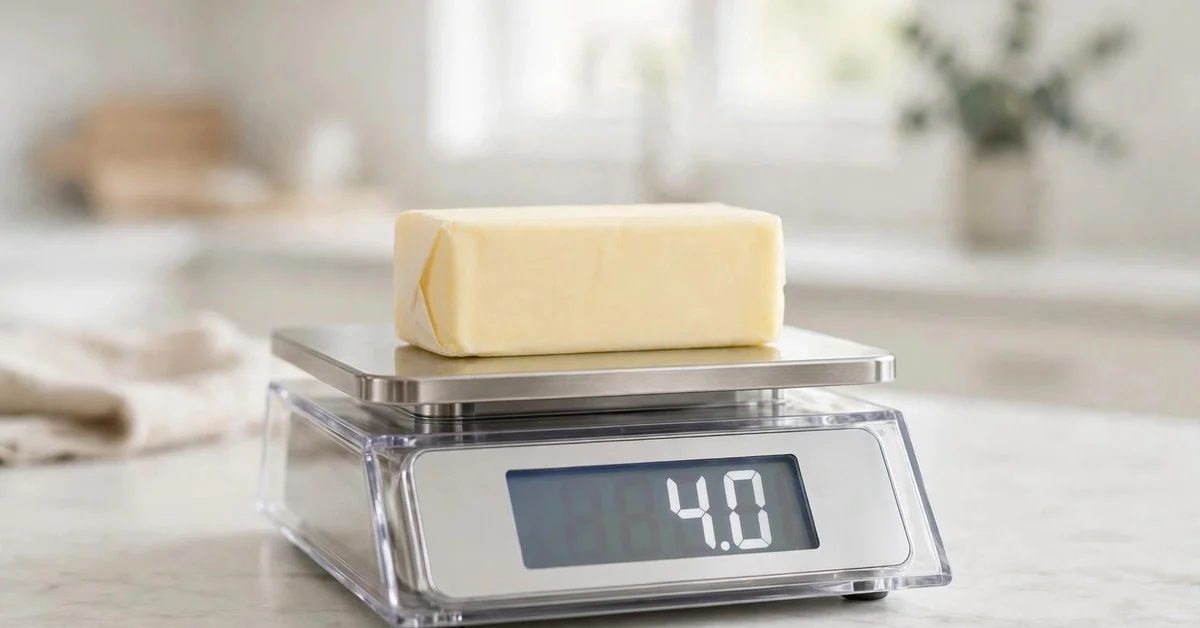
Open the kitchen drawer and grab the most honest object in it: a standard stick of butter. The wrapper says it plainly — 4 oz, 113 grams, one quarter of a pound. No guessing, no scale, no math. That little foil-wrapped rectangle is the most reliable four ounces in existence, and it is the reason this weight deserves its own article. Four ounces is 113.4 grams — exactly one quarter of a pound, which is why the fast-food industry built its flagship burger around it: the quarter-pounder patty weighs four ounces before it hits the grill. It is bigger than a snack but smaller than a meal, sitting right in the useful middle. Butter is sold in 4-ounce sticks, meat is portioned in 4-ounce servings, and small cans and cups are sized around it. Learn how much 4 oz is and you will portion ingredients, judge servings, and read labels with total confidence. We will tour the dairy case, the playground of small snacks, and the coin jar — fifteen references in all, one butter stick as our guide, and the quarter-pound math that connects them.
The butter-stick guide: why 4 oz anchors the American kitchen
Walk the dairy aisle and you will notice something peculiar: butter is sold in a shape that is also a measuring system. The standard US stick is exactly 4 ounces, divided by eight tablespoon markings — 1 tablespoon equals half an ounce, four tablespoons equal 2 ounces, eight tablespoons equal the whole 4-ounce stick. No other food packaging in America doubles as a ruler quite so elegantly. (European blocks of 250 grams are a different system entirely, which is why American recipes that say “one stick” baffle metric bakers.)
The 4-ounce stick also anchors the quarter-pound ladder that runs through the whole meat case. Four ounces is a quarter-pound burger patty. Eight ounces is half a pound. Sixteen is the pound itself. Butchers and fast-food chains chose the 4-ounce unit because it is the smallest portion that reads as a meal: below it is a snack, above it is dinner. The famous quarter-pounder was not a marketing accident — “quarter-pounder” tells the customer exactly what the scale says, 4 ounces of beef, and the name has sold billions of patties on the strength of that plain arithmetic.
And the butter stick teaches the volume-weight split better than any lecture. Four ounces of butter equals half a cup — the wrapper’s tablespoon markings confirm it. But four ounces of flour is a scant cup, four ounces of sugar is about half a cup plus two tablespoons, and four ounces of honey is barely a quarter cup. Same weight, wildly different volumes. The stick looks like a volume measure — it has lines on it, after all — but the “4 oz” printed on the end is a weight, and the markings are just the weight expressed in tablespoon-sized steps. Keep that distinction and every baking recipe gets easier.
The 4-ounce size also rules the world of small packaged snacks, and the reason is portion psychology. The FDA’s reference amount for snacks hovers around 30 grams (about 1 ounce), but manufacturers long ago learned that the single-serve sweet spot is bigger: 4-ounce juice boxes, 4-ounce applesauce cups, 4-ounce chip bags. Four ounces is the largest portion that still feels like “one serving” — big enough to satisfy, small enough to sell as a unit. It is the unit the snack industry counts in, the same way the kitchen counts in its own four ounces.
There is a final, practical reason the size endures: the stick divides cleanly. Half a stick is 2 ounces, a quarter stick is 1 ounce, a tablespoon is half an ounce. Almost no other packaged food subdivides into round numbers so gracefully. Whether it lands in a skillet for a sauce or gets creamed with sugar for a cake, the 4-ounce stick is the unit the American kitchen measures in — and now it is yours too.
Fifteen things that weigh four ounces
1. A stick of butter
The signature anchor of this article: exactly 4 ounces (113.4 grams), printed on the wrapper, subdivided into eight tablespoon markings. The foil-wrapped rectangle is always the same size in every American grocery store. Grab one, feel its cool density, and you are holding four ounces with zero approximation — the single most reliable reference in this entire series.
2. A quarter-pounder beef patty
Four ounces before cooking — the name is literal, and fast-food chains are audited on it. A raw patty is a flat disc of ground beef about four inches across. Most people have seen one even if they have never weighed one. Cooked, it loses about 25 percent of its weight to rendered fat and moisture — which is why the “quarter-pounder” promise applies to the raw weight, a labeling nuance worth knowing.
3. Twenty US quarters
Twenty quarters weigh exactly 113.40 grams — four ounces with no rounding at all, at 5.67 grams per coin. Try holding twenty quarters: the weight presses firmly into your palm, unmistakable. It is the precision backbone of the ounce ladder — five quarters per ounce, twenty per four ounces — and cashiers have been calibrating hands to it for generations.
4. A standard bar of soap
A full-size bar of soap typically weighs about 4 ounces (113 grams). Manufacturers settled on this size decades ago as the standard “one bar” unit. Everyone has held a fresh bar — firm, smooth, slightly heavy in the hand. Feel a new bar and you are feeling four ounces; feel a well-used one and you are holding a lesson in how fast soap disappears.
5. A 4-ounce applesauce cup
Single-serve applesauce cups are portioned at exactly 4 ounces — the standard kids’ snack size, the one with the peel-off foil lid. The small plastic cup fits in a child’s hand. That cup is four ounces of fruit plus packaging, and lunchboxes across the country have been teaching this portion for decades.
6. A 4-ounce juice box
Many children’s juice boxes hold exactly 4 ounces of juice — the little rectangular box with its attached straw. Hold the box and feel how light yet substantial it is — that is four ounces of liquid plus packaging. Like the applesauce cup, it is a labeled 4-ounce object from the world of packed lunches.
7. A medium banana
A medium banana weighs about 120 grams — roughly 4.2 ounces, just a hair over our target. Peel one and feel its familiar weight — that is essentially four ounces. The banana is the fruit-aisle reference: no package, no label, just a naturally portioned four ounces you can eat on the way home.
8. A cup of all-purpose flour
A US cup of all-purpose flour weighs about 120 grams — roughly 4.2 ounces, though scooping method changes it. Picture the measuring cup mounded with soft white flour, leveled with a knife: that cup is about four ounces. It is also the perfect demonstration of the volume-weight split — a cup of flour and a cup of sugar weigh completely different amounts.
9. A deck of playing cards
A standard deck of 52 playing cards weighs about 95 grams — roughly 3.4 ounces, the “just under” marker. Hold a deck and feel its compact, snappy weight — then imagine it about a fifth heavier. That mental addition lands you at four ounces, and card players carry this reference in their hands every game night.
10. A medium tomato
A medium tomato weighs about 123 grams — roughly 4.3 ounces, just over the mark. Cup one in your palm and feel its juicy heft — that is a touch more than four ounces. The tomato is the produce-aisle “just over” reference, easy to find and easy to hold.
11. A small bag of chips
Small “grab bag” chip bags are commonly sold in 4-ounce sizes — the standard single-serve, and a handful more than the 1-ounce vending bags. Hold the bag and feel how deceptively light it seems for its size — chips are mostly air. That crinkly lightness is four ounces of snack engineered to feel like more.
12. A baseball
A regulation baseball weighs between 142 and 149 grams — about 5 to 5.3 ounces, clearly over our target. Grip one and feel its hard, dense weight — noticeably more than four ounces. The baseball draws the upper boundary: hold it, then hold the butter stick, and four ounces sits clearly below.
13. A single-serve yogurt cup
Single-serve yogurt cups typically hold about 5.3 ounces (150 grams) — a bit over four ounces. Hold the cup and you are feeling just more than a quarter pound. This reference is handy because nearly every refrigerator in the country contains one: the breakfast staple that teaches the quarter-pound neighborhood.
14. A can of tuna
A standard can of tuna holds 5 ounces — one ounce over our target, and the label proves it. The can is a pantry icon. Hold the small metal cylinder and feel its dense, compact weight — that is the “just over” reference with a number printed right on it. Drain it and the tuna inside is about 4 ounces: the liquid accounts for the difference.
15. Two large eggs
Two large eggs weigh about 100 to 114 grams — right around four ounces, since each egg runs 50 to 57 grams. Hold two eggs, one in each hand or both in one palm, and feel their combined weight — that is four ounces. It is the breakfast-math reference: yesterday’s 2-ounce egg doubled, the ladder climbing exactly as the coin math says.
Four ounces in numbers
The compact reference — the ounce ladder’s third rung:
| Unit | 4 ounces equals |
|---|---|
| Grams | 113.4 g |
| Pounds | 0.25 lb |
| Tablespoons (butter) | 8 tbsp |
| Quarters | 20 coins |
| Cups (butter) | ½ cup |
Notice the pattern: five quarters per ounce, twenty per four ounces, forty per eight. The coin math never breaks — it is the precision backbone of the whole series.
Questions from the dairy case
Why is a stick of butter exactly 4 ounces?
Because the US dairy industry standardized the pound of butter as four quarter-pound sticks early in the twentieth century, and the quarter-pound unit stuck. The 4-ounce stick divides the pound into portions small enough for recipes and large enough to be useful — and the tablespoon markings made it a measuring tool, cementing the size. Once millions of printed recipes said “one stick,” the size was locked in forever.
Is 4 oz the same as half a cup?
For butter, yes — 4 ounces (one stick) equals half a cup, and the wrapper’s markings confirm it. For most other ingredients, weight and volume diverge: 4 ounces of flour is a scant cup, 4 ounces of honey is barely a quarter cup. The butter stick is the special case where weight and volume agree, which is exactly why it misleads bakers about everything else.
What does 4 oz of meat look like?
Four ounces of meat is a quarter-pounder patty, a piece about the size of your palm, or roughly half a chicken breast. Deli counters portion cold cuts in 4-ounce stacks — about four slices of turkey. Once you can picture the raw patty, you can judge any meat portion: palm-sized is four ounces, two palms is eight.
Is 4 oz the same as a quarter pound?
Yes, exactly. There are 16 ounces in a pound, so 4 ounces is precisely one quarter of a pound — which is why the burger is called the quarter-pounder and not the 113-grammer. The name is the math, stated plainly, and it has sold billions of patties on the strength of that honesty.
Why do juice boxes and applesauce cups come in 4-ounce sizes?
Four ounces is the largest portion that still reads as “one serving” for a child’s snack — big enough to satisfy, small enough to pack, and round enough for nutrition labels. Manufacturers converged on it the way the dairy industry converged on the butter stick: it is the unit the single-serve world counts in.
See also: how much 8 oz is.
See also: how much 2 oz is.
The quarter-pound close
Four ounces is the butter stick, the quarter-pounder patty, twenty quarters, two large eggs — 113.4 grams that sit exactly where a snack becomes a portion and an ingredient becomes a meal. The butter stick taught the deeper lesson along the way: the wrapper’s lines measure tablespoons, but the “4 oz” on the end is a weight, and weight and volume only agree when the ingredient lets them. Pick a reference and test it this week — grab the stick instead of the scale, count out twenty quarters, picture the raw patty. Once four ounces has a feeling attached, the rest of the ladder is simple arithmetic: double it for half a pound, double again for the pound. And the next time a recipe says “one stick,” you will know exactly how much that is — in every sense of the word.

I’m Owen Reeves, a content writer at MeasureZit.com, specializing in measurements, unit conversions, and mathematical concepts. I turn technical topics into clear, accurate content that’s easy to understand. My focus is precision, clarity, and genuinely useful information.










