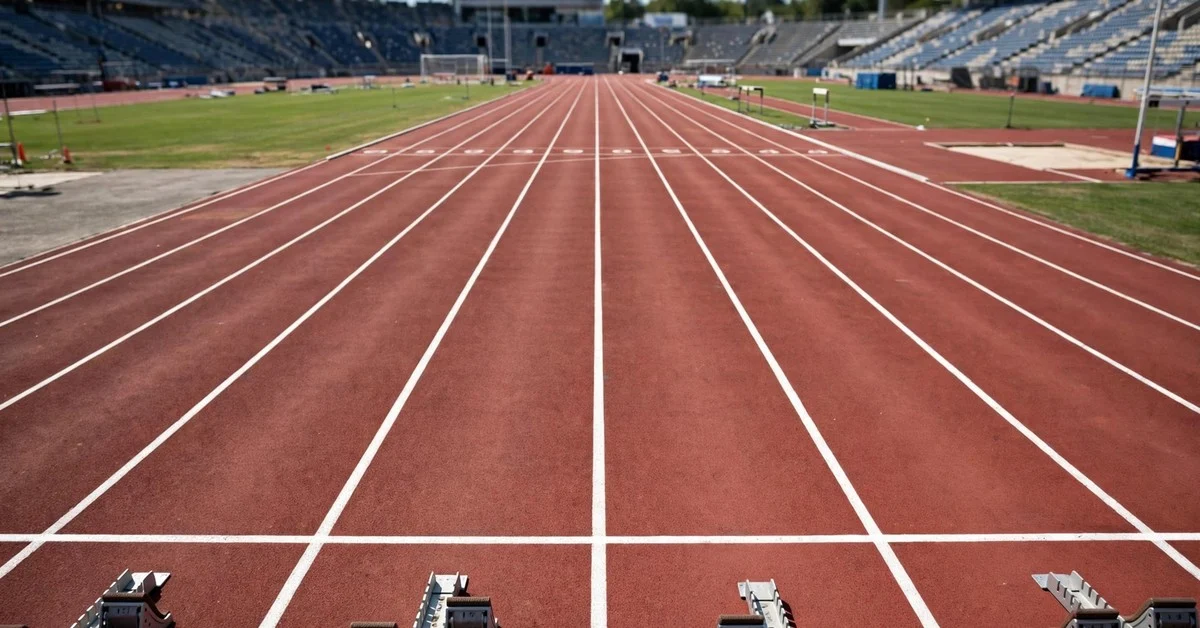
The gun goes off and nine seconds later it is over — or so it looks on television. In the stadium, the 100-meter dash feels completely different: the roar builds down the straightaway, the runners blur past in a wash of color, and the finish line arrives almost before you have processed the start. One hundred meters is the most famous distance in sports, and also one of the most misunderstood. It sounds short — a single city block, a minute’s walk — until you stand at the starting line and stare at how far away the finish really is. This is the distance that decides the title of world’s fastest human, and it shows up far beyond the track: in soccer stadiums, in city grids, even in the space between skyscrapers. Here is how to see it — from the sprinter’s drive phase to the towers you can tip sideways in your mind, plus the counting tricks that turn a hundred meters into something your feet already know.
100 meters in every unit
The conversions first, because this is a number worth having exact. Sprinters, surveyors, and soccer officials all work from the same figures.
| Unit | 100 meters equals |
|---|---|
| Feet | 328.08 ft |
| Yards | 109.36 yd |
| Inches | 3,937.01 in |
| Centimeters | 10,000 cm |
| Miles | 0.062 mi |
| Kilometers | 0.1 km |
Memorize 328 feet and a tenth of a kilometer. Sixteen of these make a mile (with a few meters to spare), and ten of them make a kilometer exactly.
Running it: the 100-meter dash, second by second
No picture of 100 meters beats the race itself. Here is what happens along the straightaway, using the men’s world record of 9.58 seconds as the reference — an average speed of 10.44 meters per second, roughly 23 miles per hour.
0–30 meters: the drive phase (0 to ~3.8 seconds). The runners explode from the blocks low, heads down, driving like sprinters escaping a fire. They are still accelerating hard at 30 meters — the fastest starters hit this mark first, and races are often decided here. For perspective, 30 meters alone is longer than a bowling lane.
30–60 meters: the transition (~3.8 to ~6.3 seconds). Bodies rise upright, strides lengthen, and the field stretches out. This is where top speed builds — elite sprinters peak around 60 to 80 meters at nearly 12 meters per second. A strong runner covers each 10-meter slice in under a second here.
60–80 meters: top speed (~6.3 to ~8.1 seconds). The race looks effortless for about two seconds. Strides hit 2.5 meters each, feet touching the ground for barely a tenth of a second per step. Nobody is getting faster from here — the only question is who slows down least.
80–100 meters: the dip (~8.1 to 9.58 seconds). Lactic acid floods in, form frays, and runners lunge — throwing the chest forward while the legs keep churning. The final 20 meters is where medals change hands by hundredths of a second. Then the clock stops, and the fastest humans alive have covered about the length of a city block in less time than it takes to read this paragraph.
For contrast: a fit amateur runs it in 13 to 15 seconds, a brisk walker needs about a minute, and a relaxed stroller takes closer to 90 seconds. Same distance, four completely different experiences of it.
Two invisible numbers govern the race before the running even starts. The first is reaction time: elite sprinters leave the blocks about 0.12 to 0.15 seconds after the gun, and anything under 0.10 is ruled a false start — deemed physiologically impossible as a genuine reaction. Championships have been lost by thousandths of a second at the start alone. The second is the wind reading: a tailwind over 2.0 meters per second invalidates a time for record purposes, which is why you will see a little “w” next to some of history’s fastest marks. The hundred meters is measured so precisely that the air itself gets a vote.
The women’s race deserves its own split times. Florence Griffith-Joyner’s 10.49-second world record from 1988 still stands — an average of 9.53 meters per second — and modern champions like Shelly-Ann Fraser-Pryce and Elaine Thompson-Herah have chased it into the 10.5s and 10.6s without catching it. Their race unfolds in the same four phases, just shifted a few tenths: the drive, the rise, the two seconds of flight, the lunge. Whatever the record board says, the geometry of the straightaway is identical for every runner who has ever toed the line — one hundred meters, eight lanes, no excuses.
Fields and pitches that measure a hundred
Team sports are built on fields that cluster around this exact distance.
1. The sprint straightaway itself
Exactly 100 meters, certified by officials before championship races — eight lanes of red track from the starting line to the finish. It is the truest picture available: stand at one end and look down all eight lanes, and you are seeing the distance with zero approximation. Every other comparison on this list is judged against it.
2. A full-size soccer pitch
International soccer fields run 100 to 110 meters long (Wembley sits near 105). The long green rectangle the camera sweeps across during a goal kick is essentially our distance. When a goalkeeper launches the ball toward the far penalty area, that flight covers most of a hundred meters.
3. Two Olympic swimming pools, end to end
An Olympic pool is exactly 50 meters, so two of them laid end to end make a perfect 100. Picture the long blue rectangle with its lane ropes, then double it. Because 50 meters is itself a famous sporting distance, doubling it feels natural — and the result is one of the most precise everyday pictures of a hundred meters.
4. A rugby field, try line to try line
In rugby league and union, the field of play between the two try lines is at most 100 meters — top-level grounds cluster tightly at the figure. Picture a kickoff sailing from one 22-meter line deep into the other half: that long arc of the ball traces most of the hundred-meter stretch, marked in white lines.
5. Four tennis courts in a row
A tennis court is 23.77 meters baseline to baseline, so four in a row cover about 95 meters — just five percent shy. Park tennis courts sit in fenced rows, and four of them together, nets and white lines included, land you close enough to call it a hundred for any estimating purpose.
6. A football field, goal line to goal line
The American field measures 100 yards — 91.44 meters — between the goal lines, about eight and a half meters short of our mark. A kickoff return from the goal line to midfield and beyond is the visual: the returner has to cover more than a hundred meters of dodging and sprinting to reach the far end zone.
7. The full field with both end zones
Add the two 10-yard end zones and the field becomes 120 yards — about 109.7 meters, roughly ten percent over. So the true hundred sits just inside the full field: start at the back of one end zone and you cross the hundred-meter mark a few strides before the far goal line.
Towers tipped sideways
Some of the world’s most photographed structures are nearly a hundred meters tall — lay them down and they become rulers.
8. Four blue whales, nose to tail
An adult blue whale — the largest animal known to have lived — reaches about 25 meters. Four of them in a line make roughly 100 meters of whale. Picture one, then imagine three more stretching behind it: few mental images convey “very long” faster, and it makes the distance feel properly grand.
9. The Statue of Liberty, ground to torch
Lady Liberty measures about 93 meters from the ground to the tip of her torch — seven meters short. Picture the full figure, pedestal, robes, raised arm, and flame, then stretch it a little further. The small shortfall teaches you what “just under a hundred meters” looks like.
10. Big Ben’s clock tower
The Elizabeth Tower in London stands about 96 meters — just four short of the mark, closer than the statue. Imagine the great clock face and spire laid on their side across a street: the far end would land almost exactly a hundred meters from where you stand. A landmark near a round number is a free measuring stick.
11. A 30-story office tower, tipped over
Office floors run 3 to 3.3 meters each, so thirty stories stack to roughly 90 to 100 meters. Pick a familiar downtown tower, tip it on its side in your mind, and that is the length — a whole city block of building, horizontal. Handy when judging long parks or waterfront promenades.
12. A typical downtown city block
Grid-planned cities were often laid out with blocks near 100 meters on the long side — Chicago’s grid is the classic example. Walk one block timing yourself or counting steps, and every block in the city becomes a measuring tool: two blocks, 200 meters; ten blocks, a kilometer.
Counting your way to a hundred
When no landmark is handy, count small things up to a big number.
13. About 1,170 credit cards, end to end
A credit card is 85.6 millimeters long, so 100 meters needs about 1,168 of them. Nobody would lay out the cards, but the math turns a tiny familiar object into a huge number — hold your own card, feel how small it is, then imagine a chain of a thousand-plus snaking down the street.
14. About 130 adult footsteps
An average step covers roughly 0.76 meters, so 130 to 132 strides carry you a hundred meters. This is the most practical reference here because your feet are always with you — try it on a track straightaway, count your own steps once, and you will own a personal hundred-meter gauge forever.
15. One-sixteenth of a mile
A hundred meters is 0.062 miles — very close to one-sixteenth of a mile (which is 100.58 meters). Runners live on this fraction: track workouts are built around 100-meter repeats, sixteen of which make a mile. Think of a mile as sixteen equal slices, and each slice is the distance you are picturing.
Questions from the finish line
Why do sprinters look like they slow down before the finish?
They are not slowing by choice — nobody can hold top speed for the full hundred. Elite sprinters peak around 60 to 80 meters and then decelerate slightly; the winner is simply the one who fades least. What looks like easing off is actually maximum effort against mounting fatigue, which is why the final 20 meters decides so many races.
How many breaths does a 100-meter sprint take?
Surprisingly few — elite sprinters breathe only two or three times in the whole race, and some take a single breath after the start and hold it. At nine to ten seconds of all-out effort, the body runs on stored energy, not oxygen intake. Breathing costs rhythm, so sprinters ration it like everything else. Distance runners, by contrast, breathe in strict patterns for the entire race — the hundred meters is the only event short enough to treat air as optional.
Is a 100-meter track straight or curved?
The 100-meter dash is run on a straightaway — one straight section of the standard 400-meter oval. That is the whole point of the event: no bends, no stagger, just pure straight-line speed. The curve only matters in the 200 and 400, where staggered starts compensate for lane geometry. It is also why the 100-meter world record carries a special prestige — it is the purest speed test in athletics, with nowhere to hide.
What counts as a good 100-meter time for a non-athlete?
Under 15 seconds is solid for a fit adult, under 13 is genuinely quick, and anything under 12 puts you in ex-sprinter territory. For context, the average untrained adult runs it in 15 to 18 seconds. If you break 15 without specific training, you have real natural speed. And if you ever want to find out properly, most cities have an all-comers track meet in summer — hand-timed, friendly, and the fastest way to put a number on it.
How far is 100 meters on a treadmill display?
Most treadmills read in miles or kilometers — 100 meters shows as 0.06 miles or 0.10 kilometers. At a 10-minute-mile jogging pace, it takes about 37 seconds; at a 6-minute-mile pace, about 22 seconds. Either way, watching the tenths of a kilometer tick over is a fine way to feel the distance indoors.
See also: how long 10 meters is.
See also: how long 5 meters is.
Your own finish line
One hundred meters is the straightaway, the soccer field, the city block, and about 130 of your footsteps — 328 feet that contains the fastest nine seconds in sports and the most ordinary minute of your walk. The distance earns its fame honestly: short enough to see end to end, long enough that covering it fast takes everything you have. Pick your reference — the track for sports, the block for the city, your own counted steps for everything else — and the number becomes a picture. The next time a commentator shouts about the final hundred meters, you will see the lanes, the lean, and the line. And if you ever get the chance, stand at a real starting line and look down the straight. Television never does it justice.

I’m Owen Reeves, a content writer at MeasureZit.com, specializing in measurements, unit conversions, and mathematical concepts. I turn technical topics into clear, accurate content that’s easy to understand. My focus is precision, clarity, and genuinely useful information.










