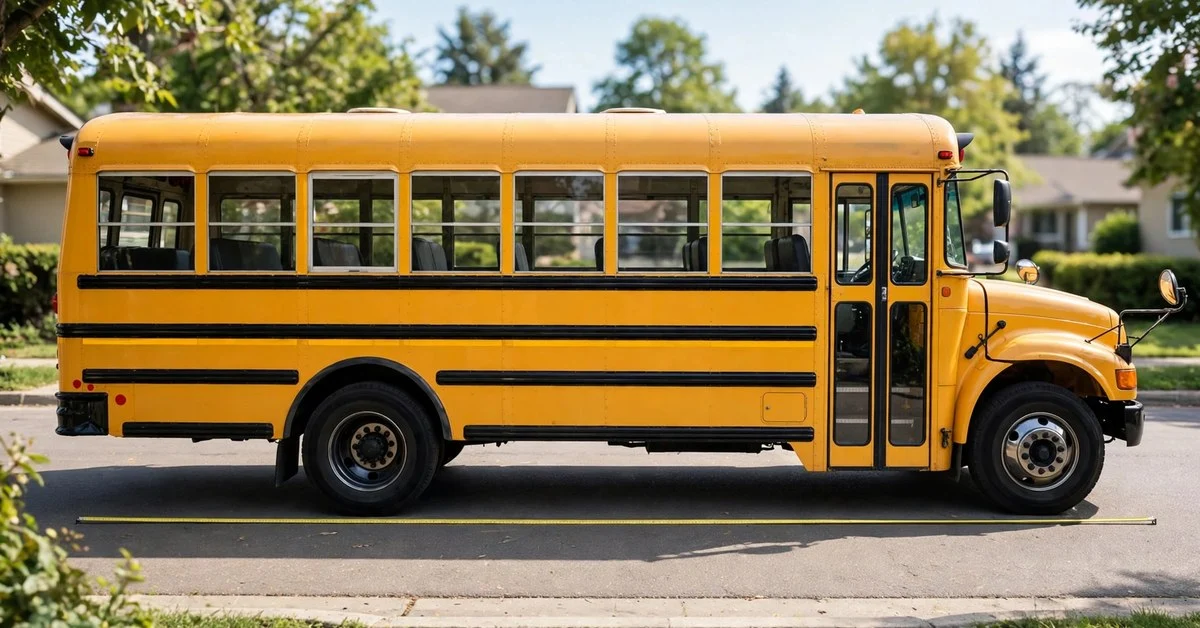
Wondering how long 30 feet really is? Picture a short school bus rolling past your window — that is one of the everyday things that are about 30 feet long. Thirty feet equals 360 inches, 10 yards, or about 9.1 meters. It is a distance that pops up constantly in daily life: the length of a first down in football, the run of a garden hose, the reach of an extension cord. Whether you are measuring a backyard, parking a trailer, or shopping for a hose, knowing how long 30 feet is can save you a trip with the tape measure. The short version is simple. Thirty feet is ten adult strides, about two car lengths, and a third of a city block.
Conversion Chart
| Unit | Converted Value |
|---|---|
| Inches | 360 in |
| Feet | 30 ft |
| Yards | 10 yd |
| Millimeters | ≈ 9,144 mm |
| Centimeters | 914.4 cm |
| Meters | ≈ 9.14 m |
15 Common Things That Are 30 Feet Long
Common Objects That Are About 30 Feet
| Item | Approximate Length |
|---|---|
| 1. A Short School Bus | About 30 ft |
| 2. An NFL First Down | Exactly 30 ft (10 yards) |
| 3. A 30-Foot Garden Hose | 30 ft |
| 4. A 30-Foot Extension Cord | 30 ft |
| 5. A Class A Motorhome | About 30 ft |
| 6. A Three-Story Building | About 30 ft |
| 7. A Utility Pole | About 30 ft |
| 8. Two Midsize Cars End to End | About 30 ft |
More Everyday Items Around 30 Feet
| Item | Approximate Length |
|---|---|
| 9. A 30-Foot Sailboat | 30 ft |
| 10. A Residential Swimming Pool | About 30 ft |
| 11. A Fire Engine | About 30 ft |
| 12. Half a Bowling Lane | About 30 ft |
| 13. A 30-Foot Flagpole | 30 ft |
| 14. Two 15-Foot Canoes | 30 ft |
| 15. A 30-Foot Tape Measure | 30 ft |
How Long Is 30 Feet?
Thirty feet sits in a sweet spot of measurement. It is long enough to matter — you cannot cross it in a couple of steps — but short enough to picture without a map. A standard 20-foot shipping container, for instance, covers only two-thirds of 30 feet, so imagine that container and then add half of it again. On the other side, three 30-foot stretches laid end to end give you roughly 100 feet, which is about the length of a basketball court plus some breathing room. For a longer stretch, see how long 50 feet is.
The easiest everyday anchor is the football field. Every first down in American football is exactly 10 yards, and 10 yards is exactly 30 feet. Next time you watch a game, look at the distance between the line of scrimmage and the first-down marker. That gap is 30 feet, and it never changes.
Easy ways to estimate 30 feet in everyday life
- Count your strides: Ten relaxed adult walking strides cover roughly 30 feet. Walk it off and count.
- Use parked cars: Two midsize sedans parked bumper to bumper stretch about 30 feet. Picture the parking lot.
- Borrow a hose: A standard 30-foot garden hose is sold in exactly this length. Unroll one mentally from the spigot.
- Think in yards: Ten yards is 30 feet. If you can picture a first down, you can picture 30 feet.
- Stack doorways: A standard interior doorway is about 7 feet tall, so four doorways stacked would reach 28 feet — just shy of 30.
- Check the cord: That orange 30-foot extension cord in your garage is literally this measurement, coiled and ready.
1. A Short School Bus
A Type A short school bus — the stubby kind used for small routes and shuttle service — runs about 30 feet from bumper to bumper. Full-size school buses stretch closer to 40 feet, but the short version lands right on our number. This is a dependable mental image because nearly everyone has stood near a school bus. Next time one drives past, watch how much road it covers. That whole moving rectangle is 30 feet. If you ever need to judge whether a driveway or parking pad can hold a 30-foot trailer, just ask yourself if a short bus would fit.
2. An NFL First Down
Here is the most exact reference on the list. Every first down in American football is 10 yards, and 10 yards is exactly 30 feet. The chains the officials carry are precisely this long. This works so well because football fields are measured with extreme care, so the reference never drifts. You have probably watched hundreds of first downs without thinking of them as rulers. From now on, the gap between the line of scrimmage and the orange marker is your built-in 30-foot gauge for any open space.
3. A 30-Foot Garden Hose
Walk into any hardware store and you will find garden hoses sold in 25, 50, 75, and 100-foot lengths — and the less common but widely available 30-foot size. Manufacturers settled on these lengths because they match real yards. A 30-foot hose reaches from a house spigot to the far corner of a modest garden. It is easy to picture because most people have dragged one around. Stretch it straight in your mind from your front door outward, and you are looking at 30 feet of ground covered.
4. A 30-Foot Extension Cord
That bright orange or yellow cord coiled in the garage is often sold as a 30-footer. It is one of the most common extension cord lengths because it bridges the gap between an outlet and a work area without excess slack. For a shorter run, a 10-foot cord does the job, but the 30-foot version is the workshop standard. Picture unrolling it across your living room and out the front door. The path it traces is your 30-foot line, and you can almost feel the weight of the coil.
5. A Class A Motorhome
Many Class A motorhomes — the big flat-fronted RVs — are built right around the 30-foot mark. Makers like this length because it fits most campground pads while still sleeping a family. You have seen these rolling down the highway, and their size is memorable: taller than a van, shorter than a semi trailer. When one passes you on the road, the space it occupies in your lane is about 30 feet long. Campground shopping is one place this reference earns its keep.
6. A Three-Story Building
A single residential story is roughly 10 feet from floor to floor, so a three-story apartment block or townhouse stands about 30 feet tall. Lay that building on its side and you have our measurement. This helps when you look at a house and try to judge a horizontal distance. Three stacked floors is a shape everyone knows from city streets. Next time you need 30 feet of rope, fence, or string lights, picture the height of a three-story walk-up and turn it sideways.
7. A Utility Pole
The wooden utility poles lining residential streets are typically around 30 feet tall. A few feet sit underground, so the visible part is a touch less, but the pole itself is a 30-foot timber. Because they repeat at even spacing down every street, they make excellent distance markers. Stand at the base of one and look up. That climb from sidewalk to wires is the same length as a first down, a short bus, and everything else on this list.
8. Two Midsize Cars End to End
An average midsize sedan is about 15 feet long, so two of them parked nose to tail cover roughly 30 feet. Parking lots are full of this picture. Find two sedans in a row and the combined footprint is your measuring stick. This reference shines when you are judging whether something fits: a boat, a trailer, a moving truck. If two cars would fill the space, you are looking at about 30 feet.
9. A 30-Foot Sailboat
Thirty feet is one of the most popular sailboat sizes in the world. Boat makers build countless models at exactly this length because it balances living space with marina fees and handling. Marina docks are often sized in 30-foot slips for this reason. If you have ever walked a dock, the boats lined up in their berths give you a repeating 30-foot pattern. Even if you never sail, picturing a modest white sailboat with its mast up is a clean way to hold this length in your head.
10. A Residential Swimming Pool
Many backyard pools are built around 30 feet long — a comfortable size for laps and play without overwhelming a suburban lot. Pool builders favor lengths in the high twenties to low thirties. Anyone who has swum laps knows the feel of pushing off one wall and counting strokes to the other. That stretch of blue water is about 30 feet. It is a handy gauge for estimating backyard distances, from fence lines to garden beds.
11. A Fire Engine
A standard fire engine runs about 30 to 35 feet long, with most models landing near the 30-foot mark. These trucks need that length to carry pumps, hoses, ladders, and crew. You have seen them parked at emergencies, and their footprint is striking — they fill an intersection. Because fire engines are built to strict specifications, their size stays consistent from city to city. The next time one rolls by with lights flashing, remember that the red machine stretching down the street is about 30 feet of purpose-built length.
12. Half a Bowling Lane
A regulation bowling lane measures 60 feet from the foul line to the head pin. Half of that is 30 feet. Bowlers know this distance in their bones: it is the stretch from the foul line to the arrows and dots midway down the lane. You can picture the polished wood, the gutters on each side, and the halfway point where the lane markings sit. Cut any lane in two and each half is a perfect 30-foot reference, hiding in plain sight at every bowling alley.
13. A 30-Foot Flagpole
Commercial flagpoles are commonly sold in 20, 25, 30, and 35-foot heights, and the 30-foot version is a favorite for schools, car dealerships, and office parks. It is tall enough to fly a large flag with presence but short enough to install without special equipment. Look at the flagpole outside any mid-size business. The climb from the base to the gold ball on top is 30 feet straight up. Tip it over in your imagination and you have a horizontal 30-foot line.
14. Two 15-Foot Canoes
A classic recreational canoe is about 15 feet long, so two of them laid end to end measure 30 feet. Canoes are easy to picture because their shape is so distinctive — long, narrow, with pointed ends. Lakeside cottages and rental docks stack them in rows. Imagine two canoes touching tip to tail on a dock. That combined silhouette, roughly the length of a first down, is a simple natural ruler for campsite and shoreline distances.
15. A 30-Foot Tape Measure
Long tape measures are sold in 25, 30, and 100-foot lengths, and the 30-foot version is the handyman’s favorite for room and yard work. It is the tool people reach for when a standard 16-foot tape comes up short. The tape itself is exactly what we are measuring, which makes this the most literal reference here. If you own one, pull it out and stretch it across the room. That ribbon of yellow steel is 30 feet, no guessing required.
Frequently Asked Questions
Is 30 feet the same as 10 yards?
Yes. One yard equals 3 feet, so 10 yards is exactly 30 feet. That is why a football first down — 10 yards — is the most precise everyday picture of 30 feet.
What is 30 feet in meters?
Thirty feet in meters is about 9.14 meters. Multiply feet by 0.3048 to convert: 30 × 0.3048 = 9.144, which rounds to roughly 9.1 meters.
What household item is closest to 30 feet?
A 30-foot garden hose or a 30-foot extension cord. Both are sold in exactly this length, so either one is a perfect real-world match you may already own.
How many car lengths is 30 feet?
About two. An average midsize sedan is roughly 15 feet long, so two parked bumper to bumper cover close to 30 feet.
See also: how long 72 inches is.
Final Thoughts
So, how long is 30 feet? It is a first down, a short school bus, a garden hose stretched across the yard, and ten easy strides. Once you tie the number to objects you see every week, 30 feet stops being abstract and becomes something you can feel. That is the whole trick to estimating without tools. Keep one or two of these pictures handy — the school bus for length, the first down for precision — and you will be able to judge 30 feet on sight, whether you are parking a trailer, buying a hose, or settling a friendly argument about the size of a backyard.

I’m Dane Whitfield, a content writer at MeasureZit.com, where I specialize in creating clear, accurate articles on measurements, unit conversions, and mathematical concepts. I enjoy breaking down complex numerical topics into simple, practical explanations that readers can actually use. My goal is always precision and clarity helping people make sense of the numbers around them.










