How long is 50 feet? Stretch a garden hose across a big yard and you are looking at it. Fifty feet equals 600 inches, about 15.24 meters, or exactly half of 100 feet. This is a working length: gardeners buy hoses in 50-foot coils, truckers haul 53-foot trailers, and a basketball court measures exactly 50 feet wide. Planning a fence line, buying outdoor lights, or settling a bet about a bowling lane all get easier when you can see 50 feet in things you already know. Here are 15 everyday items around 50 feet long, plus conversions and easy estimation tricks.
Conversion Chart
| Unit | Converted Value |
|---|---|
| Feet | 50 ft |
| Inches | 600 in |
| Yards | ≈ 16.67 yd |
| Millimeters | 15,240 mm |
| Centimeters | 1,524 cm |
| Meters | 15.24 m |
15 Everyday Things That Are 50 Feet Long
Common Objects That Are About 50 Feet
| Item | Approximate Length |
|---|---|
| 1. A 50-Foot Garden Hose | 50 ft |
| 2. A Semi-Trailer | 53 ft |
| 3. A Standard Boxcar | About 50 ft |
| 4. An Adult Humpback Whale | About 50 ft |
| 5. A Basketball Court (Width) | 50 ft |
| 6. A Bowling Lane | 60 ft |
| 7. A Five-Story Building | About 50 ft (tall) |
| 8. A Single-Wide Mobile Home | About 50 ft |
More Everyday Items Around 50 Feet
| Item | Approximate Length |
|---|---|
| 9. A 50-Foot String of Patio Lights | 50 ft |
| 10. A City Bus | About 40 ft |
| 11. A Badminton Court | 44 ft |
| 12. A Cricket Pitch | 66 ft |
| 13. A Standard Telephone Pole | About 35 ft |
| 14. The Hollywood Sign Letters | 45 ft (tall) |
| 15. A Ladder Fire Truck | About 50 ft |
How Long Is 50 Feet?
Fifty feet is longer than most people guess. It is 600 inches laid end to end, roughly the distance from home plate to second base and back, or five full-size pickup trucks nose to tail. In metric it is 15.24 meters, a number swimmers and track fans can relate to. The easiest mental anchor: 100 feet is exactly twice this, so 50 feet is the halfway point of a football field’s width plus change.
For a fast 50 feet comparison, bracket it. A badminton court is 44 feet long, 6 feet shorter. A bowling lane is 60 feet, 10 feet longer. Stand at one end of either and you are within a few strides of 50 feet. Another handy frame: 50 feet is five times 10 feet, so picture five basketball hoops stacked and you have nailed it.
Easy ways to estimate 50 feet in everyday life
- Unroll a garden hose: The standard 50-foot hose is the most literal reference. Picture it stretched straight across a yard.
- Walk it off: An average adult stride is about 2.5 feet. Twenty comfortable steps covers roughly 50 feet.
- Picture a basketball court: The court is exactly 50 feet wide. Stand on one sideline and look across.
- Think five stories: A five-story building stands about 50 feet tall. Lay it on its side in your mind.
- Count bus lengths: A city bus is about 40 feet. Add a quarter of another bus and you reach 50 feet.
- Think in meters: Fifty feet is 15.24 meters. Picture one and a half city buses end to end in metric.
1. A 50-Foot Garden Hose
This is the reference that needs no math. Walk into any hardware store and the standard garden hose comes in a 50-foot coil. It is the most common length sold. Unrolled across a lawn, it runs from the spigot to the far flower bed in most suburban yards. Gardeners handle this length weekly, dragging it around corners and coiling it back up. Because the package says 50 feet right on it, there is zero guesswork. If you own one, stretch it out once and memorize the sight. You will never wonder about 50 feet again.
2. A Semi-Trailer
Highway drivers see this one daily. A standard semi-trailer, the box towed behind a big rig, measures 53 feet long, just 3 feet past our mark. These trailers define the scale of American highways; when one passes you, that long wall of metal is essentially 50 feet. Logistics companies standardized on 53 feet decades ago to maximize cargo within legal limits. Next time you are stuck behind one at a light, notice how far it stretches. Shave off a yard and you are looking at exactly 50 feet of trailer.
3. A Standard Boxcar
Railroads built their world on this length. A standard boxcar, the enclosed freight car with sliding doors, runs about 50 feet long on the inside, the classic “50-foot car” of railroading. These cars haul everything from paper to canned goods across the country. Stand next to one at a crossing and its length is striking: about three and a half sedans end to end. The 50-foot boxcar became the industry standard in the 1930s and still defines how freight is measured. It is 50 feet of steel on wheels.
4. An Adult Humpback Whale
Nature hits this number beautifully. An adult humpback whale typically measures 46 to 56 feet long, putting a big one right around 50 feet. That is longer than a school bus, with a tail fluke as wide as a car is long. Whale-watchers off the coasts know the thrill of seeing 50 feet of animal roll beside a boat. The heart alone is the size of a small car. When you picture 50 feet, picture it moving through water, it makes the length feel properly massive.
5. A Basketball Court (Width)
Sports give us exact numbers, and this one is perfect. A regulation basketball court is 94 feet long and exactly 50 feet wide. Every NBA arena, college gym, and high school court shares these dimensions. Stand on one sideline and look straight across to the other. That span is 50 feet, no rounding needed. Players cross it in seconds, but for the rest of us it is a great fixed ruler. If you have ever watched a game, you have stared at 50 feet for two hours without knowing it.
6. A Bowling Lane
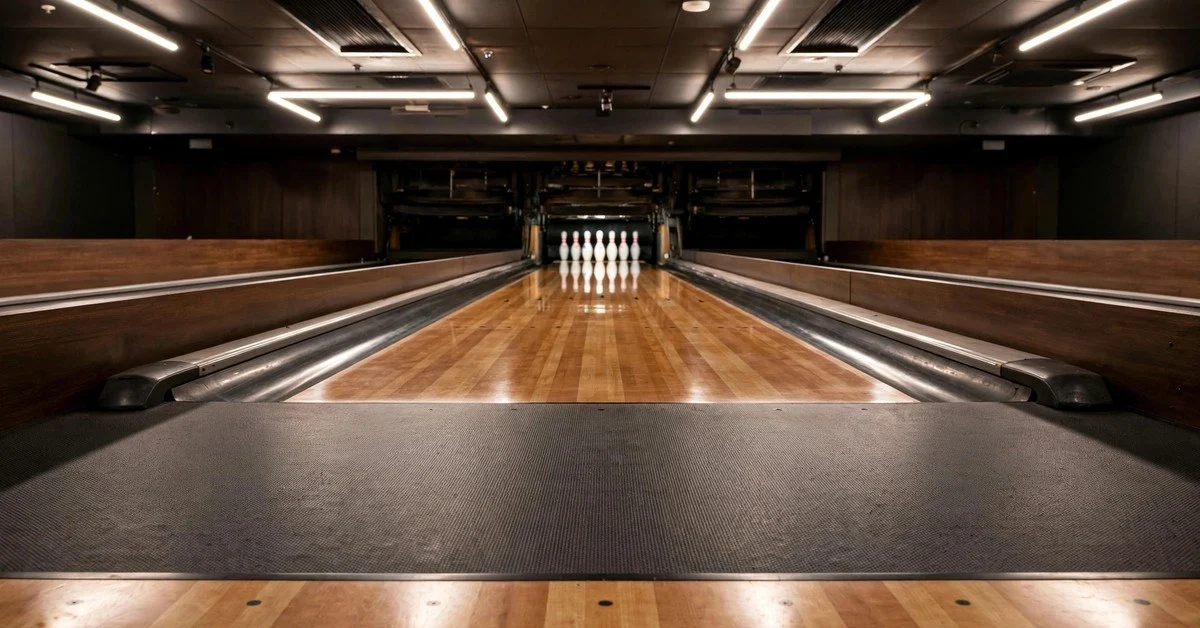
Here is the themed reference, running just long. A bowling lane measures 60 feet from the foul line to the head pin, 10 feet past 50 feet. The approach adds a bit more, but the lane itself is the famous number every bowler learns. Picture standing at the foul line, ball in hand, staring down 60 feet of polished wood. Now imagine the pins moved 10 feet closer. That shorter lane in your mind is 50 feet. Bowlers already think in lane lengths, so this one comes naturally to anyone who plays.
7. A Five-Story Building
Look up at an apartment block. A five-story building stands roughly 50 feet tall, since each story runs about 10 feet floor to floor. Walk past one on any city street and you are walking past 50 feet of height. Architects use 10 feet per story as a rule of thumb, which makes this estimate reliable across most residential buildings. Tip it on its side in your imagination and you have 50 feet of length. It is a vertical reference for a horizontal question, and it works surprisingly well.
8. A Single-Wide Mobile Home
These homes are literally sold by their dimensions. A single-wide mobile home commonly measures about 14 feet wide by 50 to 70 feet long, with 50 feet being a standard size. Drive through any mobile home park and you will see rows of them, each one a 50-foot ruler sitting on blocks. The long, narrow shape makes the length easy to read at a glance. If you have ever walked the length of one visiting a friend, you have paced off 50 feet indoors.
9. A 50-Foot String of Patio Lights
Backyard decorators know this product well. Outdoor patio lights are often sold in 50-foot strands, enough to drape across a deck or zigzag over a patio. Unboxed and stretched out, the string runs the length of a large yard. The little bulbs spaced along it make the distance easy to see at night, glowing bulb by bulb across 50 feet. It is a cheerful reference: next time you hang lights for a party, notice how far that single strand reaches. That is 50 feet of celebration.
10. A City Bus
Public transit gives us a slightly shorter bracket. A standard city bus measures about 40 feet long, 10 feet shy of 50 feet. Commuters board these every day without thinking about their size, but the length is substantial: it is two full car lengths plus change. Picture the bus, then add a small car’s worth of length to the back. That gets you to 50 feet. It is a useful lower anchor because buses are everywhere, and 40 feet is easy to remember.
11. A Badminton Court
Racket sports keep tight dimensions. A badminton court measures 44 feet long, 6 feet short of 50 feet. The court is the same for singles and doubles, marked for a game played with a shuttlecock that can top 200 mph. If you have played in a gym, you know the feeling of covering that length in a few lunging steps. Add two long strides to the end and you reach 50 feet. It is a compact, precise reference from a sport played in backyards and Olympics alike.
12. A Cricket Pitch
Here is the longer bracket from the world’s second most popular sport. A cricket pitch, the strip between the two wickets, measures 22 yards, which is 66 feet. That is 16 feet past 50 feet. Bowlers sprint down it to deliver the ball, and batsmen run its length for every run scored. Cricket fans watch this 66-foot strip for hours, so its scale is deeply familiar to them. Picture the pitch, then chop off about a sixth of it. What remains is 50 feet of cricket.
13. A Standard Telephone Pole
Utility poles line every street, and they make a fine shorter reference. A standard telephone pole stands about 35 feet tall above ground, 15 feet short of 50 feet. Linemen climb them, wires sag between them, and drivers pass them by the thousand. Picture one pole, then stack half another on top. That gets you to 50 feet. Because poles are spaced evenly along roads, they also help you judge horizontal distance: one and a half pole-heights laid flat is 50 feet.
14. The Hollywood Sign Letters
Landmarks make measurements memorable. Each letter of the Hollywood sign stands 45 feet tall, 5 feet short of 50 feet. Those nine white letters have towered over Los Angeles since 1923, visible for miles. Tourists photograph them from every angle, and each letter is as tall as a four-story building. Picture a single letter, then add a tall person’s height on top. That is 50 feet, Hollywood style. It is hard to forget a reference this famous.
15. A Ladder Fire Truck
Fire stations house some of the longest vehicles on the road. A ladder fire truck, the one with the big extendable ladder on top, can stretch about 50 feet long. These trucks need the length to carry ladders that reach over 100 feet into the air. When one rolls past with lights flashing, its size commands the whole street. Kids point at them; adults move aside. That impressive machine rolling by is roughly 50 feet of firefighting power, and now you know exactly how long it is.
FAQ
How many meters is 50 feet?
Fifty feet equals 15.24 meters. It is a handy conversion for anyone who thinks in metric, just over 15 meters.
Is 50 feet half of 100 feet?
Yes, exactly. Fifty feet is precisely half of 100 feet, which makes the two measurements easy to pair when estimating.
What is 50 feet long?
A standard garden hose, a basketball court (width), and a single-wide mobile home are all about 50 feet. A semi-trailer at 53 feet and a bowling lane at 60 feet are close comparisons.
How many inches is 50 feet?
Multiply 50 by 12 and you get 600 inches. That is also about 15.24 meters or 16.67 yards.
Final Thoughts
How long is 50 feet? It is 600 inches, the length of a garden hose, the width of a basketball court, and half of 100 feet. From semi-trailers to humpback whales, the world is full of 50-foot references hiding in plain sight. Pick the one you encounter most, probably that garden hose coiled by the spigot, and 50 feet becomes a length you can see without measuring. Once it clicks, you will start spotting it everywhere: in parking lots, on highways, and across every sports field you visit.

I’m Dane Whitfield, a content writer at MeasureZit.com, where I specialize in creating clear, accurate articles on measurements, unit conversions, and mathematical concepts. I enjoy breaking down complex numerical topics into simple, practical explanations that readers can actually use. My goal is always precision and clarity helping people make sense of the numbers around them.