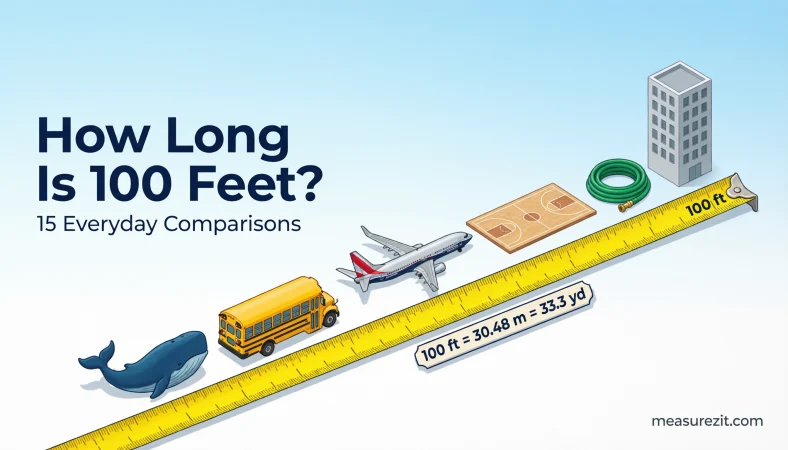
Stand at one end of your driveway and try to picture a school bus and a half stretched out in front of you. That’s roughly what 100 feet looks like a distance most people badly underestimate until they see it marked out in real life.
100 feet equals 33.3 yards, or about 30.5 meters. It’s one of those numbers that shows up more often than you’d expect: buying a garden hose, checking if a moving truck will fit along the curb, fencing in a backyard, or figuring out how far back you need to stand to fit a whole building in a photo. Once you’ve measured a few of these yourself, 100 feet stops being an abstract number and starts being something you can eyeball with reasonable accuracy.
This guide walks through exactly what 100 feet converts to, plus fifteen real-world things that sit at or near that length, so you can build an instinct for the distance without pulling out a tape measure every time.
100 Feet Conversion Chart
| Unit | Converted Value |
| Inches | 1,200 in |
| Feet | 100 ft |
| Yards | 33.33 yd |
| Miles | ≈0.019 mi |
| Millimeters | 30,480 mm |
| Centimeters | 3,048 cm |
| Meters | 30.48 m |
These are exact, standard conversions, so they’re safe to copy straight into a project plan, a materials list, or a permit application.
Everyday Things Near 100 Feet Long
Not every comparison below lands on exactly 100 feet and that’s on purpose. A few sit a little under, a few round up, and a couple hit the mark almost precisely. Seeing the range actually helps more than a list of forced exact matches would, because it shows you what 90 feet feels like next to 100, and what 105 feet feels like on the other side.
| Object | Approximate Length |
| Blue whale | Up to ~100 ft |
| One-third of a football field | 100 ft (33 yards) |
| NBA basketball court | 94 ft |
| A 10-story building | ~100 ft tall |
| A Boeing 737-600 | ~102 ft |
| A 100-foot garden hose | 100 ft |
| Six or seven midsize cars, end to end | ~90–105 ft |
| A standard suburban house lot depth | Often ~100 ft |
More Everyday Reference Points
| Object | Approximate Length |
| An NHL hockey rink (width) | 85 ft |
| A large yacht | ~100 ft |
| A tennis court (length) | 78 ft |
| Two and a half school buses | ~100 ft |
| A 100-foot tape measure | 100 ft |
| A short city block face | Often ~100 ft |
| About 17 adults lying head to toe | ~98–100 ft |
How Long Is 100 Feet, Really?
The best way to feel this distance is to compare it to something shorter and something longer. Fifty feet half of our target is about the length of a single school bus, something you can take in with one glance from the sidewalk. Go the other way, and 150 feet starts to feel like the width of a busy street with sidewalks on both sides, long enough that you’d have to raise your voice to talk to someone on the far curb.
A hundred feet sits right in the middle of that range: long enough to need a real walk, short enough to still register as one continuous space rather than a whole city block. It’s roughly the length of an NBA court plus a few extra steps, or a garden hose fully unrolled without a single kink left in it.
I’ve measured out driveways, fence lines, and extension-cord runs enough times to know the number always looks smaller on paper than it feels once you’re standing at the far end. That gap between the math and the actual feeling of the space is exactly why comparisons like these are worth having on hand.
Easy ways to estimate 100 feet without a tape measure:
- Unroll a garden hose. Most are sold in 100-foot lengths, so stretching one across your yard gives you an instant, accurate reference with zero math involved.
- Count parked cars. Roughly six or seven midsize sedans lined up bumper to bumper will land you close to 100 feet.
- Walk it off. At a relaxed pace, most adults cover 100 feet in about 35 to 40 steps.
- Use a basketball court as a ruler. An NBA court is 94 feet long, so 100 feet is just past the baseline with a few strides to spare.
- Think about building floors. Roughly ten stories of a typical office building adds up to close to 100 feet in height.
- Try your phone’s AR measuring tool. Most modern smartphones can estimate outdoor distances like this reasonably well, especially over flat, open ground.
1. Blue Whale
The blue whale is the largest animal known to have ever lived, and according to the National Oceanic and Atmospheric Administration, the biggest individuals on record approach or exceed 100 feet from nose to tail fluke. It’s one of the few living things on Earth that can genuinely stand in for this measurement on its own.
Most of us have only encountered a blue whale through a documentary, a museum skeleton, or a life-size mural painted on the side of a building. That last one is worth seeking out if you ever get the chance. Walking the full length of a life-size whale mural is one of the more effective ways to feel just how long 100 feet actually is.
2. One-Third of a Football Field
An American football field runs 300 feet between end zones, which puts 100 feet exactly at the 33-yard line measured from either goal line. Because football is watched by tens of millions of people every week, this comparison needs almost no explanation.
Next time a game is on, watch a receiver run a deep route and picture the ball crossing that 33-yard mark. That stretch of grass covered in just a few seconds at a full sprint is your 100 feet.
3. NBA Basketball Court
A regulation NBA court measures 94 feet baseline to baseline, landing just 6 feet short of the full distance. Basketball courts are everywhere: schools, parks, gyms, driveways with a hoop bolted to the garage which makes this one of the easiest comparisons to actually go stand next to.
Watch a fast break end to end and you’ve just watched someone cover 94 of your 100 feet in a handful of strides. Add a small step past the baseline, and you’re there.
4. A 10-Story Building
Most commercial buildings average close to 10 feet of height per floor, so a building with ten stories typically stands somewhere around 100 feet tall. This is the one comparison on the list that flips the measurement vertical instead of horizontal, which matters because that’s often how the question actually comes up in real life crane height limits, drone regulations, or zoning height caps.
Next time you’re near a mid-rise apartment building, count the floors from the sidewalk. Ten floors up is roughly where your 100 feet ends.
5. A Boeing 737-600
The smallest variant in the Boeing 737 family measures about 102 feet nose to tail, according to Boeing’s published aircraft specifications. Larger 737 models stretch considerably longer, but this particular one lands almost exactly on our target.
Airplanes are one of the few enormous, synthetic objects most people have stood right next to, if boarding through a jet bridge or watching one taxi past an airport window. That firsthand familiarity is what makes this comparison stick.
6. A 100-Foot Garden Hose
Hardware stores routinely sell garden hoses in 100-foot lengths, which makes this the most literal entry on the whole list. If you’ve ever fully unwound one across a backyard to reach a far corner flower bed, you’ve already walked the distance without giving it a second thought.
This comparison earns its spot because it’s genuinely useful, not just illustrative. Unrolling a hose end to end is one of the fastest ways to check this distance at home, and there’s a good chance you already own one sitting in the garage.
7. Six or Seven Midsize Cars, End to End
An average midsize sedan runs somewhere around 15 feet long, so lining up six to seven of them nose to tail gets you into the 90-to-105-foot range. The exact count depends on the models involved, which is why this one’s a range rather than a fixed number; a full-size pickup will get you there faster than a compact sedan will.
Counting parked cars is a genuinely practical trick for judging distance without any tools, if you’re deciding if a driveway extension will fit or estimating how much curb space a moving truck needs.
8. A Standard Suburban House Lot Depth
Many U.S. residential subdivisions plat their lots with a depth close to 100 feet, a dimension common enough in local zoning codes that it’s frequently used as a default figure in planning documents. Actual lot depths vary a lot by city, era of construction, and local ordinance, so treat this as a common benchmark rather than a universal rule.
Homeowners run into this number constantly when planning a fence, a pool, or a backyard addition, since permitting offices often reference lot dimensions in exactly these terms. If you’ve ever pulled a property survey, there’s a decent chance a 100-foot measurement showed up on it somewhere.
9. An NHL Hockey Rink
A regulation NHL rink measures 85 feet across, which puts it a real 15 feet shy of our target worth noting honestly rather than rounding it up to something it isn’t. Hockey rinks are common enough, from professional arenas to neighborhood rec centers, that plenty of people have skated the width of one themselves.
Picture a player carrying the puck from one boarded wall to the other, then stretch that trip by about the length of a large pickup truck. That’s how you close the gap to 100 feet.
10. A Large Yacht
In the boating world, vessels in the 100-foot class are marketed specifically at this size, a common enough category that boat brokers use the number as shorthand in listings. These yachts are large enough for multiple decks and staterooms, though they’re still well short of the true superyachts that stretch past 200 feet.
Marinas in coastal cities often dock a few vessels in this exact size range, so a walk down a marina pier is a genuinely easy way to eyeball the comparison in person.
11. A Tennis Court
A regulation doubles tennis court measures 78 feet baseline to baseline shorter than 100 feet, but still a useful anchor since courts are common in parks, schools, and country clubs everywhere. Many people already have some sense of that distance from playing or watching matches.
Add roughly another quarter of the court’s own length, and you’ve closed the gap to 100 feet. It’s a handy trick if you’re standing courtside and want a rough estimate without reaching for a phone.
12. Two and a Half School Buses
A standard American school bus runs close to 40 feet long, so lining up two and a half of them nose to tail gets you almost exactly to 100 feet. Nearly everyone has seen a school bus idling at a curb or waiting in a pickup line, which makes this an easy image to hold onto.
This comparison is especially useful for parents and school staff thinking through drop-off zones or bus loop layouts, where distances like this come up in genuinely practical terms.
13. A 100-Foot Tape Measure
Contractors and surveyors commonly carry long-format tape measures wound onto an open reel, sold specifically in 100-foot lengths rather than the short pocket case used for smaller jobs. It’s a tool built to measure exactly this distance, which makes it a fittingly literal comparison.
If you’ve ever watched a fence installer or land surveyor at work, there’s a good chance you’ve seen one of these reels stretched taut across a yard. It’s the fastest way to confirm the distance on the spot, no conversion required.
14. A Short City Block Face
In many grid-planned cities, a single block’s short side the frontage facing the street often falls somewhere close to 100 feet, though this varies enormously between cities and even between neighborhoods in the same city. It’s a figure that comes up often enough in urban planning conversations to be a useful mental anchor, without being a hard rule anywhere.
Walking past a handful of storefronts or rowhouses along one block face is a low-effort way to sense this distance firsthand, especially in older, walkable neighborhoods built before cars became the default.
15. About 17 Adults Lying Head to Toe
The Centers for Disease Control and Prevention places the average adult height in the U.S. at around 5 feet 9 inches, which means roughly 17 adults lying head to toe would stretch close to 100 feet. It’s an unusual mental image, but an effective one once you actually picture the row.
This comparison works well for classroom demonstrations or settling a casual debate about how long a space really is. Nobody needs to actually lie down and check picturing the row is usually enough to make the number click.
Frequently Asked Questions
Is 100 feet bigger than a football field?
No. A full football field measures 300 feet between end zones, so 100 feet is exactly one-third of that, roughly the distance from the goal line to the 33-yard line.
How many steps is 100 feet?
Most adults cover 100 feet in about 35 to 40 relaxed walking steps, based on an average stride length of roughly 2.5 to 3 feet.
Is 100 feet the same as 100 yards?
No, this mix-up is common. 100 yards equals 300 feet, so 100 feet is only about a third as long.
How tall is a 100-foot building in stories?
It depends on the building, but at a typical 10 feet per floor, 100 feet works out to roughly a 10-story structure. Buildings with taller ceilings, like older offices or lobbies, may reach 100 feet in fewer floors.
Is a 100-foot lot considered big?
A 100-foot lot depth is common rather than unusually large; it’s a standard figure in many U.S. residential zoning codes, though actual lot sizes still vary widely by city and neighborhood.
Final Thoughts
So, how long is 100 feet? It comes out to about 33 yards or 30.5 meters a distance that’s easy to underestimate until you see it laid out in front of you. Once you tie it to something familiar, if that’s a basketball court, a fully unrolled garden hose, or six cars parked in a row, the number stops being abstract and starts being something you can actually picture.
That’s the real point of comparisons like these. If you’re measuring a backyard for a new fence, checking if a moving truck will clear the driveway, or just trying to settle a friendly argument about how far away something really is, having a mental image beats reaching for a calculator every time. Next time 100 feet comes up, picture whichever comparison sticks with you most the whale, the court, the hose and you’ll have a fast, reliable read on the distance without ever needing a tape measure.
Discover More!
How Long Is 2 Feet? 📏 24 Inches, Chart and 15 Examples
How Long Is 20 Feet? 📏 See It in 15 Real-Life Objects
How Long Is 200 Feet? 📏 15 Easy Comparisons

I’m Priya Sharma, a content writer at MeasureZit.com, specializing in measurements, unit conversions, and mathematical concepts. I turn technical topics into clear, accurate content that’s easy to understand. My focus is precision, clarity, and genuinely useful information.






3 thoughts on “How Long Is 100 Feet? 15 Everyday Comparisons 📏”