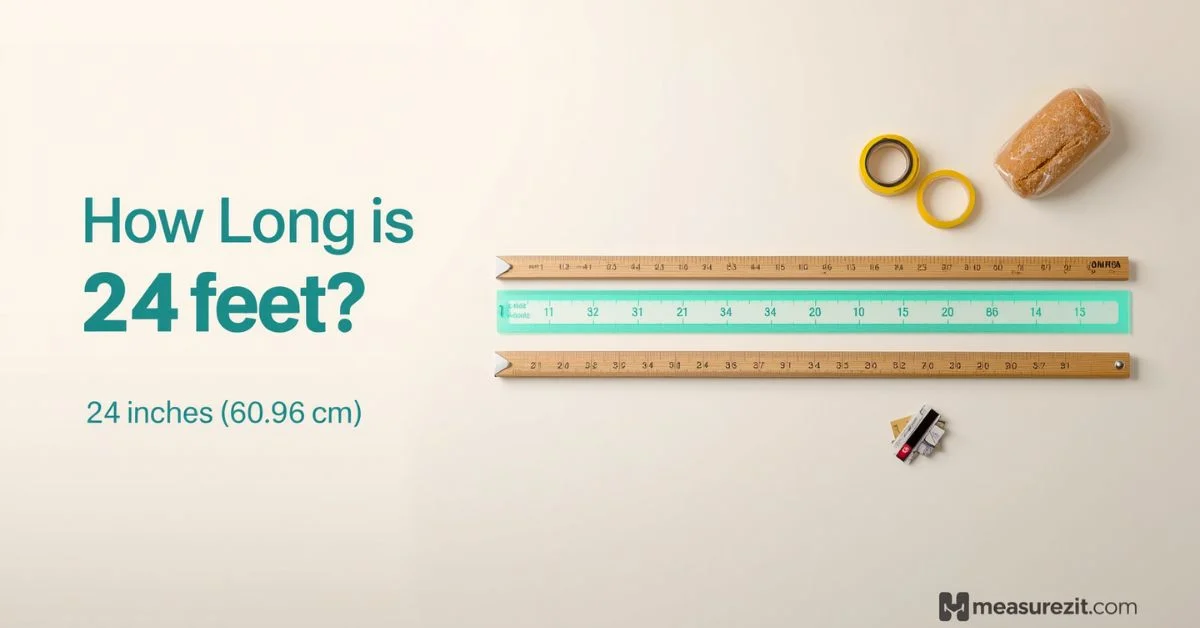
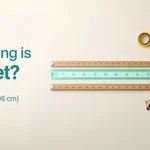
You’re standing in a hardware store with no tape measure, and the label says a shelf is 2 feet long. Will it fit in your trunk? 2 feet is 24 inches, or 60.96 centimeters. That is two standard 12-inch rulers end to end, two-thirds of a yard, and a little more than half a meter.
- In inches: 24 in
- In metric: 60.96 cm (609.6 mm)
- In yards: about 0.67 yd
- Quick picture: the depth of a kitchen counter
This length comes up when you buy furniture, pack a suitcase, cut trim or fabric, or check If an appliance fits a gap. The rest of this guide gives you a conversion chart, fifteen real-world comparisons, and ways to find 2 feet using things you already own.
Conversion chart
The foot is defined as exactly 0.3048 meters, a value set by the 1959 international yard and pound agreement and used by NIST. Every figure below follows from that.
| Unit | 2 feet equals |
| Inches | 24 in |
| Yards | ≈ 0.67 yd |
| Millimeters | 609.6 mm |
| Centimeters | 60.96 cm |
| Meters | ≈ 0.61 m |
To convert on your own, multiply feet by 12 for inches, then multiply inches by 2.54 for centimeters. Miles are left out because 2 feet is a sliver of one.
Nearby lengths help you place it:
| Length | Inches | Centimeters |
| 1 foot (a ruler) | 12 in | 30.48 cm |
| 1.5 feet | 18 in | 45.72 cm |
| 2 feet | 24 in | 60.96 cm |
| 2 feet 6 inches | 30 in | 76.2 cm |
| 3 feet (a yardstick) | 36 in | 91.44 cm |
What 2 feet looks like
Hold your hands about as far apart as a large pizza box is wide, then stretch a little more. That’s close. It is roughly the width of a standard yoga mat and the depth of most kitchen counters.
If you think in metric, 2 feet is not quite 2 meters. Two meters is about 6.56 feet, which is taller than most doorways. Two feet is closer to 0.6 meters, so if you picture a bit over half a meter, you’re in the right place.
How tall is 2 feet? Standing upright, it is about the shoulder height of a Labrador retriever. A typical baby around three months old measures roughly 60 cm long, according to WHO growth charts, so that’s a close match too.
Measure 2 feet without a ruler
You probably own several accurate measuring sticks already. Some work better than others.
- Two sheets of US letter paper: Each is 11 inches long, so two end to end give 22 inches. That is close enough for a quick check. With A4 (29.7 cm), you get about 59 cm.
- Four US dollar bills: Each is about 6.14 inches long, so four in a row come to roughly 24.6 inches.
- Seven bank cards: Cards follow an international size standard of 85.6 mm, so seven in a line measure about 23.6 inches.
- Your own arm: Elbow to fingertip is often around 17 to 19 inches. Add about a hand’s length and you’re near 2 feet. Measure yourself once against a real ruler and remember the result.
- Your stride: A normal step for many adults falls between 2 and 2.5 feet. Test yours against a tape and you have a tool that goes wherever you do.
- Floor tiles: If your floor has 12-inch tiles, count two.
For anything you plan to cut or buy, use a real tape measure. Most mark 24 inches clearly, and many label each foot. If a listing says 2 ft 6 in, that’s 30 inches, so read past the 24 mark.
15 things that are about 2 feet
These items sit at or near 24 inches. Sizes vary by brand, so use them as landmarks, not rulers.
Common objects that are about 2 feet
| Object | Approximate length |
| 1. Kitchen counter depth | About 24 in (61 cm) |
| 2. Dishwasher width | About 24 in (61 cm) |
| 3. A baguette | Roughly 22 to 26 in (56 to 66 cm) |
| 4. A Labrador’s shoulder height | About 21 to 25 in (53 to 62 cm) |
| 5. An 18 × 24 inch poster | 24 in (61 cm) long side |
| 6. Half the width of a plywood sheet | 24 in (61 cm) |
| 7. A yoga mat’s width | About 24 in (61 cm) |
| 8. A three-month-old baby | Roughly 24 in (60 cm) |
More everyday items around 2 feet
| Object | Approximate length |
| 9. A standard bed pillow | About 26 in (66 cm) long |
| 10. A carry-on suitcase | About 22 in (56 cm) tall |
| 11. Two sheets of letter paper | 22 in (56 cm) |
| 12. Seven credit cards in a row | About 23.6 in (60 cm) |
| 13. Two wine bottles, stacked | About 23 to 24 in (58 to 61 cm) |
| 14. An electric guitar’s scale length | About 24.75 to 25.5 in (63 to 65 cm) |
| 15. An adult tennis racket | About 27 in (69 cm) |
1. Kitchen counter depth
Stand at your kitchen sink and look at how far the counter runs back to the wall. Base cabinets in most homes are 24 inches deep, and the countertop often overhangs by an inch or so. If you’re wondering If a toaster oven or cutting board will fit with room to spare, this is your yardstick.
2. Dishwasher width
Most standard dishwashers are 24 inches wide, because they’re built to slide into a matching cabinet gap. Open the door and look across the tub. That span is your 2 feet. It’s handy when you’re sizing a narrow space for a small freezer or a trash can.
3. A baguette
Bakeries cut them a little differently, so expect a couple of inches of variation. Still, a fresh baguette sticking out of a grocery bag is one of the most natural 2-foot images there is. Hold one against your torso and note where it ends.
4. A Labrador’s shoulder height
Breed standards put adult Labradors at roughly 21 to 25 inches at the shoulder. Measured from floor to the top of the shoulders, a mid-size Lab is close to 2 feet. Dogs don’t hold still for a tape measure, but if you know one, the comparison sticks.
5. An 18 × 24 inch poster
Posters in this size are sold everywhere, from school supply aisles to frame shops. The short side is 18 inches, the long side is a clean 24. If you’re planning wall art, pick up a poster or a frame and you have a ready-made 2-foot guide for the long edge.
6. Half the width of a plywood sheet
In the US, a full sheet is 4 feet by 8 feet. Fold the 4-foot edge in half in your mind and you land on 2 feet. If you’ve ever hauled a sheet out of a home center, you already know how wide it is. Half of that is your target.
7. A yoga mat’s width
Standard mats are about 24 inches wide, roughly the span of a person’s shoulders and hips. Lay one on the floor and step across it. That’s a good gauge if you’re working out how much room you need beside a bed or a sofa.
8. A three-month-old baby
WHO growth charts put the typical length of a three-month-old at roughly 60 cm, or just under 24 inches. Babies vary a lot, so treat this as a loose comparison. It does explain why a newborn’s crib and changing pad feel so small.
9. A standard bed pillow
A standard pillow measures about 20 by 26 inches, so its long side runs a little past 2 feet. Because it’s soft and easy to hold, it’s useful when you want a comparison slightly larger than 24 inches. Anything that fits with room to spare against a pillow is safely under 2 feet and a bit more.
10. A carry-on suitcase
Many airlines set carry-on height limits around 22 inches, which is just short of 2 feet. Rules differ between carriers, so check yours. A bag that measures a full 24 inches may not fit the limit, and that gap of two inches is the reason this length matters at the airport.
11. Two sheets of letter paper
Each US letter sheet is 11 inches long. Lay two end to end and you have 22 inches, or 55.9 cm. It’s about 2 inches shy of a full 2 feet, so it’s perfect for a rough check when you’re at a desk with nothing else.
12. Seven credit cards in a row
Bank, ID, and loyalty cards share a size: 85.6 mm long, from an international standard. Seven of them line up to about 599 mm, or roughly 23.6 inches. It takes about a minute and it works with any wallet.
13. Two wine bottles, stacked
A standard 750 ml bottle is about 11.5 to 12 inches tall. Stand one on top of another and you’re right around 2 feet. It’s an odd comparison, but it makes sense if you’re trying to gauge shelf height in a pantry.
14. An electric guitar’s scale length
Scale length is the distance from the nut to the bridge, the part that sets the vibrating string length. Many Gibson-style guitars are around 24.75 inches and Fender-style guitars around 25.5 inches. If you play, that stretch of strings gives you 2 feet plus a small margin.
15. An adult tennis racket
A standard adult racket is about 27 inches long, or roughly 3 inches past 2 feet. That makes it a good little more than a marker. If a long item, such as a curtain rod or a piece of trim, is shorter than a racket but longer than a ruler, it’s likely in the 2-foot range.
FAQ
How many inches is 2 feet?
2 feet is 24 inches. Each foot has 12 inches, so multiply 2 by 12.
Is 2 feet longer than half a meter?
Yes. Half a meter is 50 cm and 2 feet is 60.96 cm, so 2 feet is about 11 cm (4.3 inches) longer.
How does 2 feet compare with a yard?
A yard is 36 inches, so 2 feet is two-thirds of a yard. Add one more foot, or one more ruler, to reach a full yard.
What household item is closest to 2 feet?
A dishwasher is about 24 inches wide and a kitchen counter is about 24 inches deep. Two 12-inch rulers end to end match it exactly.
How long is 2 feet in centimeters?
It’s 60.96 cm. For a quick estimate, call it 61 cm or a little over 60.
Final thoughts
So, how long is 2 feet? It’s 24 inches, or 60.96 centimeters. That’s two rulers, a kitchen counter’s depth, or seven credit cards in a row.
Key takeaways:
- 2 ft = 24 in = 60.96 cm ≈ 0.67 yd. These are exact conversions, not rounded guesses.
- Everyday anchors work. A dishwasher, a yoga mat, or a plywood half-sheet gets you close without a tool.
- Close is fine for planning, not for cutting. For shelves, trim, or fabric, confirm with a tape measure.
Next time you’re in a store or clearing space at home, pick one landmark from this list and trust it. If a measurement really matters, a tape measure takes ten seconds.
Discover Other Posts!
- How Long Is 200 Feet? 📏 15 Easy Comparisons
- How Long Is 100 Feet? 15 Everyday Comparisons 📏
- How Long Is 20 Feet? 📏 See It in 15 Real-Life Objects

I’m Priya Sharma, a content writer at MeasureZit.com, specializing in measurements, unit conversions, and mathematical concepts. I turn technical topics into clear, accurate content that’s easy to understand. My focus is precision, clarity, and genuinely useful information.


3 thoughts on “How Long Is 2 Feet? 📏 24 Inches, Chart and 15 Examples”