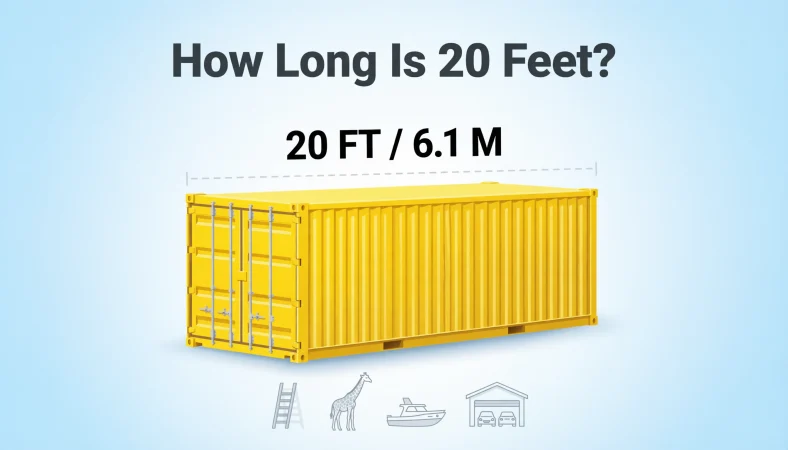
Say you’re backing a moving truck toward a garage, or scrolling a boat listing that just says 20 ft with no photo for scale. The number alone doesn’t tell you much until you can picture it. Twenty feet equals about 6.1 meters, or 240 inches roughly the length of a standard shipping container, and long enough that you’d need eight or so regular walking steps to cross it.
That distance turns up constantly once you start noticing it: measuring a room before flooring goes in, checking if a trailer will clear the driveway, sizing up a fishing boat, or figuring out how much hose you actually need to reach the back fence.
This guide breaks 20 feet into 15 real, checkable comparisons plus the exact conversions so the next time it comes up, you won’t need to do the math
Conversion Chart
| Unit | Converted Value |
| Inches | 240 in |
| Feet | 20 ft |
| Yards | ≈ 6.67 yd |
| Miles | ≈ 0.0038 mi |
| Millimeters | 6,096 mm |
| Centimeters | 609.6 cm |
| Meters | 6.096 m |
A Quick Note on Accuracy
A couple of the comparisons below the giraffe and the large snake species aren’t exact 20-foot matches, and it’s worth saying so upfront rather than letting a rounded number pass as a fact. Where a figure comes from a commonly cited range (an animal’s typical height, for instance) rather than a fixed, manufactured dimension, it’s flagged as approximate and attributed to the type of source that tracks it, such as a zoo or wildlife organization. Items like the shipping container, the extension ladder, and the garage width are standardized or close to it, so those numbers can be trusted more literally. The goal is to give you a genuinely useful mental picture, not a false sense of precision.
Common Objects That Are About 20 Feet
| Object | Approximate Length |
| 20-foot shipping container | 20 ft |
| Short school bus | 20–25 ft |
| 20-foot extension ladder | 20 ft |
| Studio apartment (length) | ≈ 20 ft |
| Adult giraffe (height) | ≈ 16–18 ft |
| Two-car garage (width) | ≈ 20 ft |
| Small residential pool (width) | ≈ 20 ft |
| Medium moving truck | ≈ 20 ft |
More Everyday Items Around 20 Feet
| Object | Approximate Length |
| Small fishing boat | ≈ 18–20 ft |
| Large python or anaconda | up to 20 ft (exceptional individuals) |
| Small travel trailer | ≈ 20 ft |
| Utility pole (above ground) | ≈ 20–25 ft |
| Two-story house (to roofline) | ≈ 20 ft |
| Half a city bus | ≈ 20 ft |
| Young backyard tree | ≈ 20 ft |
How Long Is 20 Feet?
Two parking spaces and change. That’s about the simplest way to picture 20 feet, since a standard space runs close to 9 feet wide. A little over two of them, laid end to end, gets you there. It’s a distance you cover in a driveway without thinking about it, but far enough that hauling something that size through a doorway takes real planning.
Drop down to 15 feet and the scale shrinks to a single-car garage or a small bedroom noticeably tighter. Push up to 25 feet and you’re closer to a full-size school bus or a decent backyard deck. Twenty feet lands right in the middle: big enough to matter, small enough to still hold in your head.
A few ways to eyeball 20 feet without a tape measure:
- Count your steps. Most adults cover roughly 2.5 feet per stride, so about eight normal steps in a row lands close to 20 feet.
- Picture a shipping container. If you’ve ever seen one on a flatbed or stacked at a port, that image is already dead-on.
- Use parking spaces as a ruler. A little more than two standard spaces, side by side, equals about 20 feet.
- Stretch out a garden hose. A common 20-foot hose, fully extended, is a literal measuring stick you may already own.
- Think in ladder lengths. A 20-foot extension ladder, laid flat, is one of the few household items sized to the exact number.
- Glance at your garage. Many two-car garages are built right around 20 feet wide, so you’re standing next to the measurement more often than you’d guess.
1. A 20-Foot Shipping Container
There’s no rounding involved with this one. Shipping containers built to the 20-foot standard measure exactly that plus an 8-foot width and roughly 8.5 feet in height because global shipping depends on every port and crane handling the same fixed size.
That consistency is what makes it such a reliable reference. Once you’ve seen one on a truck bed or repurposed as a backyard workshop, the scale is locked in for good. If you’re eyeing a side yard for a shed or a storage unit, holding this image in mind gives you an instantly accurate gut check before you ever pull out a tape measure.
2. A Short School Bus
Not every school bus stretches the full 40 feet most people picture. The smaller short school buses, often used on lower-ridership routes or for students needing accessible transport, typically run 20 to 25 feet closer to a large van than the classic yellow behemoth.
You’ve probably watched one idle at a curb or turn into a school driveway without registering just how compact it is compared to its full-size counterpart. That familiarity is exactly what makes it useful: it’s a mid-size vehicle reference that doesn’t require imagining anything unusually large.
3. A 20-Foot Extension Ladder
If you’ve ever cleaned out gutters or painted a two-story wall, there’s a decent chance you’ve handled one of these. A 20-foot extension ladder is a standard size sold at most hardware stores, chosen specifically because it reaches most residential rooflines with room to spare.
What makes it such a dependable comparison is that the length is right there on the box no estimating required. Next time you’re wrestling one out of a garage or off a truck rack, you’re holding almost the exact measurement in your hands, fully extended.
4. A Studio Apartment
A surprising number of city studio apartments, especially in older buildings with narrow, rectangular footprints, run close to 20 feet from the entry to the far wall. That single number often dictates how furniture gets arranged before a couch and a bed both fit without the room feeling like a hallway.
Anyone who has apartment-hunted has stood in a space exactly like this, doing rough math in their head about if a sectional will work. That lived experience is what makes the comparison and it’s not abstract, it’s a room you’ve actually stood in or seen in a listing photo.
5. An Adult Giraffe
According to the San Diego Zoo Wildlife Alliance, adult giraffes typically stand somewhere between 14 and 18 feet tall, with the tallest individuals occasionally approaching the 20-foot mark. It’s not an exact match, but it’s close enough and dramatic enough to be worth including.
Most people already have a rough sense of giraffe scale from zoo visits or nature documentaries, even without knowing the precise number. Picture one standing next to a two-story house, and the height of 20 feet suddenly feels a lot less abstract than a number on a page.
6. A Two-Car Garage
Homebuilders return to the same rough width again and again: many two-car garages are constructed close to 20 feet across, giving each vehicle enough clearance to open its doors without clipping the wall or the car parked beside it.
If you’ve ever backed a car in and eyeballed the space left on either side, you’ve tested this dimension firsthand without realizing it. That makes garages a genuinely practical benchmark especially useful when you’re trying to figure out if a boat, trailer, or workbench setup will actually fit inside.
7. A Small Residential Swimming Pool
Compact backyard pools, plunge pools or shorter lap pools built for cooling off rather than serious training often measure close to 20 feet across. It’s a popular size precisely because it fits into an average backyard without swallowing the whole lot.
Pools photograph well, which means plenty of people have a mental image of one even without owning it themselves. Because the comparison covers horizontal open space rather than a solid object, it’s especially handy for picturing a patio layout, a deck extension, or any backyard project where floor space is the real question.
8. A Medium Moving Truck
Rental trucks in the mid-size range, the ones typically recommended for a two- or three-bedroom move usually stretch close to 20 feet long. That size carries enough furniture and boxes for a full household without requiring a special driver’s license.
Nearly anyone who has moved apartments has stood behind one of these trucks, mentally calculating if the couch will actually fit through the back doors. That hands-on familiarity turns an abstract length into something concrete and it’s a useful check when you’re wondering if a truck this size will clear a low garage entrance or a tight driveway turn.
9. A Small Fishing Boat
Weekend anglers tend to gravitate toward boats in the 18-to-20-foot range, since they’re large enough for a stable ride on open water but still light enough to trailer behind a mid-size truck and launch solo at a public ramp.
Spend any time at a lake ramp or a roadside boat dealer, and you’ll notice how many models cluster right around this size. That makes it an easy comparison to recall even if you’ve never owned a boat yourself and a genuinely useful one if you’re shopping for a trailer, a dock, or storage space in your own garage.
10. A Large Python or Anaconda
Some of the largest snake species on record, reticulated pythons and green anacondas among them have been documented approaching 20 feet, according to Smithsonian’s National Zoo. Individuals that long are considered rare outliers rather than the norm; most adults of these species fall well short of that mark.
The novelty here is part of the point. A snake stretching 20 feet is startling enough to stick in memory long after you’ve closed the article, which makes it a genuinely effective way to help someone else feel just how much length that number represents even with the caveat that it’s an extreme, not an average.
11. A Small Travel Trailer
Compact travel trailers built for casual camping, not full-size fifth wheels frequently land right around 20 feet from hitch to bumper. That size hits a practical middle ground: room for a small kitchen and sleeping area, but light enough for many SUVs and half-ton trucks to tow without strain.
Spend a weekend at almost any RV park and you’ll spot several trailers in exactly this range. For anyone shopping for one, dealer listings almost always print the length right on the spec sheet, so this comparison doubles as a real shopping benchmark rather than just a mental exercise.
12. A Utility Pole
Look up on almost any residential street, and the visible part of a wooden utility pole, the section above ground, not counting what’s buried for stability, typically runs 20 to 25 feet. The full pole is usually longer, but the portion you actually see lines up closely with this measurement.
Because these poles are such a constant, unremarkable fixture of daily scenery, most people have absorbed their rough scale without ever consciously measuring one. That makes them one of the more convenient references on this list; the comparison is quite literally always in view.
13. A Two-Story House
Depending on ceiling height and roof pitch, plenty of two-story homes reach somewhere close to 20 feet from ground level to the roofline. It’s not a fixed standard the way a shipping container is, but it’s a common enough range in residential construction to serve as a solid benchmark.
Most people have direct, physical experience with a home roughly this size, if it’s their own or a neighbor’s down the street. That built-in familiarity makes it a natural way to judge vertical distance useful for gauging how tall a tree needs to grow, or how high a crane needs to reach, to match an ordinary house.
14. Half a City Bus
Standard city transit buses typically run close to 40 feet, so splitting one exactly in half lands you at 20 feet simple math, but a surprisingly effective visual. Anyone who’s waited at a bus stop has watched one of these pull up and roll to a stop.
Cutting a familiar object in half is often easier to picture than conjuring a brand-new comparison from nothing, which is exactly why this one works so well. It’s a quick mental trick worth keeping handy any time you’re trying to judge length along a city sidewalk or curb.
15. A Young Backyard Tree
Depending on the species, a tree in its first couple of decades of growth, a maple or a flowering pear, for example often reaches somewhere around 20 feet before its growth rate starts to slow. Nurseries frequently list expected heights like this right on the plant tag.
Trees are about as accessible a reference as it gets, since nearly every yard, park, or street has one. Glancing at a young tree and mentally marking its height gives you a living, growing 20-foot marker and if you’re landscaping, comparing that tag height to a tree you already know helps you picture how much space it will eventually need.
FAQ
Is 20 feet bigger than a standard parking space?
Yes, slightly. A typical space runs about 18 feet long, so 20 feet just edges past it.
What household item comes closest to exactly 20 feet?
A fully extended 20-foot ladder or a stretched-out 20-foot garden hose are about as exact as it gets without a tape measure.
How many walking steps is 20 feet?
For most adults, that’s roughly 7 to 8 normal strides.
Is a 20-foot shipping container the same size as a 40-foot one?
No, a 40-foot container is exactly double the length, though both share the same 8-foot width and similar height.
Final Thoughts
Twenty feet about 6.1 meters, or 240 inches sounds like just a number until you match it to something you’ve actually stood next to. A shipping container, a two-car garage, a fully extended ladder: once one of those clicks into place, the measurement stops being abstract and starts being something you can picture on sight.
That’s really the point of building a mental library like this. If you’re checking if a moving truck will clear the driveway, sizing up a boat trailer for the garage, or just settling an argument about how tall a giraffe actually gets, having a few solid, real-world anchors means you don’t need a tape measure to make the call. Once 20 feet has a face or a container, or a ladder you’ll start spotting it everywhere.
Read More!
How Long Is 10 Feet? 📏 15 Everyday Objects to Picture It
How Long Is 2 Feet? 📏 24 Inches, Chart and 15 Examples
How Long Is 100 Feet? 15 Everyday Comparisons 📏
How Long Is 200 Feet? 📏 15 Easy Comparisons

I’m Dane Whitfield, a content writer at MeasureZit.com, where I specialize in creating clear, accurate articles on measurements, unit conversions, and mathematical concepts. I enjoy breaking down complex numerical topics into simple, practical explanations that readers can actually use. My goal is always precision and clarity helping people make sense of the numbers around them.






2 thoughts on “How Long Is 20 Feet? 📏 See It in 15 Real-Life Objects”