Introduction
Golfers, football fans, and track athletes all think in yards, so the mile looks different through their eyes. There are exactly 1,760 yards in a mile: no more, no less. That is 5,280 feet, 63,360 inches, or about 1.61 kilometers, measured in the yard’s tidy three-foot units.
Knowing how many yards are in a mile bridges two worlds. Athletes convert race distances, students check their math, and anyone reading a British road sign or an American football broadcast meets yards constantly. Once 1,760 yards feels like a real distance instead of a trivia answer, switching between yards and miles becomes second nature.
Yards-in-a-Mile Conversion Chart
One mile converts to these standard imperial and metric units:
| Unit | 1 Mile Equals |
|---|---|
| Inches | 63,360 |
| Feet | 5,280 |
| Yards | 1,760 |
| Meters | ≈ 1,609 |
| Kilometers | ≈ 1.61 |
Distances That Are About 1,760 Yards
| Distance | Approximate Length |
|---|---|
| 1. Seventeen and a half football fields | 1,760 yd |
| 2. Four 400-meter track laps | 1,750 yd (10 yd short) |
| 3. About 20 city blocks | Roughly 1,760 yd |
| 4. A relaxed 20-minute walk | About 1,760 yd |
| 5. One minute of driving at 60 mph | Exactly 1,760 yd |
| 6. 5,280 feet | 1,760 yd (exactly) |
| 7. Roughly 2,000 walking steps | About 1,760 yd |
| 8. Thirty-two Olympic pool lengths | 1,750 yd (10 yd short) |
More Ways to Picture 1,760 Yards
| Distance | Approximate Length |
|---|---|
| 9. Half a mile | 880 yd (smaller) |
| 10. One kilometer | 1,094 yd (smaller) |
| 11. A 5K race | About 5,468 yd (bigger) |
| 12. About 15 soccer fields | Roughly 1,760 yd |
| 13. Five Eiffel Towers end to end | About 1,815 yd (a touch over) |
| 14. Six Titanic-length ships | About 1,765 yd |
| 15. A 5-minute easy bike ride | About 1,760 yd |
How Many Yards Are in a Mile, in Plain Terms?
One thousand seven hundred sixty yards is seventeen and a half football fields, and that is the fastest way to feel it. Each field is 100 yards, so the mile is simply seventeen fields plus a little more than half of another. Golfers get it even faster: 1,760 yards is about ten long drives plus change for a big hitter, or a full eighteen holes compressed into one straight line.
For a smaller reference, picture half a mile: 880 yards, or eight and three-quarter football fields. For a bigger one, picture a 5K race at about 5,468 yards, just over three miles. And for the number itself, think “seventeen-sixty.” It is the yard-lover’s 5,280: exact, standard, and worth knowing cold.
Easy ways to estimate 1,760 yards in everyday life
- Count football fields: Seventeen and a half fields, goal line to goal line, is 1,760 yards. Sports fans can build the mile field by field.
- Walk twenty minutes: A relaxed walk covers about 1,760 yards in twenty minutes. Your legs already know this distance.
- Run the track: Four laps of a 400-meter track total 1,750 yards, only ten yards short of the full 1,760.
- Remember the feet: A mile is 5,280 feet, and every 3 feet make a yard, so divide by three to get 1,760.
- Stack the hundreds: Fifty-two 100-foot stretches plus a bit more make a mile; in yards that is about seventeen and a half 100-yard fields.
- Drive a minute: At 60 mph, sixty seconds of highway driving is exactly 1,760 yards. Count the seconds between mile markers.
1. Seventeen and a Half Football Fields
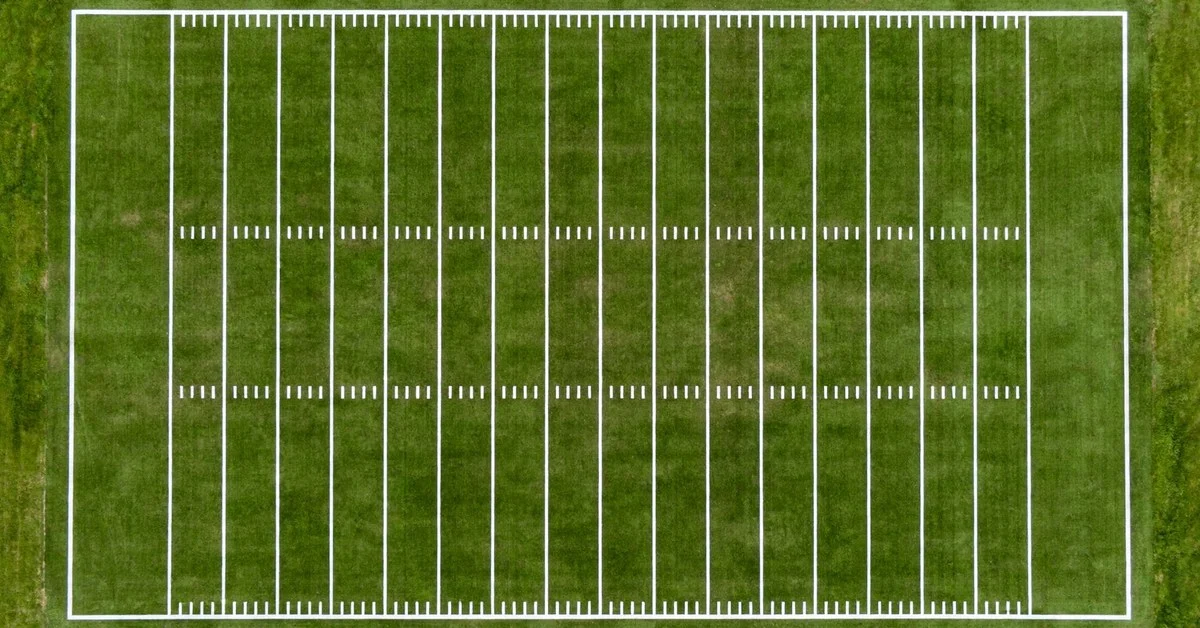
A football field is 100 yards between the goal lines, and 1,760 divided by 100 is 17.6. This is the single most intuitive form of the answer: a mile is seventeen and a half football fields. Every fan has watched drives march down those hundred yards, so the unit is already in their bones. Television broadcasts reinforce it weekly, with the first-down line marking ten-yard gains all game long. Stack seventeen of those marches plus a half, and you have walked a mile in yards. No other reference makes 1,760 yards this concrete.
2. Four 400-Meter Track Laps
Four laps of a standard 400-meter track cover 1,600 meters, which converts to about 1,750 yards: only ten yards short of the mile’s 1,760. Track athletes live in both meters and yards, and this near-match is why the 1,600 is called the metric mile. Ten yards is a single first down, invisible in a workout. For estimating, four laps is 1,760 yards. The track is where yards and meters shake hands.
3. About 20 City Blocks
In a typical grid city, twenty blocks span about 1,760 yards, each block contributing roughly 88 yards. Walkers who count blocks are already counting yards without knowing it. The math is friendly: twenty blocks, 88 yards each, 1,760 total. City life is full of yard-based estimating, from “three blocks to the subway” (about 264 yards) to “ten blocks to the park” (about 880 yards, half a mile). The grid turns every walk into a yardstick.
4. A Relaxed 20-Minute Walk
At an easy pace, twenty minutes of walking covers one mile: 1,760 yards. That is 88 yards per minute, or about one football field every 68 seconds. Walkers do not think in yards, but their bodies produce them steadily. This is the human-scale 1,760: the walk to the corner store, the stroll with the dog, the lunch-break loop. Time becomes yards becomes miles, all in one familiar outing.
5. One Minute of Driving at 60 MPH
At 60 miles per hour, each minute of driving covers exactly one mile: 1,760 yards. That is about 29 yards per second, or nearly a third of a football field every second. Highway drivers watch mile markers tick by once a minute, each gap worth 1,760 yards of asphalt. The car becomes a yard-measuring machine. Commuters who drive the same highway daily learn their route in mile markers the way walkers learn theirs in blocks. Time sixty seconds between two markers and you have measured 1,760 yards with nothing but a dashboard clock.
6. 5,280 Feet
The foot-based form of the answer is worth stating plainly: a mile is 5,280 feet, and since every yard holds 3 feet, dividing by three gives 1,760 yards. Some people think in feet (runners, builders, students), others in yards (golfers, football fans). The two groups are describing the same distance in different words. Converting between them is one division: feet divided by three is yards. A mile is 5,280 feet wearing a yards costume.
7. Roughly 2,000 Walking Steps
About 2,000 to 2,500 steps carry the average walker one mile, which is 1,760 yards. That works out to roughly one yard per step: a beautifully simple equivalence. Each stride covers about three feet, which is one yard, so steps and yards march together. Walk 1,760 steps and you have walked about 1,760 yards. The pedometer on your wrist is secretly a yard counter, ticking off the mile one yard at a time.
8. Thirty-Two Olympic Pool Lengths
An Olympic pool is 50 meters long, and 32 lengths make 1,600 meters: about 1,750 yards, ten short of the mile. Swimmers think in lengths the way runners think in laps, and 32 lengths is the pool’s version of the track’s four laps. The ten-yard gap is a single length of a backyard pool, negligible in training. For swimmers, 1,760 yards is not abstract at all. It is 32 lengths plus a push off the wall.
9. Half a Mile
The cleanest smaller reference is half a mile: 880 yards, exactly half of 1,760. That is eight and three-quarter football fields, ten city blocks, or ten minutes of relaxed walking. Halving is effortless math, and half a mile is a distance nearly everyone knows: the nearby park, the school run, the morning loop. Double it and you have built 1,760 yards from a distance your feet already understand. Neighborhood errands often fall in this range, which is why half a mile feels like the default unit of local life.
10. One Kilometer
One kilometer is 1,094 yards, about 0.62 miles, making it the natural metric companion to 1,760 yards. The mile exceeds the kilometer by 666 yards, roughly six and a half football fields. Runners and travelers juggle both units constantly: 5K races, kilometer markers, metric speed limits. Learn the pair and converting is easy. A mile is 1,760 yards; a kilometer is 1,094 yards; the mile is longer by about two-thirds of a kilometer.
11. A 5K Race
The popular 5K covers 5 kilometers, which is about 5,468 yards: just over three miles, or just over three sets of 1,760 yards. Charity runners and weekend joggers know the 5K as “three miles and change,” and now you know it as “three miles in yards.” The race puts 1,760 yards in context as the opening third of a real event. Run the first mile of a 5K and you have covered 1,760 yards before the water station.
12. About 15 Soccer Fields
A regulation soccer pitch is 100 to 110 meters long, roughly 110 to 120 yards, so about 15 of them laid end to end stretch 1,760 yards. Soccer’s global fans get a world-sized reference here. Midfielders routinely run six or seven miles per match, which is over 10,000 yards of pitch covered in ninety minutes. Fifteen pitches is a long way to sprint, and that effort is the point. A mile in yards is a serious distance however you slice it.
13. Five Eiffel Towers End to End
The Eiffel Tower is 330 meters tall, about 361 yards, and five of them in a row would span roughly 1,805 yards: a touch over the mile’s 1,760. Close enough for a landmark estimate, and memorable enough to stick. Famous structures make the best giant rulers because everyone knows their size. A mile is just under five Eiffel Towers lying down. Picture the Paris skyline on its side and you are picturing 1,760 yards with change.
14. Six Titanic-Length Ships
The Titanic was 269 meters long, about 294 yards, and six of them nose to tail would stretch about 1,765 yards: essentially one mile. Ocean liners are splendid distance references because their lengths are famous and their scale is grand. Six great ships in a line is a mile you can see from the shore. It is also a humbling image. Humanity’s largest moving objects, six in a row, barely cover a twenty-minute walk.
15. A 5-Minute Easy Bike Ride
Pedaling at a gentle 12 miles per hour covers one mile, 1,760 yards, in five minutes. That is the pace of an unhurried ride to the store, and bike commuters learn the timing by heart. Five minutes on the bike is 1,760 yards of bike lanes and side streets. The ride is short enough to feel easy and long enough to feel like a trip. If the ride takes five minutes, the destination is about 1,760 yards away.
Frequently Asked Questions
How many yards in a mile?
Exactly 1,760 yards. That is 5,280 feet, 63,360 inches, or about 1.61 kilometers. Seventeen and a half football fields is the fastest way to picture it.
How many yards are in a marathon?
About 46,100 yards. A marathon is 26.2 miles, and 26.2 times 1,760 works out to roughly 46,100 yards. That is more than 460 football fields in a single race.
How many yards long is a football field?
One hundred yards from goal line to goal line, or 120 yards including both end zones. The 100-yard playing field is the unit that makes 1,760 yards so easy to visualize.
How many yards are in half a mile?
Exactly 880 yards. Half of 1,760 is 880, which is also 2,640 feet or about 0.8 kilometers.
How many football fields are in a mile?
About 17.6, measured goal line to goal line (100 yards each). Round it to seventeen and a half fields for everyday estimating.
Is 1,760 yards the same as 5,280 feet?
Yes. Since one yard equals 3 feet, 1,760 yards times 3 is exactly 5,280 feet. They are the same distance in different units.
How long does it take to walk 1,760 yards?
About 20 minutes at a relaxed pace. That is one mile on foot, or roughly 2,000 walking steps.
See also: how long a yard is.
See also: how long a mile is.
Final Thoughts
So, how many yards in a mile? Exactly 1,760: seventeen and a half football fields, 5,280 feet, about 1.61 kilometers. Count it in fields, blocks, pool lengths, or ships: the distance never changes. Choose the reference that lives in your world and 1,760 yards becomes as familiar as your own street. Yards and miles are just two names for the ground you already walk.

I’m Owen Reeves, a content writer at MeasureZit.com, specializing in measurements, unit conversions, and mathematical concepts. I turn technical topics into clear, accurate content that’s easy to understand. My focus is precision, clarity, and genuinely useful information.










