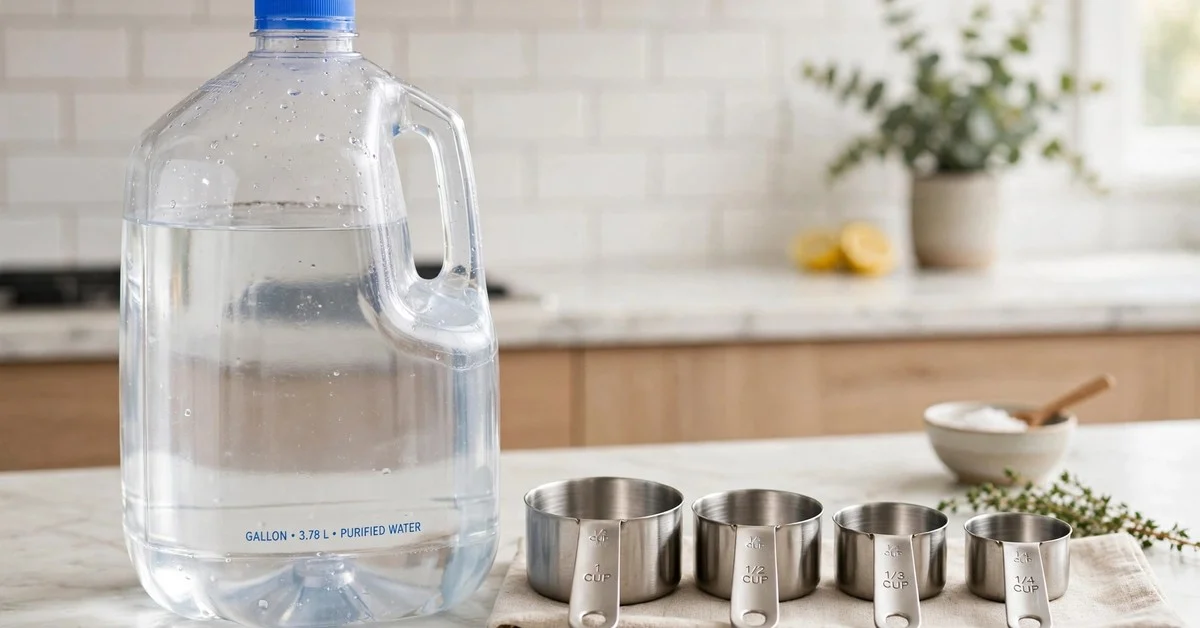
Sixteen cups. Say it out loud and it sounds like a lot; picture it and it’s just a milk jug. How many cups in a gallon? Sixteen, in the US system: 128 fluid ounces, 8 pints, 4 quarts, all the same gallon counted in different-sized bites. It’s the number behind every big batch, every party pitcher, every scaled-up recipe, and it’s one of the most satisfying numbers in the kitchen because it divides so cleanly: halves, quarters, eighths, all without a fraction in sight.
But sixteen cups is also a number most people never see all at once. The gallon hides inside jugs and pitchers, and its true scale only shows up in the places where water moves in volume: the bathtub, the shower, the washing machine. This guide covers the exact conversions, fifteen everyday containers that hold about sixteen cups, and the bathtub fill-up: a tour of where gallons actually go in real life.
Sixteen cups: the number and its family
| Unit | One US gallon equals |
|---|---|
| Cups | 16 |
| Fluid ounces | 128 fl oz |
| Pints | 8 pt |
| Quarts | 4 qt |
| Liters | 3.79 L |
| Milliliters | 3,785 ml |
| Tablespoons | 256 tbsp |
The family relationships are what make the gallon practical. A quart is 4 cups, so four quarts build the gallon with no math harder than four times four. A pint is 2 cups, so eight pints do it. A half gallon is 8 cups, the size of a large soup pot, and two of those make the whole. Learn one relationship and the rest follow: sixteen is divisible by 2, 4, and 8, which means the gallon splits into halves, quarters, and eighths cleanly, the fractions a cook actually needs.
For scale in both directions: a cup is a single serving, a gallon is a crowd. Sixteen cups is about sixteen generous bowls of soup, sixteen coffee mugs of punch, or sixteen glasses of lemonade, which is why the gallon became the standard party size. And in the other direction, five gallons is 80 cups, the water-cooler bottle, the batch size where home cooking becomes small-scale catering.
The bathtub fill-up: where gallons go in real life
Here is the signature tour: the gallon is a kitchen number, but its real life is in the bathroom, the laundry room, and the yard. Follow a gallon through an ordinary house and sixteen cups start to look small.
The bathtub. A typical full-size tub holds 40 to 60 gallons at full capacity, and a comfortable bath uses about 30 to 40 gallons. At 16 cups per gallon, that’s 480 to 640 cups of water for a single bath. Read that again: one bath is roughly six hundred cups. The next time a recipe asks for a cup, remember that your tub drinks six hundred of them without noticing.
The shower. A standard showerhead flows at about 2.5 gallons per minute, so an 8-minute shower uses about 20 gallons: 320 cups. A 15-minute shower doubles it to 40 gallons, 640 cups, an entire bathtub’s worth standing up. The low-flow showerhead, at 1.5 to 2 gallons per minute, cuts the 8-minute shower to 12 to 16 gallons, 192 to 256 cups, which is the cheapest 64 cups you’ll ever save.
The toilet. A modern low-flow toilet uses 1.6 gallons per flush: 25.6 cups, every flush. Older toilets use 3.5 gallons, 56 cups, per flush. A household of four, each flushing five times a day, sends 32 gallons, 512 cups, down the drain daily with a modern toilet, and 70 gallons, 1,120 cups, with an old one. The toilet is the quietest gallon-consumer in the house.
The washing machine. A top-loading washer uses about 30 to 40 gallons per load: 480 to 640 cups, another bathtub. A modern high-efficiency front-loader uses 15 to 30 gallons, 240 to 480 cups. Laundry day for a family, three loads, can move 90 to 120 gallons, 1,440 to 1,920 cups, through the machine before lunch.
The dishwasher. About 3 to 5 gallons per cycle: 48 to 80 cups. It’s the most gallon-frugal appliance in the kitchen, which surprises everyone who grew up hearing that hand-washing saves water. It doesn’t: hand-washing the same dishes under a running tap can use 20 gallons, 320 cups. The dishwasher wins by a factor of four.
The yard. A garden hose flows about 9 gallons per minute, so ten minutes of watering is 90 gallons: 1,440 cups. That’s ninety milk jugs poured onto the lawn. A 1-gallon watering can, making sixteen-cup trips back and forth, suddenly looks heroic: it would take ninety trips to match ten minutes of hose. This is why rain barrels, typically 50 to 60 gallons, feel so small in a dry summer: the yard drinks in minutes what the barrel collected in weeks.
The tour’s lesson: the kitchen gallon is the unit, but the house runs on tens and hundreds of them. Sixteen cups is the atom; the bathtub is the molecule. Knowing both scales makes water use visible, and visible water use is the first step to sensible water use.
The water bill in gallons. The average American household uses about 300 gallons of water per day: 4,800 cups, three hundred milk jugs, every single day. Roughly 70 percent of that goes to indoor use, showers, toilets, laundry, dishwashing, and the rest to the yard. Put the tour’s numbers against the total and the picture sharpens: the 8-minute shower is 20 of those 300 gallons, the laundry’s three loads another 90 to 120, the toilet’s twenty flushes another 32. The kitchen gallon, the one this article started with, is a rounding error in the household total, less than one percent. That’s the real perspective the sixteen buys you: the cup you measure for a recipe is the smallest water decision in the house, and the biggest ones, the showerhead, the washer setting, the sprinkler timer, are all gallon decisions made by default rather than by choice.
Fifteen 16-cup containers
- A 1-gallon gas can. Sixteen cups of capacity in red plastic, with a spout. Volume is volume: the can that holds fuel holds the same sixteen cups as the jug that holds milk.
- A 1-gallon storage bag. The big zip bag holds 16 cups of anything pourable. It’s the floppy, transparent gallon, and proof that the unit doesn’t need rigid walls.
- A 4-quart slow cooker. Four quarts at four cups each: exactly 16 cups. The cooker that feeds a crowd is a gallon in disguise.
- A 1-gallon ice cream tub. The commercial tubs sold at warehouse stores hold a true gallon: 16 cups of ice cream, about 32 generous scoops.
- Two 64-ounce growlers. Each growler is 8 cups, so two make 16. Brewery fans carry the gallon as a pair.
- A 1-gallon punch bowl. The classic party bowl holds 16 cups of punch, which is sixteen servings in the bowl’s own logic. The gallon became the party size because of vessels like this.
- A 1-gallon utility bucket. Sixteen cups of soapy water, paint, or hardware. The workhorse gallon of garages everywhere.
- A 4-liter water jug. Four liters is about 16.9 cups, just over the US gallon. The metric jug overshoots by less than a cup.
- Two 2-quart pitchers. Each pitcher is 8 cups; the pair is 16. Summer lemonade operations run on this exact configuration.
- Eight pint glasses. Eight pints at 2 cups each: 16 cups lined up on the bar. It’s the rare case where the bar tab and the math agree.
- Four quart-size takeout containers. The soup containers from the deli, four of them, total 16 cups. Takeout packaging has been speaking gallons all along.
- Two half-gallon cartons. Each half gallon is 8 cups; two make the gallon. The dairy aisle sells the sixteen cups as a pair.
- A 1-gallon popcorn tin. The holiday gift tin holds 16 cups of popcorn, which explains why it never seems to empty. Sixteen cups is a lot of popcorn.
- A 128-ounce bottle of laundry detergent. 128 fluid ounces is the definition of the gallon: 16 cups of detergent with a measuring cap.
- Thirty-two 4-ounce paper cups. The tiny bathroom cups: 32 of them total 128 ounces, 16 cups. It’s the most tedious way to measure a gallon, and the most memorable.
Batch math: scaling recipes with the sixteen
Sixteen is a scaling superpower once you think in it. The party, the potluck, and the meal-prep Sunday all run on multiples of the gallon.
The party pitcher. Sixteen cups is sixteen servings of lemonade, punch, or iced tea at a cup per guest. Thirty guests need about two gallons, 32 cups; fifty need just over three. Mix in the gallon jug itself and the container does the measuring: two jugs for thirty, three for fifty, plus one extra for the heavy pourers. Sangria scales the same way, with the fruit counted separately.
The soup pot. A gallon of soup is about sixteen bowls, which feeds a crowd or stocks a freezer. Doubling a recipe that makes 8 cups gives the gallon exactly; halving a gallon recipe gives the 8-cup family batch. The quart is the scaling gear in between: 4 cups per quart, 4 quarts per gallon, so any recipe can be walked up or down in four-cup steps without a calculator.
The brine. A Thanksgiving turkey brine typically runs 2 gallons: 32 cups of water, salt, and aromatics. Knowing the sixteen means knowing the container: a 5-gallon bucket holds the 2-gallon brine with room for the bird, and the “2 gallons” on the recipe card is just two milk jugs of water. Brines for smaller cuts halve cleanly to the gallon.
The meal-prep week. A gallon of cooked grain, about sixteen cups, is roughly sixteen side-dish servings or eight hearty ones. Cook the gallon on Sunday, portion through the week, and the sixteen becomes a countdown: every cup served is one fewer to store. Batch cooking stops feeling vague when the container is the plan.
The deeper trick is that sixteen teaches ratio thinking. Once the gallon is sixteen cups, every fraction is visible: half is 8, a quarter is 4, an eighth is 2. Recipe scaling stops being multiplication and becomes selection: pick the fraction, count the cups, done. Cooks who think in sixteenths rarely reach for a calculator, because the gallon already did the dividing for them.
Questions about gallons, cups, and big batches
How many cups are in half a gallon?
Eight. Half of sixteen is eight, which is also four pints or two quarts: the large soup pot, the big pitcher, the batch size for a family dinner. Halving and doubling around the sixteen is the whole skill.
Is it 16 cups in a UK gallon too?
No. The Imperial gallon is larger, about 4.55 liters, so it holds about 19.2 US cups. The sixteen-cup figure belongs to the US gallon only. British recipes using imperial measures need the bigger number; most modern British recipes use metric anyway.
How many water bottles make a gallon?
About seven and a half standard 16.9-ounce bottles: 128 divided by 16.9 is 7.57. In practice, eight bottles is a gallon with a little to spare. It’s a useful conversion for stocking coolers and planning drinking water for trips.
Why is the gallon 16 cups instead of a round number like 10 or 20?
Because sixteen divides beautifully: by 2, 4, and 8, the fractions cooks actually use. A 10-cup gallon would give awkward thirds and fifths; a 20-cup gallon the same. Sixteen’s divisibility is why the whole US kitchen system, cups to pints to quarts to gallons, runs on doubling. It’s not round in decimal, but it’s round in the kitchen.
How much does 16 cups of water weigh?
About 8.34 pounds, since sixteen cups is a gallon and a gallon of water weighs 8.34 pounds. That’s the tidy loop this whole measurement family makes: sixteen cups, one gallon, eight and a third pounds, all the same thing counted three ways.
See also: how many quarts are in a gallon.
See also: how many ounces are in a cup.
Count it once, know it forever
How many cups in a gallon? Sixteen: 128 ounces, 8 pints, 4 quarts, 256 tablespoons, one milk jug, one bathtub’s six-hundredth. It’s the gas can and the popcorn tin, the eight pint glasses and the thirty-two tiny paper cups. And beyond the kitchen, it’s the atom of household water: the shower’s 320 cups, the washer’s 640, the hose’s 1,440. Learn the sixteen, learn its family, and every batch, every bill, every bath starts with a number you already know. Sixteen cups, one gallon, zero guesswork, and a kitchen that finally adds up.

I’m Priya Sharma, a content writer at MeasureZit.com, specializing in measurements, unit conversions, and mathematical concepts. I turn technical topics into clear, accurate content that’s easy to understand. My focus is precision, clarity, and genuinely useful information.










