The punch bowl is empty, the ice is melting, and twelve guests are about to arrive. The recipe card says “one gallon of party punch,” your measuring cup tops out at two cups, and the store is fifteen minutes away. Here is the number that saves the evening: a gallon holds exactly 8 US pints. That is the whole answer, and it is a friendly one, because pints are the unit your kitchen already speaks.
Why does the pint matter so much? Because the gallon is a big, clumsy number until you cut it into pieces you can actually pour. Nobody ladles “one-eighth of a gallon” into a glass, but everyone understands “eight pint glasses.” Once the 8 is fixed in your head, the gallon stops being a jug on a shelf and becomes a plan: eight servings, eight containers, eight chances to get the recipe right. This guide walks through the pint math once, shows you fifteen familiar places a gallon hides, decodes the paint-can label, and gets your party punch poured without another trip to the store.
The only pint math you’ll ever need
One US gallon is defined as 231 cubic inches, and the customary system slices that volume into pieces that double neatly. A pint is 16 fluid ounces. Two pints make a quart (32 ounces), two quarts make a half-gallon (64 ounces), and two half-gallons make the full gallon (128 ounces). Multiply it out and the gallon holds exactly 8 pints — no fractions, no rounding, no fine print.
The full ladder looks like this:
| Unit | One gallon equals |
|---|---|
| Pints | 8 |
| Quarts | 4 |
| Cups | 16 |
| Fluid ounces | 128 |
| Half-gallons | 2 |
| Liters | 3.79 |
| Milliliters | 3,785 |
Two practical notes before we go further. First, the Imperial pint used in the UK is bigger — 20 fluid ounces instead of 16 — so an Imperial gallon holds 8 bigger pints and totals about 4.55 liters. If you are working from a British recipe, that 25 percent difference matters. Second, the pint-to-gallon chain is the easiest scaling tool in the kitchen: halving a gallon recipe means 4 pints, quartering it means 2 pints, and doubling it means 16. Every step stays in whole pints. It also rescues recipes written in awkward units. A recipe calling for “10 cups of stock” is 5 pints — an odd number of cups becomes a tidy one, and you can measure it in five pint containers instead of ten cupfuls. A brine calling for “3 quarts” is 6 pints, which divides beautifully into jars. Whenever a volume looks clumsy, convert it to pints first: the 8-pint gallon is the most divisible container in the kitchen, splitting evenly into halves, quarters, and eighths without a single fraction.
Eight pints, fifteen familiar faces
A gallon never looks like a number. It looks like the jug in your fridge, the bowl on the party table, the can in the garage. Here are fifteen of them, each one exactly (or very nearly) eight pints.
- The gallon milk jug. The undisputed champion of gallon references: one jug, 128 fluid ounces, 8 pints. The handle cutout and translucent plastic let you watch the level drop pint by pint, which makes it a measuring tool as well as a container.
- Eight pub pint glasses. The most memorable image in this whole guide. Line up eight standard 16-ounce pint glasses on a bar and you are staring at one gallon. It is also why a “gallon challenge” at a pub means eight pints — now you know the exact stakes.
- Four quart cartons of milk. Each quart is 2 pints, so four cartons stack up to 8 pints. The tall cartons make the doubling visible: two pints per carton, four cartons per gallon.
- Sixteen 8-ounce coffee mugs. Two mugs make a pint, so sixteen mugs make the gallon. Picture four rows of four at the office coffee station — that grid is a gallon of coffee and a very jittery afternoon.
- The one-gallon paint can. The metal can with the wire handle holds exactly 8 pints of paint — enough for about 350 to 400 square feet of wall in one coat. Pints are not just for drinks; they measure anything pourable.
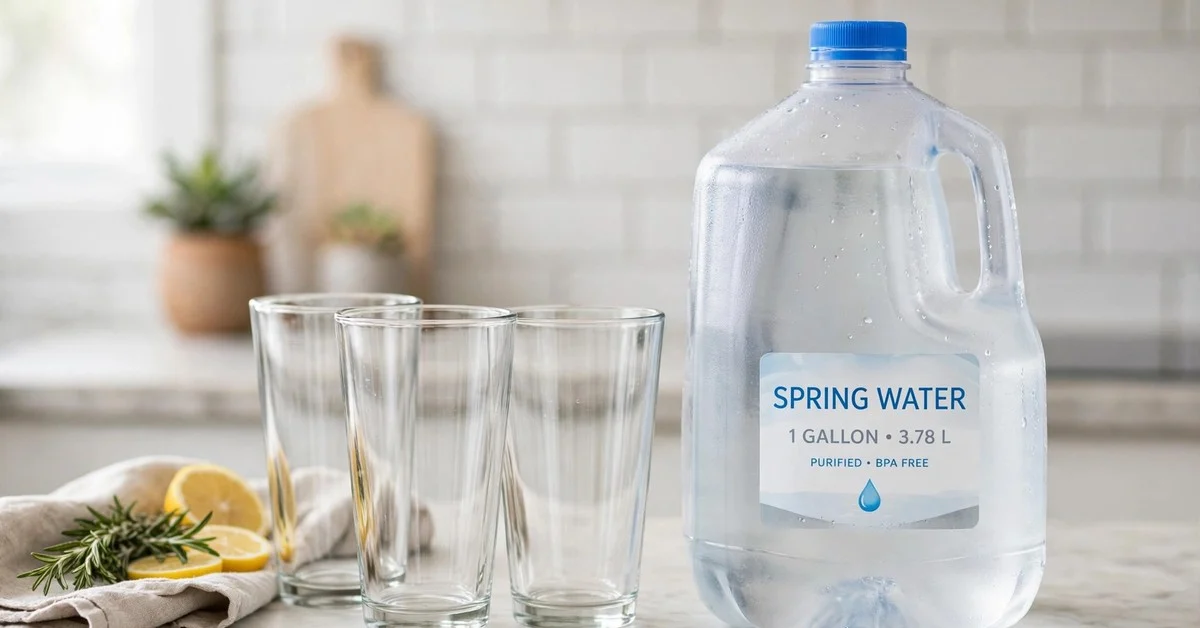
- The distilled water jug. Sold for irons and humidifiers, this translucent one-gallon jug is the purest form of the answer: 8 pints, nothing else. It costs very little, so it doubles as a household measuring jug.
- Two half-gallon juice cartons. Each half-gallon holds 4 pints, so two of them side by side are the full 8. It is the easiest possible division of the gallon: half and half.
- The gallon jug of apple cider. Every fall, orchards and markets stock these: 8 pints of cider, about sixteen generous servings. The jug’s shape matches the milk jug, which quietly confirms that a gallon is a gallon no matter what is inside.
- The gallon-size punch bowl. The centerpiece of the party table holds about 8 pints of punch or sangria — roughly sixteen party cups. If the bowl is full, the recipe worked.
- A large glass cookie jar. The big countertop cookie jar, the kind that holds a family through a month of baking, encloses roughly a gallon of space — about 8 pints. It is a fun reminder that gallons measure space, not just liquid.
- The one-gallon watering can. Gardeners empty these all summer: 8 pints per fill, delivered through the long spout. Eight cans water a thirsty bed, which tells you a gallon is smaller than a garden thinks.
- Eight 16-ounce water bottles. Each standard single-serve bottle is secretly a pint (16 fluid ounces), so eight bottles from the case equal one gallon exactly. The bottle in your gym bag is a pint measure in disguise.
- The gallon jug of lemonade. Summer’s answer to the cider jug: 8 pints of lemonade, ice cubes clinking, eight pint glasses waiting beside it. Pour it out glass by glass and you will fill exactly eight.
- The 4-quart slow cooker. The oval crock from potlucks and family dinners holds 8 pints, since each quart is 2 pints. Filled with chili, that is about sixteen servings — and the quart markings on many cookers make the math visible.
- The one-gallon party beverage dispenser. The glass dispenser with the spigot, the one that appears at weddings and open houses, typically holds exactly one gallon — 8 pints of lemonade, iced tea, or infused water, ready to serve.
What the paint-can label is really telling you
Pick up a one-gallon paint can and turn it around. Beneath the big “ONE GALLON” on the front, the side panel usually lists the same paint in smaller units: 4 quarts, 8 pints, 128 fluid ounces. That is not decoration — it is the manufacturer speaking three dialects of the same volume so that contractors, retailers, and weekend painters all get the number in the unit they think in.
Here is how to read it like a pro. The gallon tells you the bulk amount: one can, one purchase, one trip up the ladder. The quarts tell you the coverage math: most labels promise 350 to 400 square feet per gallon, which works out to roughly 90 to 100 square feet per quart — handy when you are deciding whether the leftover from the bedroom will cover the hallway. The pints tell you the working amount: touch-ups, trim, and small projects are pint-scale jobs, and knowing the can holds 8 of them lets you estimate without opening it.
The label also settles the oldest paint argument: how far will this can actually go? A gallon covers about 400 square feet, which is one pint per 50 square feet — roughly a 5-by-10-foot section of wall per pint. When the label says “one coat coverage,” you can now translate that into pints and plan the afternoon: two pints for the accent wall, three for the big wall, and so on. The paint can is the only object in the house that prints the pint conversion on its side. It earned its place as this article’s signature for exactly that reason.
Party math: pouring for a crowd without waste
Here is the gallon-to-guest formula that caterers use without saying so: plan 2 to 3 pints per person for a two-to-three-hour gathering. A single gallon — 8 pints — comfortably serves four to six moderate drinkers, or eight people having one proper glass each. For twelve guests, make a gallon and a half (12 pints); for twenty, two and a half gallons (20 pints).
Scaling works in pints because recipes do. A punch recipe that calls for a gallon can be halved to 4 pints for a small dinner or doubled to 16 pints for the big party, and every ingredient scales by the same clean multiple. Write the recipe in pints the first time you make it — “4 pints juice, 2 pints soda, 1 pint sherbet, 1 pint ice” — and you will never do the juggling math again.
One caution: glasses are liars. A pint glass filled to the brim holds 16 ounces, but a served drink usually leaves headspace for ice or foam, so each “pint” served is closer to 12 or 14 ounces. When planning quantities, assume each glass delivers about three-quarters of a pint and round up. It is far better to have a pint left over than to send a guest to an empty bowl.
Pint questions worth asking before the party
Will eight pint glasses really hold a whole gallon of punch?
Yes, if you fill each glass to the brim — eight 16-ounce glasses hold exactly 128 ounces, which is one gallon. In practice, though, nobody serves a drink filled to the very top. With ice and a sensible pour, each glass takes about 12 to 14 ounces, so a gallon of punch actually fills nine or ten served glasses. Plan for nine glasses per gallon and you will never run short mid-party.
Why does my paint can list quarts and pints on the label?
Because different buyers think in different units. Contractors estimate coverage by the gallon, retailers stock and price by the quart, and DIY painters doing trim or touch-ups think in pints. Printing all three — 1 gallon, 4 quarts, 8 pints — lets everyone read the same can in their own unit. It also helps with the coverage math: at roughly 400 square feet per gallon, each pint covers about 50 square feet.
I’m scaling a British recipe — are their pints the same as mine?
No, and this is the one that ruins recipes. A UK Imperial pint is 20 fluid ounces (about 568 ml), while a US pint is 16 fluid ounces (about 473 ml). An Imperial gallon is 8 Imperial pints, totaling about 4.55 liters versus the US gallon’s 3.79. If a British recipe calls for “a pint” of stock, use 2½ US cups (20 ounces), not 2 cups. For a full Imperial gallon, add an extra US quart and a splash.
How many pints should I actually plan per guest?
Two to three pints per person for a two-to-three-hour event is the caterer’s rule of thumb. Light drinkers will have one glass (about a pint with ice), average guests will have two, and a few will have three. For eight guests, one gallon (8 pints) is tight — make a gallon and a half. For twelve, two gallons gives you comfortable breathing room. Leftover punch keeps a day or two refrigerated; running out mid-party is forever.
Can I portion a gallon of soup into pint containers for the freezer?
Absolutely — it is one of the best uses of the 8-pint fact. Standard pint deli containers (the kind takeout soup comes in) each hold 16 ounces, so eight of them hold exactly one gallon. Fill, leave half an inch of headspace for expansion, label, and freeze flat. Each container is then a single-serving or two-serving portion you can thaw without committing to the whole batch.
See also: how many quarts are in a gallon.
See also: how many cups are in a gallon.
Keep the eight in your back pocket
Eight pints. That is the number behind every round of drinks, every batch of soup, every gallon of paint, and every party punch bowl you will ever meet. Two cups make a pint, two pints make a quart, four quarts make a gallon — the whole system stacks neatly once the 8 is fixed, and it never changes no matter what you are pouring. The next time a recipe says “one gallon,” skip the measuring cup entirely: count out eight pints in whatever containers are handy, and you are done. It is the kind of math that feels like a trick the first time and like common sense forever after. Eight pints, one gallon, zero guesswork — party math worth keeping.

I’m Dane Whitfield, a content writer at MeasureZit.com, where I specialize in creating clear, accurate articles on measurements, unit conversions, and mathematical concepts. I enjoy breaking down complex numerical topics into simple, practical explanations that readers can actually use. My goal is always precision and clarity helping people make sense of the numbers around them.










