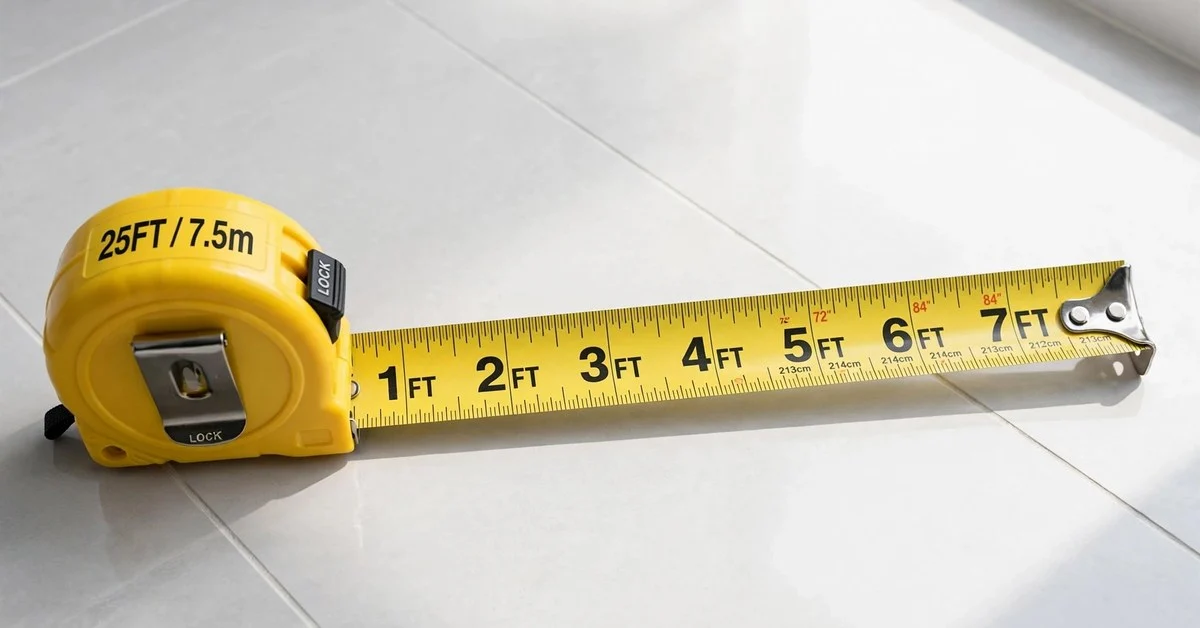
The delivery crew just called: your new bookcase is on the truck, and it’s seven feet tall. Will it fit through the front door? Under the ceiling? Around the stairwell corner? Welcome to the most stressful length in homeownership — 7 feet is exactly 84 inches, 213.36 centimeters, about 2.13 meters — bigger than any person you know, smaller than a car, and exactly the size where “measure twice” stops being advice and becomes survival. Seven feet is the in-between giant: the grand Christmas tree, the bar-room pool table, the garage door. Learn to judge it and delivery day loses its terror. Eighty-four inches sits three inches past a standard door and twelve shy of a standard ceiling, which makes it the trickiest common length to eyeball. It haunts game rooms, garages, and December living rooms. This guide covers fifteen seven-footers — trees, tables, and camels — plus the doorway trick that lets you judge any of them with nothing but a fist and a doorframe.
The Tree That Owns December
Every holiday season has a height hierarchy, and seven feet sits at the top of the residential ranks — the biggest tree most living rooms can handle.
A 7-foot artificial Christmas tree stands 84 inches of boxed-up ambition. It’s the “grand” size: dramatic enough to anchor a room, short enough to clear a standard 8-foot ceiling with the topper. Families buy this height for the main tree year after year, and the box always prints the number big — because 7 feet is a commitment. You’ll need a step stool for the star, a serious ornament count, and a plan for January.
Eighty-Four Inches of Play
Game rooms run on seven feet. It’s the size of serious fun — bigger than a toy, smaller than a tournament rig.
An 84-inch credenza is the dining room’s workhorse — seven feet of sideboard that serves as buffet, bar, and storage in one. At 84 inches it anchors a wall the way a long table anchors a room, with drawers for linens and shelves for the good dishes. It’s the furniture equivalent of a deep breath: long, low, and calming.
A standard 7-foot barbell is the 84-inch Olympic-style bar you’ll find on every serious squat rack. The seven-foot length gives you regulation sleeve spacing — the plates sit where your hands expect them — while fitting racks built to the standard width. When lifters talk about “a real bar,” this is the length they mean.
A field hockey goal stands 7 feet tall (and 12 feet wide). The seven-foot height is the goalkeeper’s domain — high enough that lifted shots are legal and dangerous, low enough that a keeper can cover it. It’s one of the biggest goals in field sports, and standing in front of one explains why field hockey goalies wear that much padding.
A 7-foot teepee tent is the glamping-size shelter — 84 inches of canvas peak that sleeps two adults without the claustrophobia of a backpacking tent. The height lets you stand to dress, which is the true luxury of car camping. Modern teepees borrow the shape from Plains lodges and the dimensions from the family SUV they need to fit.
A 7-foot hot tub — the classic 7×7-foot square — seats five or six adults and defines the backyard spa category. The 84-inch footprint fits most patios and decks (check your deck’s load rating — water is heavy), and the size is why hot tub delivery is a planned event, not a casual purchase.
Seven Feet Under Your Own Roof
Inside the house, seven feet is the height of things that almost — but not quite — touch the ceiling. Living with these objects teaches you exactly where 84 inches falls.
A 7-foot garage door is the classic residential height: 84 inches of steel or wood that clears SUVs and most trucks with room to spare. It’s the door your street grew up with. When you’re sizing a new door, remember the opening needs the full seven feet plus hardware — measure the rough opening, not the old door.
A 7-foot sliding barn door — 84 inches tall — is the farmhouse-renovation staple. The extra four inches over a standard 80-inch door is the whole aesthetic: it makes the doorway feel grand and the hardware feel intentional. Barn door kits are sold in 84-inch heights precisely because standard doors look stubby once you’ve seen the tall version.
An 84-inch tall bookcase is the serious reader’s shelf — seven feet of vertical storage holding six or seven shelves of books. It towers over most adults, which means the top shelf is display territory and everything else stays within reach. Anchor it to the wall: seven feet of loaded shelves is top-heavy in a way that demands an L-bracket and some respect.
A California king bed measures 72 by 84 inches — seven feet long, built for tall sleepers whose feet hang off a standard king. The extra four inches over a regular king’s 80-inch length is the entire selling point. If you’re over six-two, those four inches are the difference between sleeping and merely lying down.
An 85-inch TV hangs one inch past the seven-foot mark — close enough to count as a 7-foot screen in spirit. The diagonal that once seemed absurd is now the home-theater sweet spot, and wall-mounting one is a two-person job with a stud finder. Remember: the screen is seven feet diagonal, but the wall needs about 75 inches of width.
A parlor grand piano stretches about seven feet from keys to tail. It’s the serious amateur’s piano — bigger voice than a baby grand, small enough for a real living room. Movers charge by the foot for pianos, and at seven feet you’re paying for expertise: this is the size where doorways start saying no.
Seven Feet in the Wild
A camel stands about seven feet at the hump — 84 inches of desert engineering. The hump is fat storage, the height is radiator: the body sits high above the hot sand. When a camel looks down at you, you’re getting the full seven-foot assessment.
A grizzly bear rearing on its hind legs reaches about seven feet — sometimes eight. That upright seven feet is the classic warning posture, and it’s designed to impress: the bear is showing you exactly how much animal you’re dealing with. Wildlife guides are unanimous — admire the seven feet from a very long way away.
A lake sturgeon can reach seven feet long — a living dinosaur gliding along the river bottom. These ancient fish outlive the fishermen who catch them, and a seven-footer might be a century old. When one surfaces beside a boat, the 84 inches of armored fish has a way of silencing everyone aboard.
The Doorway-Plus Test: Clearing Seven Feet
Here’s the signature skill: judging anything near seven feet using the doorway you already own. A standard interior doorway is 80 inches tall — four inches short of seven feet. That four-inch gap is your measuring instrument.
The test is simple: the fist rule. A closed adult fist is about four inches across the knuckles. Stand something (or someone) in a standard doorway. If the top clears the frame by about a fist, it’s seven feet tall. Less than a fist — it’s shorter. More — it’s taller. Movers use this constantly: “will it clear the door?” becomes “how many fists over the frame?” and suddenly every doorway in the house is a calibrated gauge.
For moving day, add the tilt-and-pivot. A seven-foot bookcase won’t go through a seven-foot doorway straight — but tilted on the diagonal, the effective height drops. The math: a doorway 80 inches tall and 36 inches wide offers a diagonal of about 87.7 inches. That means a rigid 84-inch object can pass through on the tilt, with about three inches to spare — if you pivot it through the plane of the doorway rather than ramming it straight. Measure the diagonal, not just the height.
For ceilings, learn the fan clearance check. Ceiling fans hang 8 to 12 inches below an 8-foot ceiling, putting the blades around seven feet off the floor. If you can stand flat-footed under a fan without your head entering the blade zone, your ceiling is standard and your height is safely under seven feet. Tall visitors, take note: the fan doesn’t care about your feelings.
And for the garage, the door-plus-mirror rule: a 7-foot garage door gives 84 inches of vertical opening, but your mirrors and roof racks live above the beltline. Measure your vehicle’s tallest point — antenna, rack, cargo box — and compare against 84 inches with the door fully open. The door frame, not the door, is the limit, and roof boxes have ended more garage doors than storms have.
One more technique for the truly cautious: the painter’s-tape preview. Before the delivery truck arrives, tape the object’s footprint on the floor (84 inches long for that bookcase, say) and its height on the wall. Live with the blue outline for a day. Walk around it, open the nearby doors, picture the room with the thing in it. It takes five minutes and a three-dollar roll of tape, and it has saved more returns than any spec sheet. Seven feet is exactly the size where imagination fails and tape succeeds — big enough that you can’t quite picture it, common enough that the tape makes it obvious. When the outline looks right, buy with confidence. When it swallows the wall, you just saved yourself a delivery fee and a marital dispute.
Seven-Foot Questions, Answered
Will a 7-foot Christmas tree fit under an 8-foot ceiling?
Yes, but mind the topper. Seven feet is 84 inches; an 8-foot ceiling is 96. That leaves 12 inches — plenty for the tree, tight for a tall angel or star, which can run 8 to 12 inches themselves. If your topper is grand, either skip it or drop to a 6.5-foot tree. Also account for the stand (2 to 3 inches) and any tree skirt bunching at the base. Measure from the floor to where the topper’s tip will land, not just to the tree’s top branch.
Will an 84-inch credenza overwhelm a small dining room?
Only if the room is truly tiny. An 84-inch credenza needs a wall at least 108 inches wide to breathe — twelve inches of clearance on each side is the designer minimum. In a 10×12 dining room it anchors the long wall beautifully; in an 8×10 nook it will dominate. Tape the 84-inch outline on the wall and live with it for a day. If your eye goes straight to the tape and stays there, the credenza is too much. If the tape fades into the background, buy with confidence.
Is an 84-inch barn door too tall for a standard doorway?
No — it’s the upgrade. Standard doors are 80 inches; an 84-inch barn door mounted on exposed hardware covers the 80-inch opening with two inches of overlap top and bottom, which looks intentional and blocks the light gap. You need about 88 inches of wall height for the track and clearance. The result reads as custom and grand, which is exactly why the 84-inch barn door outsells the 80-inch version.
How do I measure a room for a 7-foot-tall bookcase?
Measure three things: the ceiling height (you need at least 85 inches to stand it up — remember it goes up on the diagonal, which needs more than 84 inches of vertical), the doorway diagonal (about 88 inches for a standard 80×36 door, so it’ll pass on the tilt), and the path from the truck to the room, including stairwell turns. The bookcase is seven feet; the journey is the hard part. Movers call this “the last ten feet problem.”
Why is seven feet the minimum ceiling for living space?
Building codes set seven feet (84 inches) as the minimum ceiling height for habitable rooms because it’s the smallest height where most adults can live without the space feeling oppressive — it clears a tall person’s head plus a margin. Basement remodels hit this rule constantly: a 6-foot-8 basement ceiling can’t legally become a bedroom. The code isn’t about comfort alone; it’s about light, air, and resale honesty.
See also: how long 6 feet is.
See also: how long 8 feet is.
Thinking in Sevens
Seven feet is the measurement of almost — almost as tall as the ceiling, almost too big for the door, almost a story in itself. Master the doorway-plus test and the almosts become exacts: a fist over the frame, a diagonal through the door, a topper that clears the ceiling, a tape outline that tells the truth. Eighty-four inches stops being a gamble and starts being a number you own. Measure it once — with a fist, a tape, or a roll of blue painter’s tape — and delivery day is just another Tuesday. The truck can come whenever it wants. You’re ready.

I’m Priya Sharma, a content writer at MeasureZit.com, specializing in measurements, unit conversions, and mathematical concepts. I turn technical topics into clear, accurate content that’s easy to understand. My focus is precision, clarity, and genuinely useful information.