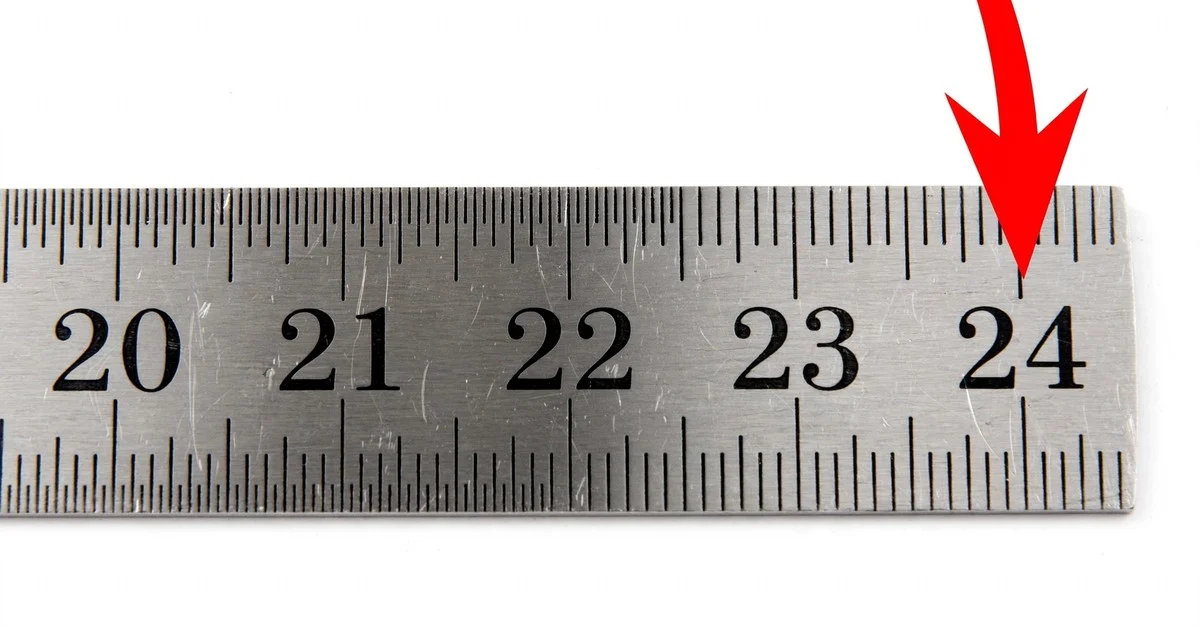
No tape measure? No problem. You are carrying one — several, actually — and they never run out of batteries. Line up two of your shoes heel to toe, and you have just measured 24 inches. Stretch your hand wide three times, same result. Twenty-four inches is exactly 2 feet, which equals 60.96 centimeters. It is the cleanest round number in the inch world, and the only common measurement you can verify with body parts you were born with. How long is 24 inches? Take two steps — or rather, two feet — and see.
Because 24 inches equals exactly two feet, it is the easiest length in this whole series to remember — and the easiest to measure without tools. This article teaches you the “two-foot handshake”: a set of body-based tricks for finding 24 inches anywhere, then backs them up with the manufactured 24s hiding in your workshop, your rooms, and your record collection’s loudest corner.
The two-foot handshake: measuring 24 inches with your own body
Here is the signature skill for this article, and it is genuinely practical: your body is a set of rough rulers, and 24 inches is the one length they combine to hit exactly. Nobody’s body matches the averages perfectly — that is why the first step is calibrating once against a real tape measure — but after that, you carry these references everywhere.
| Your body ruler | Typical length | How it makes 24 inches |
|---|---|---|
| Shoe, heel to toe | ≈ 11–12 in | Line up 2, heel to toe |
| Hand span, thumb to pinky stretched | ≈ 8–9 in | Stretch 3 in a row |
| Forearm, elbow to wrist | ≈ 10–11 in | Double it, add a thumb’s width |
| Cubit, elbow to middle fingertip | ≈ 17–19 in | Add a fist (≈ 4 in) and a bit |
The shoe trick is the star — the “two-foot handshake” itself. Kick off a shoe, set it heel-to-toe against its mate, and the pair spans about 24 inches for most adult men (women’s sizes run an inch or two shorter per shoe, so calibrate). Movers and carpet installers have used this forever to pace off rooms. The hand-span method is the backup when your shoes are on: three wide stretches, thumb tip to pinky tip, lands within an inch of 24 for most adults.
To calibrate, measure your shoe and your span once against a tape measure and remember your personal numbers — “my shoe is 11 and a half, my span is 8 and three-quarters,” for example. From then on, 24 inches is two shoes or three spans, no tools required. Ancient builders did exactly this: the cubit — elbow to fingertip — was a formal unit of measure for millennia, and it still works as a rough 18-inch gauge today.
Workshop 24s: tools built to two feet
Body tricks are great, but workshops are full of objects manufactured to exactly 24 inches — the number is so standard in construction that “two-foot” is practically a unit of its own.
1. The 2-foot spirit level
The classic spirit level — the 24-inch aluminum bar with the bubble vials — is exactly 24 inches long, and it is the level most homeowners own. Pros carry 4-footers, but the 2-foot model fits in a toolbox and handles shelves, pictures, and appliances. Hold one horizontally in your mind: that bar is 24 inches of pure, level truth.
2. The carpenter’s framing square — 24 by 16 inches
A framing square — the big L-shaped steel tool — measures 24 inches on its long blade and 16 on its tongue. Carpenters have used it for centuries to lay out rafters, stairs, and right angles, and the 24-inch blade is stamped with rafter tables. You have seen its distinctive L silhouette in every workshop. The long arm is a true 24 inches of old-school geometry.
3. The 24-inch bar clamp
Bar clamps — the sliding-jaw clamps for glue-ups and woodworking — come in standard lengths including 24 inches, the size that handles most cabinet and furniture work. The length is the maximum jaw opening, printed on the bar. Picture one stretched across a tabletop glue-up: 24 inches of clamping pressure holding the project together.
4. The 24-inch bolt cutters
Bolt cutters come in standard lengths — 24 inches is the popular mid-size, long enough for real leverage, short enough to carry. The length gives the mechanical advantage that lets the jaws slice hardened steel. You have seen firefighters and fence crews wield these. Those long red handles are 24 inches of “yes, it will cut.”
5. The 24-inch push broom
Push brooms — the wide-headed brooms for garages, decks, and workshops — commonly come with 24-inch heads, the size that clears a good path without getting unwieldy. Janitorial suppliers stock 18, 24, and 36 as the standards. Picture pushing one across the garage floor: every sweep covers a 24-inch swath.
Home 24s: the rooms you live in
Step inside and 24 inches keeps appearing — in furniture depths, wall fixtures, and the crate the dog sleeps in. The house is quietly built on two-foot modules.
6. The writing desk — about 24 inches deep
A standard writing desk is about 24 inches deep, front to back — the depth that fits a laptop, a notebook, and a coffee mug in comfortable rows. Furniture makers converged on it because it matches human reach: deeper, and the back of the desk becomes a dead zone. Sit at yours and look at the depth: 24 inches of workspace, edge to wall.
7. The 2×3 accent rug — 24 by 36 inches
The little “2 by 3” accent rug — the one by the door, the sink, or the bed — measures 24 by 36 inches. Rug sellers name sizes in feet, so the 24-inch side is exact by definition. You step on one of these daily without noticing. That short edge under your feet is 24 inches of welcome mat.
8. The 24-inch towel bar
Towel bars come in standard lengths — 18 and 24 inches are the two big ones — and the 24 holds a full bath towel spread flat. Bathrooms are fitted with them by the thousand, which keeps the size consistent. Picture your bath towel hanging at full width: the bar it hangs on is 24 inches of bathroom standard.
9. The 24-inch round mirror
Round mirrors are sold by diameter, and 24 inches is one of the most popular sizes — big enough to anchor a vanity or entryway, small enough to hang solo. Home stores stock this size because it fits standard wall spaces. Check your reflection in one: that circle of glass is 24 inches across.
10. The 24-inch window box
Window boxes and planter troughs commonly come in 24-inch lengths — the size that fits a standard double-hung window without overwhelming it. Garden centers stock 24, 30, and 36 as the core sizes. Picture the geraniums spilling over the edge: that wooden or resin trough is 24 inches of curb appeal.
11. The 24-inch dog crate
Wire dog crates come in standard lengths — 24 inches is the small size, fitted to beagles, French bulldogs, and other compact breeds. Pet stores size them by the dog: the crate should let the dog stand and turn, nothing more. If a small dog naps in your house, its bedroom is 24 inches long.
The fun ones: music, air, and cardboard
The last four are the extroverts: loud, breezy, and puzzling — each one a 24-inch reference with a little personality.
12. The djembe — about 23 to 24 inches tall
The djembe — the goblet-shaped West African drum — typically stands 23 to 24 inches tall, carved from a single piece of hardwood. The height puts the playing surface at the right level for a seated drummer, which keeps it consistent across makers. You have heard its deep bass tones at drum circles and festivals. Stand one upright in your mind: 24 inches of carved rhythm.
13. The 24-inch kick drum
Kick drums — the big bass drums at the heart of a kit — come in standard diameters, and 24 inches is the classic rock size, between the common 22 and the thunderous 26. Drummers choose it for a deep, chest-felt punch, and the size is printed on the shell. Picture it anchoring the kit, front head logo and all: a 24-inch circle of pure low end.
14. The 24-inch drum fan
High-velocity drum fans — the round metal beasts that cool workshops and gyms — commonly come in 20- and 24-inch diameters. The size is the fan’s blade sweep, printed on the box because buyers match it to the space. You have felt one blasting across a garage on a hot day. That roaring circle of steel is 24 inches of airflow.
15. The 500-piece jigsaw puzzle — about 18 by 24 inches
A standard 500-piece jigsaw puzzle typically finishes at about 18 by 24 inches — the 24-inch edge being the long side. Puzzle makers hold these dimensions so frames and mats fit, which keeps the size consistent across brands. If your family does puzzles on the dining table, you have built a 24-inch rectangle one piece at a time. The last piece clicks in, and so does the measurement.
When two feet is the wrong tool
Body measuring is wonderful, but know its limits. Your shoe-and-span method is good to about half an inch — plenty for furniture shopping, spacing plants, or settling bets, but not for cutting lumber or hanging cabinets, where a sixteenth of an inch matters. The rule is simple: estimate with your body, verify with a tape. The handshake gets you to 24 inches in seconds; the tape measure confirms it when money or safety is on the line. Use each where it shines and you get the best of both.
Body-measure questions about 24 inches
How accurate is measuring with my shoe?
Surprisingly good — within half an inch, once calibrated. An adult shoe’s outside length runs about 11 to 12 inches for men and 10 to 11 for women, so two shoes heel-to-toe land at 22 to 24 inches. Measure your own shoe once against a tape measure, remember the number, and your personal “two shoes” becomes a reliable 24-inch gauge. It is the method movers use to pace rooms, and it has survived because it works.
Is 24 inches exactly 2 feet, or just close?
Exactly. Twelve inches make a foot by definition, so 24 inches is precisely 2 feet — no rounding, no “about.” It is one of the cleanest conversions in the imperial system, which is why construction runs on it: studs, tiles, and plywood are all laid out in two-foot modules. Whenever inches feel clunky, just say “two feet” and move on.
Is there a body-free trick for estimating 24 inches in metric?
Two sheets of A4 paper, end to end. Each sheet is 29.7 cm long, so two give you 59.4 cm — just 1.6 cm shy of 24 inches (60.96 cm). For rough work like spacing picture hooks or checking whether a box fits a shelf, ‘two A4 sheets’ beats hand spans, which vary wildly person to person. Keep a couple of sheets in a drawer and you will never hunt for a tape measure for mid-size jobs again.
What is the easiest way to picture 24 inches without tools?
Two shoes, heel to toe — it is the fastest and most accurate body method. The runner-up is three wide hand spans, thumb tip to pinky tip. Both beat guessing, and both are always with you. Calibrate once against a tape measure (shoe length and span vary person to person), and you will never be more than half an inch off.
Why do so many products come in 24-inch sizes?
Because construction standardized on it. Plywood and drywall come in 4-by-8-foot sheets, wall studs sit 16 or 24 inches apart, and ceiling grids are 2-by-2 or 2-by-4 feet — so furniture, tools, and fixtures sized to 24 inches fit the world’s rooms without cutting. It is a network effect: the more things built on two-foot modules, the more sense it makes to build the next thing on one too.
See also: how long 21 inches is.
See also: how long 25 inches is.
Shake hands with two feet
So, how long is 24 inches? Exactly two feet — two shoes heel to toe, three hand spans, the level in your toolbox, the desk you work at, the kick drum’s thunder, the puzzle on the dining table. It is the friendliest measurement in the imperial system: no fractions, no awkward decimals, just a round number the construction world built its modules around — and a body-based backup plan whenever the tape measure is in the other room. Calibrate your shoe and your span once, and the number is yours for life. Kick off a shoe, line them up, and shake hands with two feet. Twenty-four inches was yours all along.

I’m Owen Reeves, a content writer at MeasureZit.com, specializing in measurements, unit conversions, and mathematical concepts. I turn technical topics into clear, accurate content that’s easy to understand. My focus is precision, clarity, and genuinely useful information.










