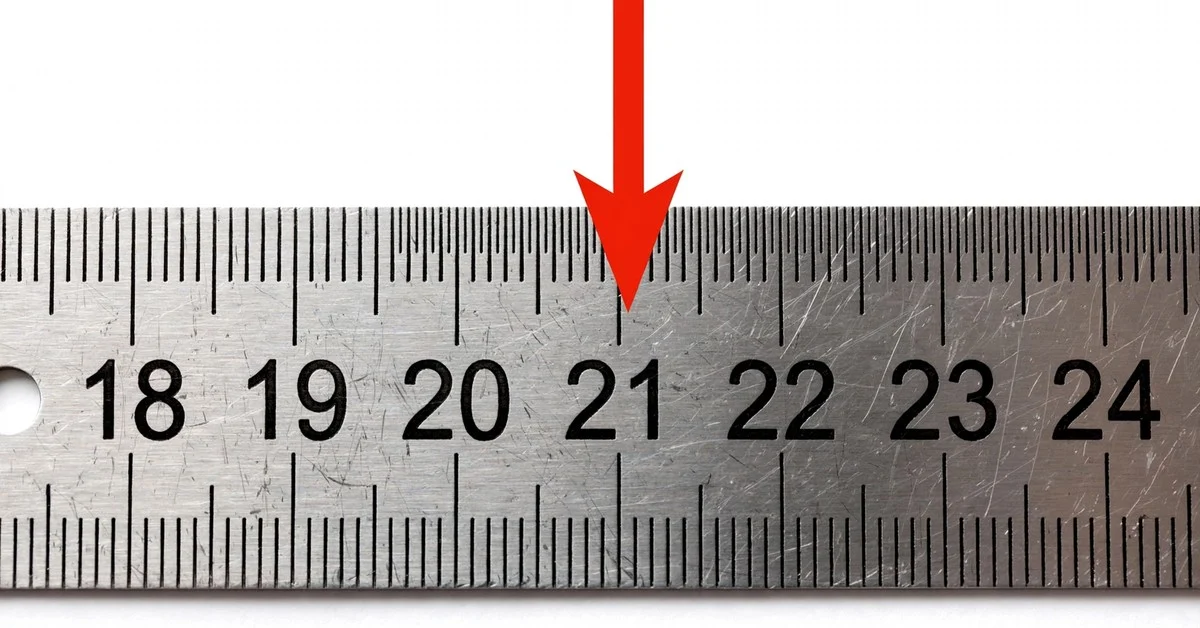
The gate agent points at the metal frame by the boarding door: if your bag does not slide into the sizer, it is getting checked. Your suitcase tag says 21 inches — but 21 inches of what, exactly? Twenty-one inches is 1 foot 9 inches, which equals 53.34 centimeters. And at the airport, that number is doing very specific work: it is the height of the carry-on the entire industry designed its overhead bins around. How long is 21 inches? Stand your cabin bag upright. That is your answer.
Twenty-one inches is three-quarters of the way from one foot to two — closer to two feet than to one, but still comfortably under it. It is the traveler’s number as much as the shopper’s, and it hides in lawn mowers, cymbals, bathroom vanities, and even crows. This article starts at the departure gate and fans out from there, so that 21 inches becomes a length you can picture whether you are packing, mowing, or birdwatching.
The 21-inch rule of the overhead bin
Here is the signature fact about 21 inches: it is the height the carry-on world standardized on. Most airlines’ sizers allow about 22 × 14 × 9 inches, and bag makers responded by building their most popular cabin bags at 21 to 22 inches tall — 21 playing it safe, 22 pushing the limit. The measurement includes the wheels and the handle housing, which is the detail that trips people up: the bag’s body might be 19 inches, but the airline measures the whole thing, wheels down. Two inches of wheels is the difference between the overhead bin and the cargo hold.
Depth gets its own quiet standard too: about 9 inches front to back, the dimension that decides whether the bag slides wheels-first into the bin. Height gets the glory, but depth does the fitting. Together, 21 inches tall and 9 inches deep is the formula that has survived decades of airline rule-tweaking.
1. The standard domestic carry-on — 21 to 22 inches tall
The classic hard-shell or soft-side cabin bag stands 21 to 22 inches tall with wheels included — a size airlines effectively co-designed through their sizer frames. This is the single most familiar 21-inch object in modern life: you have lifted one into an overhead bin, wrestled it through security, and felt its full height every time it tipped over in the aisle. When you need 21 inches, picture your own bag standing upright by the door. That height is the answer, wheels and all.
2. The rolling weekender duffel — about 21 inches long
Rolling weekender duffels — the soft-sided bags built for two-to-three-day trips — typically run about 21 inches long, sized to match carry-on limits while staying squashable. Unlike hard suitcases, they give a little when the sizer frame presses in, which is why frequent flyers love them. Toss one on the bed half-packed in your mind: 21 inches of flexible travel space, ready to be sat on to close.
Tools and machines built to 21 inches
Away from the airport, 21 inches is a working dimension in garages and workshops. These are not approximations — they are manufactured standards, which makes them some of the most trustworthy references on this list.
3. The 21-inch bow saw
Bow saws — the H-framed saws for cutting firewood and pruning branches — commonly come with 21-inch blades, a standard length that balances cutting capacity with control. The blade length is stamped on the packaging because replacement blades must match. You have seen these hanging in garages, their tubular steel frames unmistakable. That toothed 21 inches has cut a lot of winter firewood.
4. The 21-inch lawn mower deck
Walk-behind lawn mowers are sold by cutting width, and 21 inches is the classic residential size — wide enough to mow efficiently, narrow enough to fit through a garden gate. The deck width is printed in big numbers on the box because buyers match it to their yard. Picture the mower’s path across the lawn: every pass lays down a 21-inch stripe of fresh-cut grass.
5. The 21-inch wiper blade
Windshield wiper blades come in inch-by-inch sizes, and 21 inches is one of the most common — fitted to millions of cars and SUVs. Auto-parts stores stock them by length, and the number is molded into the packaging because the wrong size streaks or overhangs. Next time you are stuck in traffic staring at the windshield, remember: that rubber blade sweeping the glass is 21 inches of rainy-day engineering.
6. The 21-inch single-stage snowblower
Single-stage snowblowers — the compact electric and small gas models for driveways and sidewalks — commonly clear a 21-inch path. The clearing width is the headline spec, printed larger than the horsepower, because buyers match it to their driveway. Picture the machine chewing through fresh snow: every pass opens a 21-inch lane, one stripe at a time.
7. The 21-inch pro-audio subwoofer
In professional concert sound, subwoofers come in serious diameters — 15, 18, and 21 inches — and the 21 is the monster, moving enough air to shake a venue’s floor. The cone diameter is exact because it has to match the cabinet’s cutout. You have felt these at concerts, in your chest more than your ears. That 21-inch circle of speaker cone is the biggest manufactured 21 inches on this list.
Around the house and yard: 21 inches at home
The last manufactured group lives indoors and out — furniture, fitness gear, wheels, and instruments that all landed on 21 inches (or within an inch of it) for their own practical reasons.
8. The bathroom vanity — 21 inches deep
Standard bathroom vanities are 21 inches deep, front to back — a dimension the cabinet industry settled on so the sink, plumbing, and countertop all fit without crowding the room. You lean over this depth every morning. Picture your vanity’s countertop from edge to wall: 21 inches of toothbrushes, soap dispensers, and barely enough elbow room.
9. The 20-inch plyo box — an inch under
Plyometric boxes — the sturdy platforms for box jumps — come in standard heights of 20, 24, and 30 inches, and the 20 is exactly one inch under our target. Gyms stack them because the heights combine for training progressions. Picture the smallest box in the stack and add an inch on top: 21 inches of leg-day ambition.
10. The 20-inch BMX wheel — an inch under
BMX and many kids’ bikes roll on 20-inch wheels — the standard diameter for the whole freestyle world, one inch under 21. The size is molded into the tire sidewall, so it is exact. Picture the bike leaned against the skate-park fence: that tough little wheel, plus a finger’s width, is 21 inches.
11. The handpan — about 21 to 22 inches across
The handpan — the UFO-shaped steel drum played with the hands — typically spans about 21 to 22 inches in diameter. Makers tune each note into the steel shell, and the diameter has to stay in this range to fit the scale. You have heard its ethereal tones in street performances and meditation videos. Picture the player cradling it in their lap: 21 inches of tuned steel, humming.
12. The 21-inch ride cymbal
Drummers buy ride cymbals in standard diameters, and 21 inches is a classic — between the common 20 and the big 22, favored for its balance of ping and wash. The size is lathed into the bronze and printed on the box. You have seen one shimmering to the drummer’s right on every stage. That golden disc is a true 21 inches, keeping time.
Wild things: nature near 21 inches
Not every 21-inch reference comes from a factory. A few wild creatures land in this neighborhood too — and living references stick in memory better than manufactured ones, because they come with feathers and personality attached.
13. The American crow — 17 to 21 inches long
An American crow measures 17 to 21 inches from beak to tail — the big end of the range covering the largest males. Ornithologists measure specimens formally, so the range is solid. You have watched these glossy black birds strut across lawns and heard their arguments from the treetops. Picture the biggest crow you have ever seen, beak to tail tip: 21 inches of attitude.
14. The adult bearded dragon — about 18 to 22 inches long
An adult bearded dragon — the popular pet lizard — typically reaches 18 to 22 inches from nose to tail tip, with the tail making up more than half. Reptile keepers know the range because enclosure sizes depend on it. Picture one basking under its heat lamp, chin up: 21 inches of prehistoric calm, most of it tail.
15. The ring-billed gull — about 17 to 21 inches long
The ring-billed gull — the common gull of parking lots and lake shores, named for the black ring around its bill — measures about 17 to 21 inches long. Bird guides list the range for identification, since size separates it from its larger and smaller cousins. Next time one is eyeing your fries, size it up: the biggest of the flock is 21 inches, beak to tail.
The 21-inch packing check you can do at home
Here is a thirty-second test before any trip: stand your bag upright against a wall, mark the top of the wheels-down height with a sticky note, and measure floor to mark. If the tape reads 21 to 22 inches, you are safe on virtually every airline. Over 22? Repack or check it — the sizer frame at the gate does not negotiate. Travelers who do this once never get surprised at boarding again, and the number sticks: 21 inches becomes the height you measured yourself, not a figure from a tag.
Traveler’s questions about 21 inches
Will a 21-inch suitcase fit in the overhead bin?
Almost always, yes — that is exactly what the size is for. Most US airlines allow around 22 × 14 × 9 inches, so a 21-inch bag (measured with wheels and handles) slides in with an inch to spare. The catch is the “with wheels” part: manufacturers’ listed sizes sometimes measure only the body, so a “21-inch” bag can actually stand 23 inches tall. Check the true dimensions before you buy, not just the headline number.
Do airlines count the wheels in the 21 inches?
Yes — at the sizer frame, everything counts. The bag has to fit inside the metal frame as a whole: wheels, handle housing, and any bulging side pockets. This is why seasoned travelers buy 21-inch bags rather than 22-inch ones for strict airlines: that spare inch absorbs the wheels and the overpacking. When in doubt, measure your packed bag yourself with a tape measure, wheels down.
European airlines list carry-on limits in centimeters — what is 21 inches in cm?
53.34 cm, usually rounded to 53 or 54 cm on airline charts. Watch the fine print: many European carriers cap carry-on height at 55 cm, so a bare 21-inch bag at 53.3 cm squeaks under — but add wheels and handles and you may measure 55 to 56 cm at the sizer. Always measure the bag fully packed, wheels and handles included, before trusting the nominal size.
Is 21 inches the same as 1.75 feet?
Exactly. Twenty-one divided by 12 is 1.75, so 21 inches and 1.75 feet are the same length — one of the cleanest conversions in the bunch. It is also seven-quarters of a foot, if you like fractions. Whenever inches feel clunky, say “a foot and three-quarters” and the number suddenly sounds friendly.
What is the difference between 21-inch and 22-inch luggage?
About an inch — and occasionally a checked-bag fee. Twenty-two inches is the stated maximum for many airlines, so a 22-inch bag fits only if its true dimensions (wheels included) stay honest. A 21-inch bag buys you margin for the sizer frame, the wheels, and the souvenir you swore would fit. Frequent flyers treat 21 as the safe choice and 22 as the gamble.
See also: how long 19 inches is.
See also: how long 24 inches is.
Pack 21 inches in your carry-on
So, how long is 21 inches? A foot and three-quarters — the height of the carry-on you wheel through every airport, the width of a mower’s stripe, the depth of your bathroom vanity, the diameter of a ride cymbal, the length of a crow at its most impressive. It is a traveler’s number first: built into sizer frames, printed on luggage tags, and tested at every boarding gate. Next time you pack, stand the bag upright before you zip it. Twenty-one inches, wheels included — and now you will never have to guess it again.

I’m Dane Whitfield, a content writer at MeasureZit.com, where I specialize in creating clear, accurate articles on measurements, unit conversions, and mathematical concepts. I enjoy breaking down complex numerical topics into simple, practical explanations that readers can actually use. My goal is always precision and clarity helping people make sense of the numbers around them.










