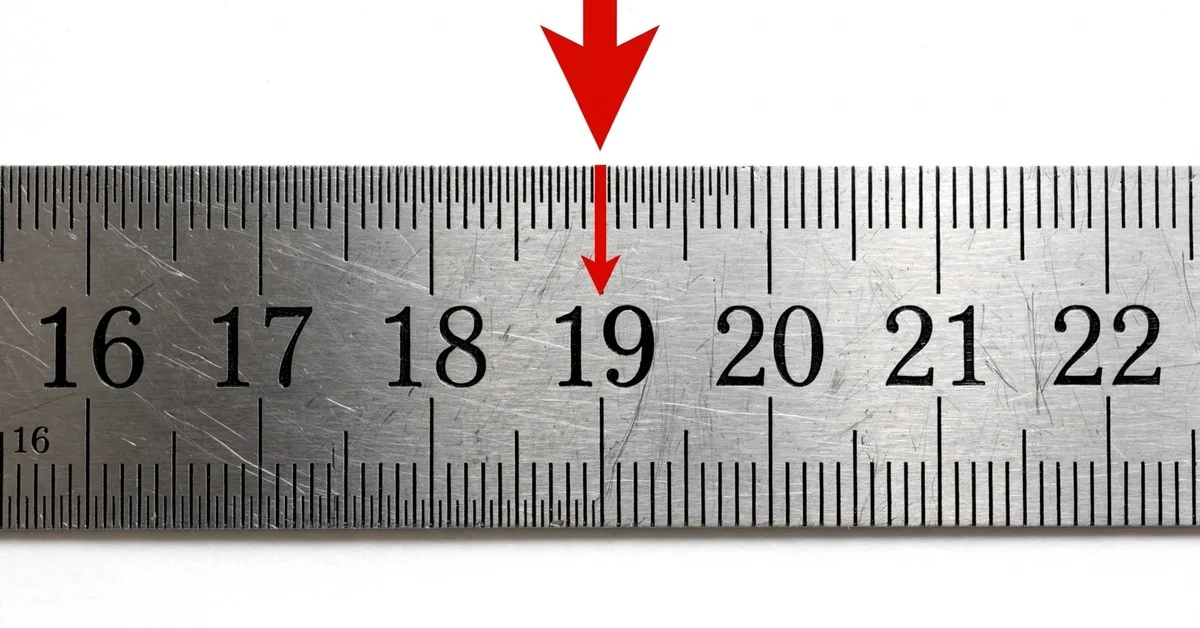
You are comparing two monitors online. One listing says “19-inch class,” another says 18.5 inches, and a third swears its 22-inch screen is only a little wider. Which one is actually 19 inches wide? Trick question: probably none of them. Nineteen inches is 1 foot 7 inches, which equals 48.26 centimeters — but on screens, the number on the box is the diagonal, never the width. That single misunderstanding is responsible for more wrong furniture purchases than any other measurement in tech.
This article answers “how long is 19 inches” the way a careful shopper needs it: by separating the diagonal from the width, checking which real screens land near 19 inches, and then anchoring the number to everyday objects that have nothing to do with electronics. Whether you are sizing a monitor, a microwave gap, or a carry-on, you will leave knowing exactly what 19 inches looks like.
The width check: what 19 inches really means on a screen
Here is the signature insight for 19 inches: almost no screen sold as “19 inches” is 19 inches wide. Manufacturers measure diagonally, corner to corner, and the aspect ratio decides how much of that diagonal becomes width. A 19-inch monitor from the old square-screen era is barely 15 inches wide — while a modern 22-inch widescreen is actually wider than 19 inches. The table tells the real story:
| Screen (as sold) | Aspect ratio | True width |
|---|---|---|
| 19 in monitor (classic office) | 5:4 | ≈ 14.8 in |
| 18.5 in monitor (“19-inch class”) | 16:9 | ≈ 16.1 in |
| 19 in TV | 16:9 | ≈ 16.6 in |
| 20 in monitor | 16:9 | ≈ 17.4 in |
| 21.5 in monitor | 16:9 | ≈ 18.7 in |
| 22 in monitor | 16:9 | ≈ 19.2 in |
| 24 in monitor | 16:9 | ≈ 20.9 in |
Read that again: the screen that is truly about 19 inches wide is the 22-inch monitor, not the 19-inch one. Every other “19-inch” screen is really 15 to 17 inches across. Keep this table in mind the next time a product page gives you only the diagonal — multiply by 0.87 for a widescreen to get the real width.
1. The 19-inch 5:4 office monitor — 19 inches diagonally
The classic workplace monitor of the 2000s measured 19 inches on the diagonal with a squarish 5:4 screen — but only about 14.8 inches wide. Offices bought them by the pallet, and millions are still in service as second screens. If you ever worked at a desk with one, you stared at a 19-inch diagonal for years while the actual width stayed hidden. It is the perfect lesson: the headline number and the usable width are different things.
2. The 18.5-inch “19-inch class” monitor
Retailers sell 18.5-inch widescreens as “19-inch class,” and the fine print matters: the true width is only about 16.1 inches. The “class” wording is the industry’s way of rounding up, and it confuses buyers who measure their desk space literally. When you see “class” on a listing, subtract your expectations by a couple of inches — or better, check the table above.
3. The 22-inch widescreen — the true 19-inch-wide screen
Here is the punchline of the width check: a 22-inch 16:9 monitor is about 19.2 inches wide — the only common screen that genuinely spans 19 inches side to side. If your question was really “how wide is 19 inches on a desk,” this is your answer wearing a 22-inch badge. It is a popular size for dual-monitor setups, so you have probably seen two of them side by side: each one is a true 19-inch width.
4. The 21.5-inch widescreen — about 18.7 inches wide
One step down, the ubiquitous 21.5-inch office monitor measures about 18.7 inches wide — a third of an inch shy of 19. It is the default screen of corporate America, which makes it a great casual reference: picture the standard-issue monitor at any office desk, add a thumbnail’s width, and you have 19 inches.
5. The 19-inch kitchen TV — about 16.6 inches wide
Small flat-screen TVs sold as 19 inches — the ones mounted under kitchen cabinets or perched on bedroom dressers — are 16:9 widescreens, so their true width is only about 16.6 inches. The 19-inch figure is the diagonal, same as monitors. It is a fine size for the morning news, but if you are building a cabinet around it, measure the width, not the box.
Beyond the screen: the other 19-inch standards
Screens may own the number in advertising, but 19 inches is a genuine standard in several other worlds — some of them far more exact than any monitor listing.
6. The 19-inch server rack
The most exact 19 inches in technology has nothing to do with screens: equipment racks for servers and network gear are standardized at 19 inches wide, a dimension set decades ago that every rack-mount device obeys. Data centers, office closets, and broadcast studios are all built on this module. You will probably never own one, but an entire global industry agreeing on 19.0 inches — not 18, not 20 — tells you this number has real engineering weight.
7. The daypack — about 19 inches tall
A typical daypack — the 20-to-25-liter bag for commuting, hiking, and school — stands about 19 inches tall. Pack makers size them to fit an adult torso, which keeps the height remarkably consistent across brands. Hoist yours onto your back in your mind: from base to the top of the main compartment, that is 19 inches riding behind you every day.
8. The cajón — about 19 inches tall
The cajón, the box-shaped Peruvian drum players sit on, typically measures about 19 inches tall (makers work in a 48-centimeter standard). The height is functional: it has to put the playing surface at a comfortable level for a seated drummer. You have seen these wooden boxes at acoustic gigs and drum circles. Sit one in your imagination and its height — 19 inches of rhythm — is right there.
9. The classical guitar’s body — about 19 inches long
A classical guitar’s body — from the base to where the neck joins — runs about 19 inches long. Luthiers hold this proportion because it balances the instrument on the player’s knee and tunes the body’s resonance. The full guitar is about 39 inches, so the body is essentially half the instrument. Picture a guitarist cradling one: the wooden half in their lap is 19 inches of craftsmanship.
10. The half-sheet pan — 18 inches on the long side
The half-sheet pan — the 18-by-13-inch workhorse of home baking — falls exactly one inch short of 19 on its long edge. Professional kitchens call it a “half sheet” because two of them fill a full-size commercial sheet pan. It is in your oven right now, most likely. Picture its long side and add an inch: 19 inches, fresh from the oven.
Close neighbors: an inch under, an inch over
The fastest way to feel an odd number like 19 is to bracket it. These five objects sit within about an inch on either side — close enough that picturing them gets you to 19 inches without any math at all.
11. The small pet carrier — about 19 inches long
A small hard-sided pet carrier — the airline-approved box for cats and small dogs — typically measures about 19 inches long. The length is designed around a curled-up cat, which keeps it consistent across brands. If you have ever coaxed a reluctant cat into one, you have handled 19 inches of molded plastic with both hands.
12. The dorm mini-fridge — about 18 to 19 inches wide
Compact mini-fridges — the dorm-room staple — run about 18 to 19 inches wide, sized to slide under a lofted bed or beside a desk. Manufacturers squeeze the width because floor space is the whole point. Picture the little humming box from your college years (or your kid’s): its width is 19 inches, humming away.
13. The 20-inch box fan — an inch over
The classic square box fan — the one that has cooled bedrooms for generations — commonly comes in a 20-inch size, exactly one inch over our target. Window-mount it in your memory and shave an inch off the frame: that is 19 inches of summer survival. It is the “slightly big” anchor that keeps your estimate honest.
14. The bristle dartboard — 17.75 inches across
A regulation bristle dartboard measures 17.75 inches in diameter — about an inch and a quarter under 19. The specification is strict (451 millimeters), so every board in every pub matches. Picture the familiar concentric rings on the wall and add a finger’s width all around: 19 inches, ready for the next throw.
15. The 18-inch doll — one inch under
The classic 18-inch doll — the size that made American Girl famous — stands exactly one inch under 19. The height is a defining feature of the category: clothes, furniture, and accessories are all scaled to it. Anyone who has shopped for one knows the number by heart. Picture the doll and add the height of a thumbnail on top — that is 19 inches.
A 19-inch rule of thumb for shoppers
If you take one habit from this article, make it this: whenever a product lists inches, ask which inches. Screens quote the diagonal, racks quote the width, pans quote the longest edge, and luggage quotes the tallest point including wheels. Two products can both say “19 inches” and differ by four inches where it matters. The fix takes ten seconds — check the spec sheet’s width, height, and depth lines instead of the headline — and it is the difference between a monitor that fits your desk and one that gets returned.
Screen-shopper’s questions about 19 inches
Why is my 19-inch monitor not 19 inches wide?
Because screens are measured diagonally, corner to corner — a convention dating back to the first television tubes. On a 19-inch 16:9 screen, the width is only about 16.6 inches; on the older 5:4 office monitors, it was about 14.8 inches. The diagonal is always the biggest number on the box, which is exactly why it became the marketing standard. Always convert with the aspect ratio: for widescreens, multiply the diagonal by 0.87 to get the true width.
What monitor is actually 19 inches wide?
A 22-inch 16:9 monitor — its true width is about 19.2 inches. A 21.5-inch monitor gets you to about 18.7 inches, just a third of an inch shy. So if you measured a 19-inch gap on your desk and went shopping for a “19-inch monitor,” you would come home with a screen roughly two inches too narrow. Shop by the width row in the table above, not the headline diagonal.
My monitor’s spec sheet says 48 cm — is that a 19-inch monitor?
Effectively, yes. Monitor makers round the diagonal to the nearest whole inch, and metric spec sheets usually round to whole centimeters too. A true 19.0-inch diagonal is 48.26 cm, so a box that says 48 cm is describing the same 19-inch class display. If you are comparing two monitors, ignore the rounded marketing numbers and compare the exact millimeter widths in the detailed specs instead.
Is a 19-inch rack the same as a 19-inch screen?
Only in the number. A 19-inch server rack is 19 inches wide — a true, exact horizontal measurement that equipment must match to the millimeter. A 19-inch screen is 19 inches diagonally, and its width is several inches less. Same digits, different geometry, different industries. Context is everything with this number.
What household object is closest to 19 inches?
The half-sheet pan’s 18-inch long side (add an inch) and the small pet carrier’s 19-inch length are the closest common items — both things you can put your hands on in under a minute. The daypack on your back at about 19 inches tall is a close third. Between the three, most homes contain at least one true 19-inch reference without anyone having bought it on purpose.
See also: how long 16 inches is.
See also: how long 21 inches is.
Nineteen inches, measured twice
So, how long is 19 inches? A foot and seven inches — the diagonal of a classic office monitor, the width of a server rack, the height of a cajón, the length of a small pet carrier. It is a number that rewards measuring twice: once for the diagonal the box advertises, once for the width your desk actually has. Remember the table, remember that a 22-inch screen is the true 19-inch width, and keep a half-sheet pan in mind for everything else. Nineteen inches is no longer a confusing listing — it is a length you can verify with your own eyes.

I’m Priya Sharma, a content writer at MeasureZit.com, specializing in measurements, unit conversions, and mathematical concepts. I turn technical topics into clear, accurate content that’s easy to understand. My focus is precision, clarity, and genuinely useful information.










