The gutters are full of last year’s leaves, the ladder is leaning against the eave, and you’re doing the math every homeowner does: how high is “up there,” really? The answer for a single-story house is usually 12 feet — 144 inches, 365.76 centimeters, about 3.66 meters, exactly four yards. Twelve feet is the dozen of measurement: the height of a house eave, the length of a proper kayak, the span of the trampoline the kids have been lobbying for. It’s where backyards get serious and ladders get tall. This guide maps twelve feet from the ground up — and ends with the safety knowledge that makes working at this height survivable. One hundred forty-four inches is four yards, a full dozen feet, and the most divisible common length in the book — halves, thirds, quarters, sixths, and twelfths, all clean. It spans the trampoline, floats the jon boat, and rings the conference table. Fifteen twelve-footers below, plus the ladder rules that keep this height from ever hurting you.
The Backyard Dozen
Twelve feet found its suburban calling in the backyard, where it’s the size that separates the toys from the commitments.
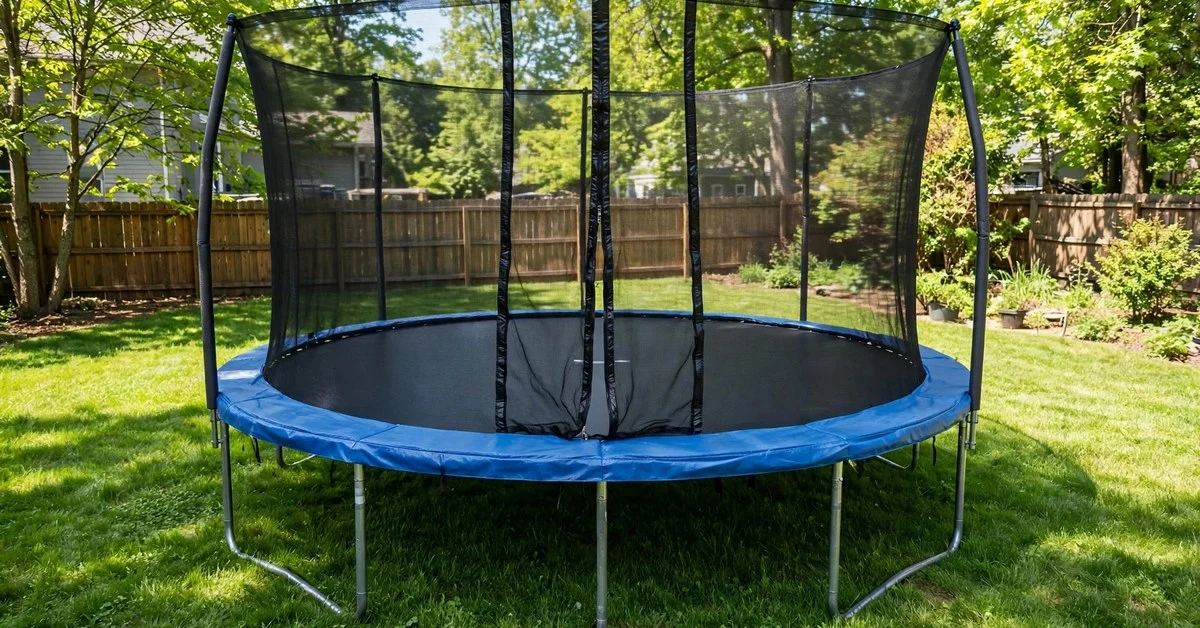
A 12-foot trampoline is the classic family size — 144 inches across the frame, room for several kids with space to spare. The twelve-foot circle needs a clear zone of several feet on every side plus overhead clearance, which is why it becomes a yard-planning exercise, not just a purchase. Before you buy, lay a garden hose in a 12-foot circle on the grass and live with it for a day. The real space always looks bigger on the box.
A 12-foot yurt is the small end of the modern yurt range — 144 inches across the lattice wall, about 113 square feet inside. It’s the home-office yurt, the meditation yurt, the glamping yurt that fits a bed and a stove. Twelve feet of diameter makes a circle you can heat easily and furnish like a studio apartment, and the whole thing goes up in a day with two people.
Twelve Feet Afloat
On the water, twelve feet is the smallest “real boat” — big enough for open water, small enough to trailer behind anything.
A 12-foot aluminum jon boat is the flat-bottomed workhorse of lakes and rivers: 144 inches of riveted aluminum that floats in inches of water and hauls two anglers plus gear. Jon boats are the pickup trucks of the boating world — unglamorous, nearly indestructible, and exactly twelve feet of useful. They trailer behind a sedan and launch anywhere.
A 12-foot skiff is the saltwater cousin — a shallow-draft boat for flats fishing and island hopping. The twelve-foot length poles silently across inches of water and still handles a light chop. Guides love this size because it goes where bigger boats can’t and costs a fraction to run.
A 12-foot recreational kayak is the classic touring length — 144 inches of sleek hull that’s fast enough for distance and stable enough for beginners. Sea kayakers cross bays in twelve-footers with sealed hatches fore and aft. It’s the sweet spot where kayaks stop being pool toys and start being expedition craft.
A 12-foot dock section is the modular unit of waterfronts — docks are built in 12-foot increments because the lumber, the floats, and the hardware all dimension to it. Need 24 feet of dock? Two sections. Thirty-six? Three. The twelve-foot module is why every dock looks effortlessly right: it’s the water’s version of the 4×8 sheet.
Twelve Feet of Work and Play
A 12-foot round above-ground pool is the family-size circle — 144 inches across, big enough to actually swim in, small enough for most suburban yards. It needs level ground, a filter, and a ladder, plus a few feet of clearance on every side. Set it up in a weekend and the backyard becomes summer headquarters.
A 12-foot box truck — the size rental companies market to studio and one-bedroom movers — swallows about 400 cubic feet of life. Twelve feet of box fits the couch, the bed, the boxes, and the regrets, usually in one trip. It’s the biggest truck most people can drive without a commercial license or a prayer.
A 12-foot conference table is the boardroom standard: 144 inches of polished authority that seats ten to twelve. The twelve-foot table exists to create distance — literally. The boss at one end, the new hire at the other, and twelve feet of mahogany diplomacy between them. Cable grommets included; survivors’ guilt optional.
Twelve Feet in the Wild
At twelve feet, wildlife stops being scenery and starts being the reason for the fence, the guide, and the life insurance.
A Burmese python reaches twelve to eighteen feet — a twelve-footer is a big adult, thick as a fire hose and strong enough to be a genuine problem. In Florida’s Everglades, where they’re invasive, twelve-foot pythons are the ones that make the news. The length is the story: twelve feet of constrictor doesn’t bluff.
An American crocodile runs twelve to fifteen feet — longer and leaner than its alligator cousin, with the toothy overbite grin. South Florida is the only place in the world where alligators and crocodiles share the water, and the twelve-foot croc is the apex of that overlap. Give it the whole canal.
A tiger shark averages ten to fourteen feet — call a twelve-footer typical. Striped, curious, and responsible for more “what was that bump?” stories than any other shark, the tiger is the ocean’s twelve-foot question mark. Divers who’ve met one describe the same thing: the moment twelve feet of shark decides you’re boring.
A dusky shark reaches about twelve feet — the big coastal cruiser that migrates thousands of miles along the Atlantic seaboard. Twelve feet of dusky is twelve feet of endurance athlete, built for the long haul. They’re the marathoners of the shark world, and the distance shows in every streamlined inch.
A white rhino measures about twelve feet long — 144 inches of grazer that happens to weigh two tons. The “white” is a mistranslation (it means “wide,” for the mouth), but the twelve feet is exact enough: nose to tail, it’s as long as a jon boat and considerably less cooperative about docking.
A hippopotamus stretches twelve to sixteen feet — the river horse that kills more people in Africa than any other large animal. Twelve feet of hippo is twelve feet of territorial muscle that can outrun you on land and outswim you in the river. The length isn’t the danger; the attitude is. But the length tells you the attitude has backup.
Twelve Feet, Sliced Neatly
| Fraction of 12 Feet | Equals |
|---|---|
| One half | 6 ft (72 in) |
| One third | 4 ft (48 in) |
| One quarter | 3 ft (36 in) |
| One sixth | 2 ft (24 in) |
| One twelfth | 1 ft (12 in) |
| Double | 24 ft (288 in) |
The Ladder-Safety Zone: Working at 12 Feet
Here’s the signature section, and it matters more than any other in this guide: how to work at twelve feet without becoming a statistic. Falls are the leading cause of serious DIY injuries, and twelve feet — gutter height, eave height, second-story-window height — is exactly where amateurs get hurt. The pros have rules. Learn them.
Rule one — the right ladder for twelve feet of work. To work at twelve feet (hands at twelve feet, feet a few feet lower), you want an extension ladder in the 20- to 24-foot range — because of rule two. A 12-foot step ladder puts your feet at about ten feet max, and the top cap is not a step. Match the ladder to the task: extension ladders for eaves and gutters, step ladders for anything you can reach from ten feet.
Rule two — the 4-to-1 rule. For every four feet of ladder height, the base sits one foot out from the wall. Working at twelve feet with a 20-foot ladder extended, the feet go about five feet out from the house. Too steep and it tips backward; too shallow and the base slides out. Pros eyeball it, then check it — you should check it twice.
Rule three — three feet above the landing. The ladder must extend three feet past the roof edge or gutter you’re climbing onto. That extension is your handhold when you step off — without it, you’re lunging for the gutter with nothing to grab. If your ladder doesn’t reach three feet past, it’s the wrong ladder. Full stop.
Rule four — three points of contact. Two hands and a foot, or two feet and a hand — always. That means tools go in a belt or a bucket on a rope, not in your hands. The number of people who fall carrying a paint can up a ladder would fill a stadium. Hoist the gear after you’re positioned.
Rule five — know when to hire it out. Twelve feet is the threshold where “I’ll just” becomes “I wish I hadn’t.” Steep roofs, power lines within ten feet, high winds, or any wobble in the ladder’s footing — call a professional. A gutter cleaning costs a couple hundred dollars. A fall from twelve feet costs whatever the emergency room charges, plus the months after. The math is not close.
And the material note: fiberglass near electricity, always. Aluminum ladders conduct. If there’s any chance of contacting a power line, a service drop, or even a weatherhead at twelve feet, the ladder must be fiberglass. This is the rule written in the most blood. Honor it.
Ladder, Trailer, and Twelve-Foot Questions
What size ladder do I actually need to reach 12 feet?
A 20- to 24-foot extension ladder. That sounds like overkill until you apply the rules: the ladder needs three feet of extension past your 12-foot work point, and it leans at the 4-to-1 angle, which consumes length. A 20-footer extended to about 17 feet of working length gets your hands to twelve feet with the required three-foot grab above. A 16-foot ladder technically reaches, but leaves you clinging to the top rung — which is how falls happen.
Can I tow a 12-foot utility trailer with a sedan?
Usually not safely. A 12-foot utility trailer weighs 1,000 to 1,500 pounds empty, and most sedans are rated to tow 1,000 to 1,500 pounds total — leaving zero capacity for cargo. A small SUV or crossover rated for 3,500 pounds handles it comfortably. Check your owner’s manual for the tow rating (not the internet’s opinion), and remember the 60/40 rule: sixty percent of the load’s weight goes ahead of the trailer axle, or it will sway.
How many people fit around a 12-foot conference table?
Ten to twelve comfortably — allow 24 to 30 inches of table edge per person. Twelve feet is 144 inches; at 24 inches each that’s exactly twelve seats, at 30 inches it’s just under ten. Real boardrooms usually seat ten with room for laptops, documents, and the occasional dramatic pause. If you’re planning the room, add three feet of chair clearance on every side: a 12-foot table needs a room at least 18 by 12 feet.
Is a 12-foot trampoline too big for a typical suburban yard?
It depends on the yard, but measure honestly. The trampoline needs its 12-foot diameter plus a clear safety zone of about 6 feet on every side — that’s a 24-foot circle of clear, level ground with no fences, trees, or structures, plus overhead clearance. Many suburban lots can fit it; many can’t once you subtract the house, the patio, and the setback requirements. The garden-hose test from this article is the move: lay the circle, walk it, then decide.
Why do docks come in 12-foot sections?
Because the whole supply chain does. Pressure-treated lumber, composite decking, dock floats, and hardware all dimension efficiently to twelve feet — it’s divisible by 2, 3, 4, and 6, so cuts are clean and waste is minimal. Two sections make 24 feet, three make 36, and every joint lands on a piling. It’s the same modular thinking as the 4×8 plywood sheet, applied to waterfront. Build on the module and the dock practically designs itself.
See also: how long 9 feet is.
See also: how long 15 feet is.
Respect the Dozen
Twelve feet is where measurement meets consequence — the height of the eave, the length of the boat, the circle in the yard, the table where decisions get made. It’s divisible, haulable, and climbable, which makes it feel friendly right up until you’re standing on a ladder looking down. Learn its fractions, match the ladder to the task, count the dock sections, and know when to call the pro. The dozen rewards respect and punishes cockiness in equal measure. Give it exactly the respect it asks for, and it’ll give you a clean gutter, a straight dock, a trailer that tracks true — and all your bones intact.

I’m Priya Sharma, a content writer at MeasureZit.com, specializing in measurements, unit conversions, and mathematical concepts. I turn technical topics into clear, accurate content that’s easy to understand. My focus is precision, clarity, and genuinely useful information.










