TITLE TAG
Circumference of a Soda Can: Exact Size in Inches & mm
META DESCRIPTION
How big around is a Coke can? The circumference of a soda can is about 8.16 inches (207 mm). See how it compares to everyday objects around you.
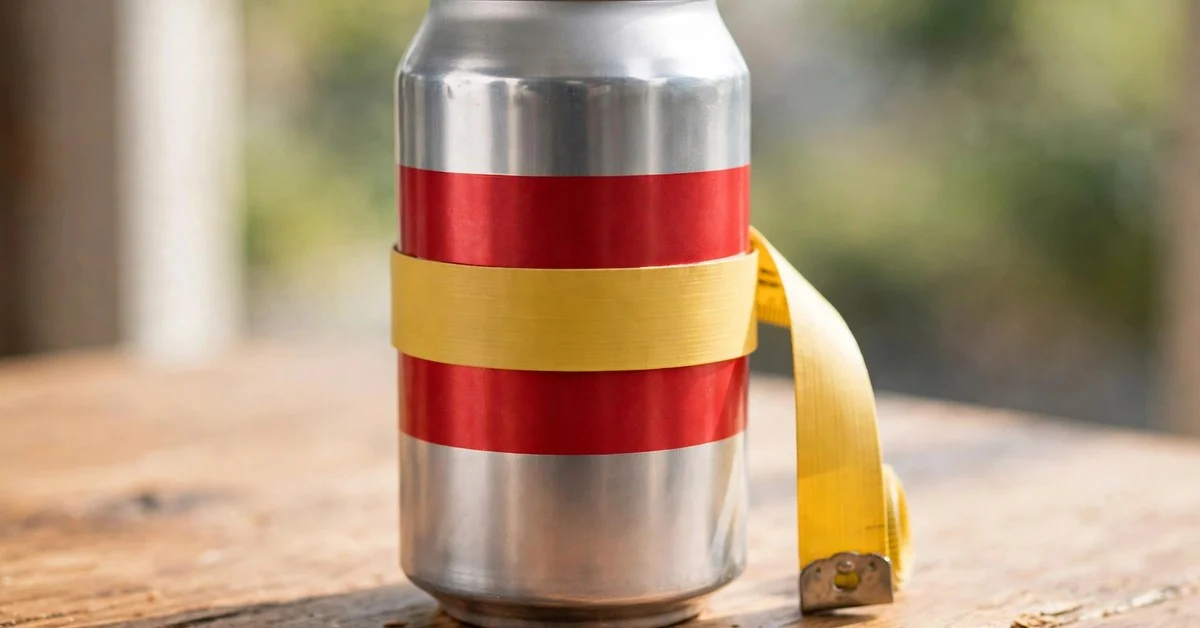
Wrap a measuring tape around a Coke and you get a number most people never think about. The circumference of a soda can is about 8.16 inches (207 mm) for a standard 12 oz can. That is the distance all the way around the middle of the can, and it comes from a diameter of about 2.6 inches (66 mm). If you have ever wondered how big around a Coke can is, picture a circle roughly as wide as a tennis ball.
People look up the coke can circumference for practical reasons. Crafters need it to cut vinyl wraps, labels, and koozies that fit without gaps. Students use it in math class when a teacher asks for the circumference of a real circle they can hold. And 3D-printing hobbyists need the exact girth of a soda can before designing a cup holder insert or a desk organizer. A tape measure, a strip of paper, or even a phone-charging cable can confirm the number in seconds.
It helps to keep diameter and circumference straight, because the two get mixed up constantly. The diameter is the straight line across the top of the can — about 2.6 inches, or the width of a Coke can. The circumference is the full journey around the outside — about 8.16 inches. Circumference is always a little more than three times the diameter, thanks to pi (3.14). So if you only know the width, multiply it by 3.14 and you have the distance around.
Circumference of a Soda Can: Conversion Chart
| Unit | Converted Value |
|---|---|
| Inches | 8.16 |
| Feet | ≈ 0.68 |
| Yards | ≈ 0.23 |
| Millimeters | 207 |
| Centimeters | ≈ 20.7 |
| Meters | ≈ 0.21 |
Common Objects That Are About 8.16 Inches Around
| Object | Approximate Circumference |
|---|---|
| Standard 12 oz soda can | 8.16 in |
| Standard 12 oz beer can | 8.16 in |
| 16 oz Monster energy can | 8.16 in |
| Standard soup can | ≈ 8.2 in |
| 500 ml water bottle | ≈ 8 in |
| Tennis ball canister | ≈ 8.2 in |
| Regular-mouth mason jar | ≈ 8.6 in |
| Baby bottle | ≈ 7.9 in |
More Everyday Items Around 8.2 Inches
| Object | Approximate Circumference |
|---|---|
| Large grapefruit | 9–10 in |
| Baseball | 9–9.25 in |
| Adult wrist | 6.5–7.5 in |
| Standard coffee mug | ≈ 10 in |
| Tuna can | ≈ 10.2 in |
| Pringles can | ≈ 9.4 in |
| Standard wine bottle | ≈ 9.4 in |
How Big Around Is a Soda Can?
Eight inches around is easy to picture once you hold the can itself. Curl your fingers around a cold 12 oz can and your fingertips nearly touch your palm. That grip is the circumference you are feeling. The number comes from simple math: multiply the 2.6-inch diameter by pi (3.14) and you land at about 8.16 inches, or 207 mm.
For a smaller reference, wrap a tape around your wrist. Most adult wrists measure 6.5 to 7.5 inches, so a soda can is a little bigger around than your wrist. For a larger reference, look at a standard coffee mug. Mugs run about 10 inches around the middle, so a soda can sits comfortably between your wrist and your morning mug.
Another way to feel the size: the circumference is roughly the length of your hand from wrist to fingertip plus a thumb’s width. Most adult hands span 7 to 7.5 inches, so adding that last inch gets you to 8.16. Once you anchor it to your own hand, you can estimate the girth of any can-shaped object — jars, bottles, candles — without measuring at all.
Easy ways to estimate 8.16 inches in everyday life
- Use your hand: Wrap your dominant hand around the can. If your middle finger just reaches your palm, you are feeling about 8 inches of circumference.
- Use a strip of paper: Mark 8.16 inches on a strip of receipt paper, tape the ends together, and slide it over any can to test the fit.
- Use a dollar bill: A US dollar bill is just over 6 inches long, so the can’s circumference is about one bill plus one-third of another.
- Use string: Loop a piece of string once around the can, then lay it straight against a ruler to read the circumference directly.
- Use your phone cable: Most charging cables are easy to bend into a loop. Form a loop that hugs the can snugly, then measure the loop.
- Use pi: Measure straight across the top of the can (about 2.6 inches) and multiply by 3.14. No flexible tape needed.
1. Standard 12 oz Soda Can
The 12 oz soda can is the anchor for this whole article. Every major brand, from Coke to Pepsi to store-brand cola, uses the same 12-fluid-ounce body: about 2.6 inches wide and 4.83 inches tall. Because the size is standardized across the industry, the circumference of a pop can barely varies from brand to brand. Grab any can from your fridge and you are holding the 8.16-inch reference itself. That makes it the most reliable visual in this list.
2. Standard 12 oz Beer Can
A 12 oz beer can shares the exact body dimensions of a soda can, so its circumference is the same 8.16 inches. Breweries use identical canning lines and lid sizes, which keeps the diameter locked at about 66 mm. If you want a second opinion on the measurement, measure a beer can and a soda can side by side. The tape will read the same number on both, which is a handy way to double-check your technique.
3. 16 oz Monster Energy Can
The tall 16 oz Monster energy can looks bigger, but its width matches the standard soda can. It stands about 6.61 inches tall while keeping the same 66 mm diameter, so the circumference is still about 8.16 inches. This surprises people who assume the taller can is wider too. It is a useful reminder that height and circumference are independent: only the diameter decides how far around the can measures.
4. Standard Soup Can
A standard soup can (the 10.75 oz size) is a close cousin at roughly 8.2 inches around. It is a touch shorter and slightly narrower-looking than a soda can, but the tape barely notices the difference. Because soup cans sit in nearly every pantry, they work as a backup reference when no soda can is handy. Wrap the tape around the middle, away from the rim, for the truest reading.
5. 500 ml Water Bottle
A 500 ml disposable water bottle measures about 8 inches around its widest point. The body is a hair slimmer than a soda can, and the molded grip ridges can throw off a sloppy measurement. Measure across the smooth middle band for the cleanest number. Since these bottles are everywhere — gyms, offices, car cup holders — they make a convenient real-world check on the 8.16-inch figure.
6. Tennis Ball Canister
The plastic tennis ball canister that holds three balls is about 8.2 inches around. It has to be, since each ball inside is roughly 2.6 inches wide and the tube hugs them snugly. If you play tennis, you already own a near-perfect 8-inch reference. The straight sides also make it easier to measure than a curved bottle: the tape sits flat with no wobble.
7. Regular-Mouth Mason Jar
A regular-mouth mason jar runs about 8.6 inches around, just a shade bigger than a soda can. The difference is small enough that the two feel similar in the hand, but a tape measure will catch it. Canners and jam-makers handle these jars constantly, so the size is familiar in kitchens. Use it when you want a “slightly larger” version of the soda can circle.
8. Baby Bottle
A standard baby bottle measures roughly 7.9 inches around the body, a touch smaller than a soda can. Parents will recognize the grip instantly: it is designed for small hands, which is why it runs a little narrower. The slight difference makes it a good “slightly smaller” reference. Hold the two side by side and you can feel the quarter-inch gap the numbers describe.
9. Large Grapefruit
A large grapefruit measures roughly 9 to 10 inches around, a bit bigger than a soda can. It is one of the few fruits that lands close to the 8-inch circle, and its round shape makes the comparison easy to see. Hold a grapefruit in one hand and a soda can in the other, and you can feel how the fruit’s extra width adds about an inch of circumference. It is a handy kitchen reference for a “slightly larger” circle.
10. Baseball
A regulation baseball has a circumference of 9 to 9.25 inches, making it the classic “slightly larger” reference. The number is standardized by the leagues, so every baseball you pick up tells the same story. Compared with the 8.16-inch soda can, the baseball adds about an inch all the way around. If you can picture a baseball, you can picture a soda can’s girth minus a little.
11. Adult Wrist
The average adult wrist measures 6.5 to 7.5 inches around, noticeably smaller than a soda can. This is why a can feels chunky when you wrap your hand around it: your fingers have farther to travel than they do around your own wrist. Jewelers and watch sellers measure wrists daily, so the range is well established. Use your wrist as the “smaller” bookend for the 8.16-inch figure.
12. Standard Coffee Mug
A standard coffee mug runs about 10 inches around the middle, clearly larger than a soda can. Mugs are built wide so coffee cools at a pleasant rate and fingers fit the handle. The two-inch gap between a mug and a can is easy to feel: a mug fills your whole grip while a can leaves your fingertips close together. Keep the mug in mind as the “larger” bookend.
13. Tuna Can
A standard tuna can (5 oz) is about 10.2 inches around. It is short and wide, which tricks the eye — it looks smaller than a soda can until you measure around it. The wide body is what gives tuna cans their larger circumference despite the small volume. It is a nice lesson in how shape changes girth: same metal, very different circle.
14. Pringles Can
A Pringles can measures roughly 9.4 inches around. The cardboard tube is wider than a soda can but narrower than a coffee mug, landing it right between the two. Snack fans know the one-handed grip well: your fingers spread a little wider than they do on a soda can. That extra stretch is the 1.2-inch difference made tangible.
15. Standard Wine Bottle
A standard wine bottle is about 9.4 inches around the body, similar to the Pringles can. The Bordeaux-style bottle keeps straight sides through the middle, so the tape reads cleanly. It is larger than a soda can but not dramatically so — about 15 percent more circumference. If you have ever wrapped a gift bag around a wine bottle, you have handled a circle just bigger than our 8.16-inch anchor.
Frequently Asked Questions
What is the diameter of a Coke can?
The diameter of a Coke can is about 2.6 inches (66 mm) for a standard 12 oz can. Multiply by pi (3.14) to get the circumference of about 8.16 inches.
What is the circumference of a Coke can in inches?
The circumference of a Coke can in inches is about 8.16 inches, measured around the middle of a standard 12 oz can. In metric, that is about 207 mm or 20.7 cm.
What is the girth of a soda can?
The girth of a soda can is the same as its circumference: about 8.16 inches (207 mm) for a standard 12 oz can. “Girth” is just the everyday word for the distance around something.
Is the circumference of a pop can the same as a beer can?
Yes. A standard 12 oz pop can and a 12 oz beer can share the same body dimensions, so both measure about 8.16 inches around. Taller cans like the 16 oz energy drink keep the same width, so their circumference matches too.
How do you measure the circumference of a can without a flexible tape?
Wrap a strip of paper, a shoelace, or a charging cable once around the can and mark where it overlaps. Lay the strip flat against a ruler and read the length — that is your circumference. Alternatively, measure straight across the top for the diameter (about 2.6 inches) and multiply by 3.14.
Final Thoughts
The circumference of a soda can is one of those numbers you never need until you suddenly do — cutting a label, solving a geometry problem, or sizing a 3D-printed holder. At about 8.16 inches (207 mm), it sits in a sweet spot: bigger around than your wrist, smaller than your coffee mug, and nearly identical to a tennis ball canister or a soup can. Remember the simple relationship behind it, too: measure the 2.6-inch width, multiply by pi, and the 8.16-inch trip around the can appears. Once you connect the number to objects you handle every day, estimating it becomes second nature. Keep a can from the fridge in mind as your personal 8-inch reference, and you will never need to guess this measurement again.

I’m Owen Reeves, a content writer at MeasureZit.com, specializing in measurements, unit conversions, and mathematical concepts. I turn technical topics into clear, accurate content that’s easy to understand. My focus is precision, clarity, and genuinely useful information.










